〒213-0002 神奈川県川崎市高津区二子1丁目7−17
リバーサイドマンション杉崎 102 二子新地駅 徒歩3分
| 月 | 火 | 水 | 木 | 金 | 土 | 日祝 | |
|---|---|---|---|---|---|---|---|
| 9:00〜13:00 | ● | ● | ● | ● | ● | ● | ─ |
| 15:00〜19:00 | ● | ● | ● | ● | ● | ● | ─ |
最新の腰痛診療における国際的なコンセンサス:2026年
公開日:2026/08/12
更新日:2026/00/00
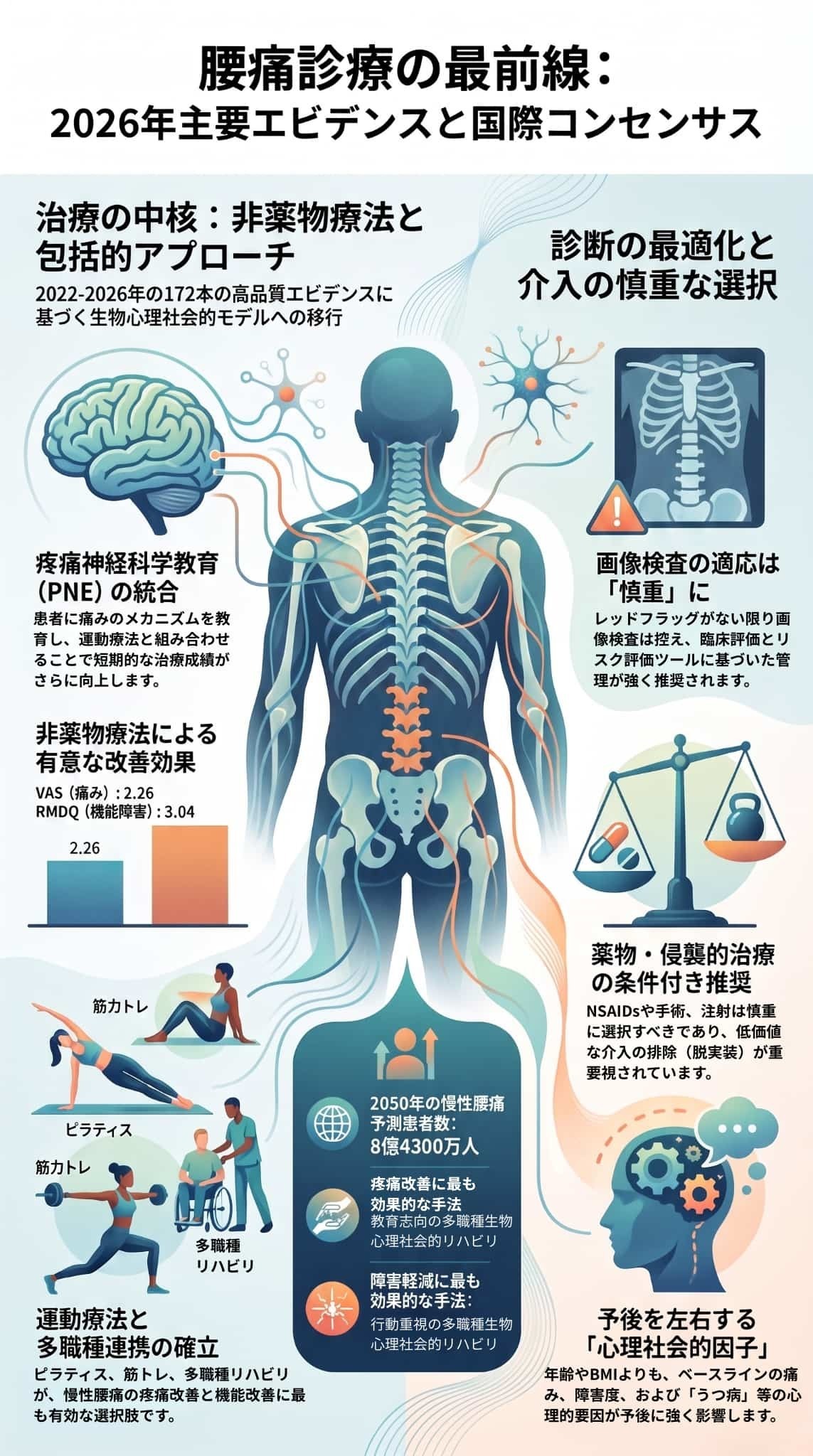
2022年から2026年にかけて発表された172件の高品質なエビデンスを統合し、最新の腰痛診療における国際的なコンセンサスをまとめたレポートです。
主な知見として、従来の生物医学的モデルから生物心理社会的モデルへの転換が示されており、運動療法や多職種連携、心理社会的介入といった非薬物療法が治療の中核として位置づけられています。
診断面では画像検査の慎重な選択と、リスク評価に基づく層別化管理の重要性が強調される一方、薬物療法や手術については限定的な推奨にとどまっています。
WHOを含む世界各国のガイドラインは、患者の生活の質を向上させるための包括的なアプローチで一致しており、エビデンスに基づく標準化が進んでいます。
今後の課題として、個別の運動メニューの具体化や実装科学の推進、さらには新興治療の検証が必要であると結論づけています。
目次
2022年から2026年に発表された172本の高品質なエビデンス(システマティックレビュー、メタアナリシス、診療ガイドライン)に基づき、腰痛診療における最新の主要な知見は、主に以下の5つのポイントに整理されます。
- 高い治療効果: 非薬物療法介入は、視覚的アナログスケール(VAS)で効果量2.26、ローランド・モリス障害質問票(RMDQ)で効果量3.04という統計的に有意な機能改善および疼痛軽減を示しています。
- 運動療法の選択肢: 慢性腰痛に対しては、ピラティス、筋力トレーニング、コアベース運動、マインドボディ運動(ヨガなど)が疼痛と障害を軽減する最良の選択肢とされています。
- 心理社会的介入の融合: 認知行動療法(CBT)は患者の否定的な信念を修正するのに有効であり、さらに疼痛神経科学教育(PNE)を運動や理学療法に組み合わせることで、短期的な疼痛と障害がさらに軽減することが実証されています。
腰痛管理のパラダイムは、従来の生物医学的(身体的異常のみに着目する)モデルから、生物心理社会的モデル(身体・心理・社会因子の複合的影響を考慮する)へと移行しています。
- 患者の不適応な疾患信念への対処、共感的なコミュニケーション、患者と施術者の信頼関係(治療同盟)といった**「文脈的要因」が、治療成績を大きく向上させる**可能性が指摘されています。
適切な治療戦略を決定するため、検証されたツールを用いた層別化管理(患者を低・中・高リスクに分類して適切な介入を行うアプローチ)が強く推奨されています。
- 画像検査の制限: 重篤な病態を示唆する「レッドフラッグ」が存在しない限り、不要な画像検査は控えること(制限的使用)が推奨されています。これは不必要な医療介入や医療費の削減に寄与します。
- 非特異的腰痛: 明確な病理的原因が特定できない「非特異的腰痛」は全体の約85%を占めており、これらに対しても生物心理社会的アプローチが重視されます。
最新のエビデンスは、薬物や侵襲的治療の選択に対して慎重なアプローチを求めています。
- 薬物療法の注意点: 非ステロイド性抗炎症薬(NSAIDs)は慎重に使用すべきであり、特に慢性例や高齢者での使用には注意が必要です。オピオイドや抗うつ薬も副作用やリスクを考慮した慎重な選択が求められます。
- 条件付きの推奨: 硬膜外ステロイド注射、高周波除神経術、脊椎減圧術などの侵襲的治療は、特定の病態に対して「条件付き」で推奨されるにとどまります。
- 低価値介入の脱実装: エビデンスが限定的または有害な可能性がある「低価値介入」(電気療法や機械的牽引、床上安静、腰部コルセットなど)の使用を減らす(脱実装)動きが重要視されています。
慢性腰痛患者において、ベースライン(治療開始時)の疼痛強度と障害度が6ヶ月後の健康関連QOL(生活の質)を予測する可能性が示されています。一方で、年齢やBMIがアウトカムに与える影響は限定的です。また、うつ病などの心理社会的因子が腰痛の慢性化や予後に悪影響を及ぼすことも確認されています。
最新のガイドライン(2023年のWHOガイドラインや各国の最新診療基準)は、こうしたエビデンスを背景に、**「患者中心で、非薬物療法をベースにした全人的かつ統合的なケア」**へと世界的なヘルスケアシステムを再方向付けようとしています。
腰痛診療に関する研究や最新のガイドライン策定が進められている背景には、主に以下のような世界的な規模の課題と、治療アプローチにおける歴史的なパラダイムの移行が存在します。
腰痛(LBP)は世界的に最も一般的な筋骨格系疾患の一つです。その患者数は増加の一途をたどっており、2050年までに慢性腰痛の有病者数は世界で8億4,300万人に達すると予測されています。これにより、個人の生活の質(QOL)が著しく低下することが重大な問題となっています。
腰痛は個人への影響にとどまらず、医療システムに対して多大な経済的負担をもたらしています。特に高所得国における臨床的・経済的負担は膨大であり、限られた医療資源を適切に配分し、効果的な管理戦略を確立することが急務となっています。
近年、腰痛管理の考え方は大きく変化しています。これまでは身体的な異常のみに焦点を当てる「生物医学的モデル」が主流でしたが、現代では疼痛の多面的な性質(身体的、精神的、社会的要因)を考慮する「生物心理社会的モデル」への移行が進んでいます。これにより、患者を全人的かつ包括的に評価・治療するアプローチが重視されるようになりました。
世界保健機関(WHO)は2023年に、成人の慢性原発性腰痛に対する非外科的管理ガイドラインを発表しました。この背景には、公平なケアの提供と世界的な医療システムの強化という狙いがあります。
特に、高齢者や低・中所得国の脆弱な集団に対しても適切な腰痛ケアを提供し、国際的なユニバーサル・ヘルス・カバレッジ(すべての人が適切な保健医療サービスを負担可能な費用で受けられる状態)を達成することが目標に掲げられています。
2022年から2026年にかけて、システマティックレビュー、メタアナリシス、診療ガイドラインといった高品質なエビデンスが172本発表されるなど、研究が急速に蓄積されました。これに伴い、WHOのみならず、サウジアラビア、オランダ、日本、香港、オーストラリアなどの世界各国で診療ガイドラインが次々と更新され、エビデンスに基づく腰痛管理の国際的なコンセンサス(合意)が形成されつつあることも、現在の研究・診療を支える重要な背景となっています。
腰痛診療における最新の知見が示す診断と分類は、**「不要な検査を避け、患者を適切にグループ分け(層別化)して、それぞれに最適な治療を提供する」**という考え方を強く支持しています。
- リスクに基づく分類: 妥当性が検証されたリスク評価ツールを用いて、患者を**「低リスク」「中リスク」「高リスク」**に分類します。それぞれのリスクレベルに応じた最適な介入を提供することで、治療成績の向上が期待できます。サウジアラビアの臨床ガイドラインでは、この層別化管理が強く推奨(エビデンスの確実性は中程度)されています。
- 治療ベース分類(Treatment-Based Classification: TBC): 患者がどのような治療(運動、徒手療法など)に適しているかに基づいて分類するアプローチです。これは急性腰痛、坐骨神経痛、脊柱管狭窄症の患者に有用であるとされています。ただし、これに関する現在のエビデンスの確実性は全体的に低く、さらなる高品質な研究が必要とされています。
レントゲンやMRIといった画像検査の実施については、**「慎重な選択(制限的使用)」**が世界的なスタンダードとなっています。
- レッドフラッグのスクリーニング: プライマリケアにおける腰痛の評価では、まずがん、感染、骨折といった重篤な病態を示唆する徴候である**「レッドフラッグ(警告徴候)」**の有無を確認することが極めて重要です。
- 画像検査を控える推奨: これらのレッドフラッグが存在しない場合は、画像検査を控える(制限する)ことが強く推奨されています。臨床評価に基づいた管理を優先することで、不必要な医療介入や医療費を削減することができます。カナダ放射線学会の紹介ガイドラインなどでも、適切な画像検査の適応に関する具体的な指針が示されています。
腰痛の大部分は、画像や検査で明確な病理学的原因が特定できないタイプに分類されます。
- 全体の約85%を占める: 明確な原因が特定できない腰痛は「非特異的腰痛」と分類され、**腰痛患者全体の約85%**にのぼるとされています。
- 生物心理社会的アプローチの重視: 非特異的腰痛と分類された患者に対しては、骨や神経の異常といった生体力学的な視点(生物医学的モデル)だけで評価するのではなく、患者の心理状態や社会的背景、疾患に対する信念なども考慮した**「生物心理社会的アプローチ」**による包括的な評価と介入が必要不可欠であるとされています。
このように、最新の診断・分類プロセスは、単に脊椎の異常を画像で探す段階から、**「重篤な疾患を迅速に除外し、リスクレベルや患者の全体像を評価して適切な治療経路へ乗せる」**ための交通整理の役割へと進化しています。
腰痛診療における非薬物療法は、現在腰痛管理の中核として位置づけられており、最新のエビデンスはその極めて高い有効性を強く支持しています。
運動療法は、非特異的腰痛に対する中心的介入として一貫して強く推奨されています。
- 効果的な運動の種類: ネットワークメタアナリシスにおいて、慢性腰痛患者に対してはピラティス、筋力トレーニング、コアベース運動、マインドボディ運動(ヨガなど)が疼痛と障害を軽減する最良の選択肢であることが示されています。
- 徒手療法との比較: 運動療法は、疼痛や身体機能の改善において徒手療法と同等またはそれ以上の効果を示す可能性があるとされています。
生物心理社会的モデルに基づき、身体へのアプローチだけでなく、痛みへの理解や信念を修正する介入が重視されています。
- 認知行動療法(CBT): 慢性非特異的腰痛に対して頻繁に推奨されており、疼痛、恐怖回避(痛みを恐れて動かないこと)、自己効力感の改善に有効です。
- 疼痛神経科学教育(PNE): 脳が痛みを作り出すメカニズムを患者に教育するアプローチです。これを運動療法や理学療法に組み合わせることで、単独治療と比べて短期的な疼痛と障害がさらに軽減されることがメタアナリシスで実証されています。
- 認知機能療法(CFT): 患者の誤った信念や不適応な運動パターンを修正する統合的アプローチで、従来の理学療法よりも優れた効果を示す可能性があります。
- 文脈的要因(Contextual Factors)の重要性: 共感的なコミュニケーション、患者の疾患信念への対処、治療同盟(信頼関係)といった文脈的要因が、保存的治療の効果を大きく高めることが分かっています。
複数の専門職が協力して行う包括的なプログラムは、特に非特異的慢性腰痛において高い成果を上げています。
■多職種生物心理社会的リハビリテーション(MBR):
- 「教育志向」のMBRは疼痛軽減に最も効果的(平均差 MD = 18.29)。
- 「行動重視」のMBRは障害軽減に最も効果的(SMD = 0.88)とされています。
■多職種職場復帰プログラム: 医療専門家、雇用主、患者が協力して行うプログラムであり、長期的な障害を予防し、円滑な職場復帰を支援する役割を果たします。
ケアを主導する職種や、エビデンスに基づかない治療の除外(脱実装)についても明確な指針が示されています。
■理学療法士主導ケアのメリット: プライマリケアにおいて、理学療法士が主導するケアは医師主導と比較して、患者満足度の向上、不要な画像検査・薬物処方の減少、総医療費の削減、病欠の減少をもたらすことが示されています。
■一貫して非推奨とされる「低価値介入」: 最新のガイドラインにおいて、以下の治療法はエビデンスが欠如、または限定的であるとして**一貫して推奨から除外(または脱実装が推奨)**されています。
- 電気療法(低周波治療など)
- 機械的牽引(引っ張り治療)
- 床上安静
- 腰部コルセット
腰痛診療における薬物療法、注射、手術といった医学的・侵襲的介入について、最新のエビデンスは**「一律な適用を避け、特定の適切な症例に対して慎重に選択・使用する」**ことを強く求めています。
それぞれの具体的な知見は以下の通りです。
従来の「痛みに対してまず一律に薬を処方する」というアプローチから、副作用や依存リスクを考慮した慎重な意思決定へと移行しています。
- NSAIDs(非ステロイド性抗炎症薬)の慎重な使用: 腰痛治療で最も一般的に使用される薬剤ですが、最新の知見では特に慢性例における使用において慎重な選択が必要であると注意喚起されています。
- 多様式(マルチモーダル)鎮痛アプローチ: 急性腰痛の管理においては、単一の薬剤に頼るのではなく、複数のメカニズムを組み合わせた多様式アプローチの重要性が強調されています。
- オピオイドと抗うつ薬のリスク管理: オピオイド系鎮痛薬は、依存性や副作用のリスクを考慮し、極めて慎重な選択が必要です。また、抗うつ薬は慢性腰痛にうつ病を併発している患者などに使用されることがありますが、その有効性と安全性を十分に評価した上での慎重な使用が検討されます。
注射療法は、すべての腰痛患者に広く推奨されるわけではなく、特定の診断や病態に対して「条件付き」で用いられる介入に位置づけられています。
- 硬膜外ステロイド注射: 坐骨神経痛や神経根症を伴う腰痛患者に対して使用される治療法ですが、サウジアラビアなどの最新ガイドラインにおいては**「条件付きでの推奨」**という位置づけにとどまっています。
- 高周波除神経術: 主に椎間関節に由来する疼痛に対して用いられる治療法であり、これも最新ガイドラインでは条件付きでの推奨となっています。
- 針治療(鍼治療・ドライニードリング): 慢性原発性腰痛や筋筋膜性疼痛の管理において有効である可能性が示されており、サウジアラビアのガイドラインで条件付き推奨されているほか、香港のガイドラインなどで具体的な推奨事項が提供されています。また、カッピング療法なども一部で有効な可能性が報告されています。
手術の適応基準の厳格化や、エビデンスに基づかない「低価値な介入」の排除(脱実装)が強く進められています。
■脊椎減圧術の条件付き適応: 脊柱管狭窄症や椎間板ヘルニアなどの明確な病変がある特定の病態に対して検討されますが、これもガイドライン上は条件付き推奨の範囲内です。
■ガイドラインに一致した手術の推進: 不適切な手術を減らし、本当に手術が必要な適切な患者に対してのみ適切なタイミングで手術を提供するための適応支援戦略が極めて重要視されています。
■低価値介入(不要な介入)の脱実装: エビデンスが極めて限定的であるか、あるいは有害な可能性(床上安静による機能低下など)がある以下の介入は、臨床ガイドラインにおいて**一貫して推奨が欠如しており、臨床現場での使用を減らすこと(脱実装)**が強く求められています。
- 電気療法(低周波など)
- 機械的牽引(引っ張り治療)
- 床上安静
- 腰部コルセット
このように、最新の知見は「薬や手術」に安易に依存するのではなく、これまでにご紹介した「非薬物療法(運動や心理社会的アプローチ)」をケアの主軸に据えつつ、これらの医療介入を**「必要な患者に、適切なタイミングで慎重に届ける」**ことを一貫して推奨しています。
腰痛の経過(予後)を予測し、適切な治療アプローチを選択する上で、予後因子やリスク因子の理解は極めて重要です。最新のエビデンスが示す知見は、以下のように整理されます。
治療開始時(ベースライン)の患者の状態や、身体以外の要因が将来の経過に強く影響することが分かっています。
- 初期状態の影響(ベースラインの疼痛と障害度): 理学療法を受ける慢性腰痛患者において、「治療開始時(ベースライン)の疼痛強度と障害度」が6ヶ月後の健康関連QOL(生活の質)を予測する可能性が示されています。
- 年齢やBMIの影響は限定的: 一般的に予後に影響しそうに見える**「年齢」や「BMI(体格指数)」が治療アウトカムに与える影響は限定的**であるとされています。ただし、これらの結果をさらに検証するためには、より大規模な集団と長期的な追跡調査(フォローアップ)を伴うさらなる研究が必要であると指摘されています。
- 心理社会的因子の深刻な影響: うつ症状やうつ病は、腰痛患者の健康アウトカム(予後)に明らかな悪影響を及ぼします。また、単に腰の痛みという身体的な問題だけでなく、こうした心理社会的因子(生物心理社会的因子)が非特異的腰痛の慢性化リスクを高めることも確認されています。
臨床現場で患者の経過を予測するための「臨床予測モデル」はいくつか開発されていますが、実用にはまだ課題が残されています。
- 妥当性の検証不足とバイアスのリスク: 保存的治療(手術をしない治療)を受ける腰痛患者を対象としたアウトカム予測モデルは複数存在しますが、プライマリケアにおける慢性腰痛の予測モデルは、全体的にバイアスリスクが高く、外部での妥当性検証が不足しているのが現状です。個別化医療(パーソナライズド・ケア)を安全に実現するためには、より高品質な研究によるモデルの検証が急務となっています。
特定の職業、ライフステージ、あるいは活動内容によって、腰痛の発生や悪化のリスクが著しく高まる集団が特定されています。
- 青少年アスリート: スポーツ活動を行う青少年アスリートは腰痛の発生率および有病率が高く、腰痛のリスクが高い集団であることが示されています。
- 学校教師: 職種別では、特にアフリカの学校教師などを対象とした研究において、教師が腰痛の高いリスクを抱えていることが報告されています。
- 妊婦: **妊娠中の腰痛は世界的にきわめて一般的(高頻度)**であり、この集団に対しては「運動と教育」を組み合わせたアプローチが有効である可能性が示されています。
- 神経根症を伴う腰椎椎間板ヘルニア: この病態の発生率や発症に関わる複数のリスク因子が特定されています。
最新のエビデンスは、単なる「痛みの強さ」だけでなく「患者が抱える心理的背景(うつなど)」や「初期の生活障害レベル」が長期的な経過を見極めるカギであることを示しています。そのため、実際の臨床においては、単一の身体的治療に終始せず、患者の個別的なニーズや社会的文脈を考慮した包括的な患者教育、多職種連携、自己管理支援を行うことが強く推奨されています。
2022年から2026年にかけて、世界保健機関(WHO)や日本を含む世界各国で腰痛診療ガイドラインの更新が相次ぎ、エビデンスに基づく管理の国際的なコンセンサスが形成されつつあります。
WHOは成人の慢性原発性腰痛に対する非外科的管理ガイドラインを発表しました。これは、プライマリケアやコミュニティケアにおいて全人的、統合的、患者中心かつ価値の高いケアを提供し、ユニバーサル・ヘルス・カバレッジ(UHC)の達成を目指すものです。
- 強く推奨される介入: 構造化・標準化された**教育や助言、構造化運動プログラム、針治療(鍼治療)**などが含まれます。
- 非推奨の介入: 通常ケアの一部として提供すべきでない(エビデンスに基づく効果が限定的、または有害な可能性がある)介入についても具体的な推奨事項を提供しています。
英国のNICEガイドライン(NG59)を主要エビデンス源としつつ、疼痛神経科学教育(PNE)などを追加して開発されました。
- 強い推奨(Strongly Recommended): 妥当性が検証されたリスク評価ツールの使用(エビデンス確実性は非常に低い)および層別化管理(エビデンス確実性は中程度)を強く推奨しています。
- 条件付き推奨(Conditionally Recommended): **画像検査の適応、坐骨神経痛に対する薬物治療、心理的介入、多職種職場復帰プログラム、硬膜外ステロイド注射、脊椎減圧術、高周波除神経術、疼痛神経科学教育(PNE)**などが含まれます(エビデンスの確実性は非常に低い〜低い範囲)。
一般診療向けに策定されたスイスの最新ガイドラインは、**「薬物なしで疼痛を止める(Stop pain without drugs)」**という方針を掲げており、非薬物療法を最優先するアプローチを強く提唱しています。
- 日本(日本整形外科学会:JOA): 『腰痛管理に関する臨床実践ガイドライン(2019年改訂版)』において、エビデンスに基づく腰痛治療の推奨事項を提供しています。
- オランダ(オランダ理学療法学会:KNGF): 従来のガイドラインから重要な進歩と新しい知見を反映し、腰痛および腰仙部神経根症候群の管理に関するガイドラインを更新しました。
- 香港(鍼治療標準化実践タスクフォース): 腰痛治療における**鍼治療(針治療)**の使用について、詳細で具体的な臨床指針を提供しています。
- オーストラリア: 質の高い腰痛管理の提供を支援するための「臨床ケア基準(Clinical Care Standard)」を定めています。
高品質な各国のガイドラインを比較した結果、治療アプローチにおいて非常に強い国際的な一致が見られます。
- 一貫して推奨されている治療法: 症状の持続期間(急性・慢性)に関係なく、**「運動療法」「身体活動の維持」「徒手療法」は、非特異的腰痛患者に対して一貫して推奨されています。また、慢性非特異的腰痛に対しては、「認知行動療法(CBT)」**が頻繁に推奨されます。
- 一貫して推奨が顕著に欠如(非推奨)している治療法(低価値介入): **「電気療法」「機械的牽引(牽引治療)」「床上安静」「腰部コルセット」**については、各国ガイドラインで推奨が明確に欠如(または不使用を推奨)しており、これら「低価値介入」の使用を減らすこと(脱実装)が重要視されています。
このように、世界的なトレンドは「不要な画像検査や投薬、効果の薄い物理療法」を避け、**「運動療法や心理社会的介入を主軸としたアクティブな非薬物療法」**へと完全にシフトしています。
2022年から2026年に発表された172本の高品質なエビデンスを統合した結果、腰痛診療には多くの進歩が見られるものの、依然として臨床現場や研究においていくつかの**重要なギャップ(課題)**が存在し、今後の研究の方向性が示されています。
運動療法は一貫して強く推奨されているものの、具体的な処方に関する詳細な指針が不足しています。
- 現状の課題: 最新の18の臨床実践ガイドライン(CPG)を分析した研究によると、十分な質のエビデンスを持っていたのはわずか27%(5つ)でした。また、腰痛の一次予防や、身体活動の具体的な「種類」「量」「頻度」「強度」「期間」について明確な基準を示しているガイドラインは一つもありませんでした。
- 今後の方向性: 慢性腰痛に対してどのような監督下運動を、どの程度の用量・頻度・強度で処方すべきかという、詳細かつ具体的な運動処方ガイダンスの確立が強く求められています。
「生物心理社会的モデル」の重要性は広く認識されていますが、臨床への具体的な落とし込みにはまだ課題があります。
- 現状の課題: 現行の臨床実践ガイドラインにおいて、身体因子・心理因子・社会因子を効果的に統合した治療・管理モデルを明示しているものはまだ不十分です。
- 今後の方向性: 非特異的腰痛患者の管理において、生物心理社会的アプローチを臨床現場で一貫して実践できるように設計された、更新された臨床実践ガイドラインの策定が必要です。
個別化医療(パーソナライズド・ケア)の鍵となる予後予測ですが、モデル自体の信頼性に課題があります。
- 現状の課題: プライマリケアにおける慢性腰痛のアウトカムを予測するモデルは複数存在しますが、全体的に**「バイアスリスクが高く、外部での妥当性検証が著しく不足している」**のが現状です。
- 今後の方向性: 臨床的意思決定を安全かつ的確に支援するため、開発されたモデルをより大規模な集団で追跡し、外部での妥当性を検証する高品質な研究が急務となっています。
「エビデンスに基づく治療」と「実際の臨床現場でのケア」の間の乖離を埋める研究が求められています。
- 現状の課題: 画像検査の制限や低価値な介入(牽引、コルセット等)の排除など、ガイドラインが示す「ガイドライン一致ケア」が臨床現場(理学療法士や医師など)でどの程度守られているか、またどうすれば遵守されるかという戦略の研究が不足しています。
- 今後の方向性: ガイドラインを医療機関や多職種連携の中に効果的に導入し、現場への普及と定着を促進する**「実装戦略の有効性」を検証する研究(実装科学)**が重視されています。
新しい治療アプローチに対する科学的評価が追いついていません。
- 現状の課題: 「衝撃波療法」や「認知機能療法(CFT)」などの新しいアプローチは、多くのガイドラインでまだ十分に網羅されていません。また、「AI支援理学療法」といった新興テクノロジーの導入も進みつつありますが、エビデンスは限定的です。
- 今後の方向性: これら新興技術や革新的アプローチの有効性と安全性を評価する高品質な研究が必要です。
- 現状の課題: 多くの臨床研究は短期的な効果(治療直後や数週間後)の評価に焦点が当てられており、長期間における効果の持続性が十分に追跡されていません。
- 今後の方向性: 介入による長期的な疼痛軽減、障害の予防、生活の質(QOL)の向上、職場復帰の維持効果を評価するための長期的なフォローアップ研究が必要です。
- 現状の課題: 高所得国を中心に、腰痛がもたらす経済的負担や医療システムへの負荷は極めて甚大です。しかし、どの治療介入が最もコスト効率が良いのか(費用対効果)についてのデータは限られています。
- 今後の方向性: 医療資源の適切な配分を実現するために、さまざまな治療介入の費用対効果を評価・比較する研究が必要です。
- 現状の課題: 青少年アスリート、妊婦、高齢者、あるいは学校教師などの特定職業群は、特有のリスク因子や治療ニーズを持っていますが、これらに個別化された管理プログラムの研究は限定的です。
- 今後の方向性: 各特定集団の特性に応じた、個別化された予防・管理アプローチの研究が求められています。
- 現状の課題: 「なぜその治療が効くのか」という本質的なメカニズムが完全には明らかになっていません。
- 今後の方向性: 椎間板変性の本質的な病態プロセスや、股関節バイオメカニクスと腰痛の運動連鎖(アライメント)など、基礎的・バイオメカニクス的な治療メカニズムの解明を目指す研究が期待されています。
- 現状の課題: 日常診療(プライマリケア)において、迅速かつ正確に患者のリスクを評価し、分類するツールの臨床的価値や適用可能性の検証が求められています。
- 今後の方向性: 臨床現場で実用しやすい、診断価値の高い新たな患者評価スケールやスクリーニングツールの開発が求められています。
最新のエビデンスは、従来の対症療法的なアプローチを超え、**「患者一人ひとりのリスクや心理社会的背景に基づき、長期的かつ費用対効果の高い方法でアクティブな治療(運動や教育)を届ける」**ための、より包括的で精緻な医療システムへの転換を指し示しています。
2022年から2026年に発表された172本の高品質なエビデンス(システマティックレビュー、メタアナリシス、診療ガイドライン)の統合分析から導き出された、最新の腰痛診療における科学的結論は以下の通りです。
慢性原発性腰痛および非特異的腰痛の管理において、非薬物療法(特に運動療法と多職種連携アプローチ)が確固たる治療の中核として確立されています。
- 高い改善効果: 非薬物療法介入は、視覚的アナログスケール(VAS)で効果量2.26、ローランド・モリス障害質問票(RMDQ)で効果量3.04という、統計的に極めて有意な疼痛軽減および機能改善を示しています。
- 最良の運動療法: 慢性腰痛に対しては、ピラティス、筋力トレーニング、コアベース運動、マインドボディ運動(ヨガなど)が疼痛と障害の軽減に最も有効な選択肢です。
- 多職種リハビリテーション(MBR): 運動を含む多職種連携プログラムは、疼痛や障害を有意に改善します。特に「教育志向」のMBRは疼痛軽減に、「行動重視」のMBRは障害軽減に高い効果を発揮します。
- 理学療法士主導ケアの有用性: プライマリケアにおいて理学療法士が主導するケアは、医師主導と比較して患者満足度を向上させ、不要な画像検査・薬物処方・総医療費を削減することが実証されています。
腰痛管理のパラダイムは、身体的異常のみを対象とする従来の「生物医学的モデル」から、心理・社会的因子も包括する「生物心理社会的モデル」へ完全に移行しています。
- 心理・教育的介入: 認知行動療法(CBT)は慢性非特異的腰痛に頻繁に推奨されており、否定的な信念や恐怖回避を改善します。また、痛みのメカニズムを学ぶ疼痛神経科学教育(PNE)を運動や理学療法と併用することで、短期的な疼痛と障害がさらに有意に軽減します。
- 文脈的要因(Contextual Factors)の力: 治療同盟を強化する共感、不適応な疾患信念への対処、症状変化への期待などの**「文脈的要因」が、保存的治療の効果を増強する**ことが判明しています。
- 層別化管理(Stratified Care): 妥当性が検証された評価ツールを用いて患者を低・中・高リスクに分類し、リスクレベルに応じた介入を行うことが強く推奨されています。
- 画像検査の制限: がんや感染、骨折などの重篤な病態を示唆する「レッドフラッグ」がない限り、不要な画像検査(レントゲンやMRI)は控えるべきであり、臨床評価に基づいた慎重な選択が推奨されています。明確な病因が特定できない「非特異的腰痛」は全体の約85%を占めます。
- 薬物・注射・手術の限定的推奨: NSAIDsの使用は(特に慢性例で)慎重であるべきであり、硬膜外ステロイド注射や高周波除神経術、脊椎減圧術などの侵襲的治療は、特定の病態に対して「条件付き」でのみ推奨されます。
- 低価値介入(Low-value interventions)の脱実装: **「電気療法」「機械的牽引」「床上安静」「腰部コルセット」**は、エビデンスに基づく効果が限定的であるか有害な可能性があり、各国のガイドラインで一貫して推奨が欠如しているため、使用を減らすこと(脱実装)が強く推奨されています。
- 予後予測の指標: 理学療法を受ける慢性腰痛患者において、「治療開始時(ベースライン)の疼痛強度と障害度」が6ヶ月後の生活の質(健康関連QOL)を予測する一方で、年齢やBMIの影響は限定的です。
- 心理的影響: うつ症状やうつ病などの心理社会的因子は、腰痛の予後に悪影響を及ぼし、慢性化リスクを高めます。
最新の統合研究は、以下のギャップを埋めることが今後の方向性であると示しています。
- 運動療法の具体的な「種類、強度、頻度、期間」を示す詳細な処方ガイドラインの不足。
- プライマリケアにおける慢性腰痛予後予測モデルのバイアスリスク低減と外部妥当性の検証。
- エビデンスに基づくケアの実践と定着を促進する「実装科学研究」の推進。
世界保健機関(WHO)の2023年ガイドラインが示すように、現在の腰痛診療の究極の目標は、これら科学的結論に基づいた**「全人的、統合的、患者中心、そして価値の高いケア」**を医療システム全体に導入し、公平なユニバーサル・ヘルス・カバレッジ(UHC)を達成することです。
[1]A. M. Briggs, Y. Sumi, and A. Banerjee, “The World Health Organization guideline for non-surgical management of chronic primary low back pain in adults: implications for equitable care and strengthening health systems globally,” Global Health Research and Policy, vol. 10, July 2025, doi: 10.1186/s41256-025-00426-w.
[2]A. A. Alhomidani et al., “Effectiveness of Non-pharmacological Interventions for Chronic Non-specific Lower Back Pain in Family Medicine Practices: A Systematic Review and Meta-analysis,” vol. 1, no. 3, pp. 913–921, July 2024, doi: 10.4103/atmr.atmr_161_24.
[3]M. Aldera et al., “Saudi Clinical Practice Guideline for the Assessment and Management of Low Back Pain and Sciatica in Adults,” Journal of Clinical Medicine, Jan. 2026, doi: 10.3390/jcm15020528.
[4]N. Vega-Retuerta, S. Sánchez‐Parente, and V. Segura‐Jiménez, “Effectiveness of multidisciplinary approaches including exercise to treat non-specific chronic low back pain: A systematic review and meta-analysis across multiple regions,” Preventive Medicine, pp. 108381–108381, Aug. 2025, doi: 10.1016/j.ypmed.2025.108381.
[5]S. Danielle et al., “Systematic Review to Inform a World Health Organization (WHO) Clinical Practice Guideline: Benefits and Harms of Structured Exercise Programs for Chronic Primary Low Back Pain in Adults,” Feb. 2024, doi: 10.5167/uzh-254737.
[6]H. Ranganathan and D. K. A. Singh, “A Review of Clinical Practice Guidelines for Physiotherapy Management of Patients with Non-Specific Low Back Pain,” National journal of community medicine, May 2024, doi: 10.55489/njcm.150520243849.
[7]I. Jurak, K. Delaš, L. Erjavec, J. Stare, and I. Locatelli, “Effects of Multidisciplinary Biopsychosocial Rehabilitation on Short-Term Pain and Disability in Chronic Low Back Pain: A Systematic Review with Network Meta-Analysis,” Journal of Clinical Medicine, vol. 12, Dec. 2023, doi: 10.3390/jcm12237489.
[8]D. Chauhan and S. Sharma, “Adjunctive Approach to Therapeutic Laser and Exercise Therapies in Alleviating Pain and Disability in Patients with Low Back Pain: A Systematic Review,” Journal of lifestyle medicine, vol. 14, no. 2, pp. 69–79, Aug. 2024, doi: 10.15280/jlm.2024.14.2.69.
[9]A. T. Apeldoorn, N. M. Swart, D. Conijn, G. Meerhoff, and R. Ostelo, “Management of low back pain and lumbosacral radicular syndrome: the Guideline of the Royal Dutch Society for Physical Therapy (KNGF).,” European Journal of Physical and Rehabilitation Medicine, Feb. 2024, doi: 10.23736/s1973-9087.24.08352-7.
[10]M. Cardellat‐González, L. González‐Gómez, J.-D. Guzmán-Gómez, L. Blanco-Heras, A. Arana-Rodríguez, and Á. Rodríguez‐Domínguez, “Isolated Exercise Interventions for Acute Low Back Pain: Systematic Review and Meta-Analysis of Randomized Controlled Trials,” Healthcare, vol. 13, no. 17, pp. 2209–2209, Sept. 2025, doi: 10.3390/healthcare13172209.
[11]Y. Hainan et al., “Systematic Review to Inform a World Health Organization (WHO) Clinical Practice Guideline: Benefits and Harms of Needling Therapies for Chronic Primary Low Back Pain in Adults,” Jan. 2024, doi: 10.5167/uzh-254461.
[12]X.-Q. Wang et al., “Physical therapy for acute and sub-acute low back pain: A systematic review and expert consensus.,” Clinical Rehabilitation, pp. 2692155241229398–2692155241229398, Feb. 2024, doi: 10.1177/02692155241229398.
[13]G. Q. Silva et al., “Non-Invasive Therapeutic Approaches for Mechanical Low Back Pain: An Integrative Systematic Review,” Manual Therapy, Posturology & Rehabilitation Journal, vol. 22, Oct. 2024, doi: 10.17784/mtprehabjournal.2024.22.1382.
[14]J. Comachio et al., “Clinical guidelines are silent on the recommendation of physical activity and exercise therapy for low back pain: A systematic review.,” Journal of Science and Medicine in Sport, Jan. 2024, doi: 10.1016/j.jsams.2024.01.003.
[15]P. Severijns et al., “Physiotherapy-led care versus physician-led care for persons with low back pain: A systematic review,” Clinical Rehabilitation, Sept. 2024, doi: 10.1177/02692155241282987.
[16]C. Cancelliere et al., “Systematic Review Procedures for the World Health Organization (WHO) Evidence Syntheses on Benefits and Harms of Structured and Standardized Education/Advice, Structured Exercise Programs, Transcutaneous Electrical Nerve Stimulation (TENS), and Needling Therapies for the Management of Chronic Low Back Pain in Adults,” Journal of Occupational Rehabilitation, vol. 33, no. 4, pp. 618–624, Nov. 2023, doi: 10.1007/s10926-023-10156-w.
[17]A. Baroncini et al., “Prognostic Factors in Patients Undergoing Physiotherapy for Chronic Low Back Pain: A Level I Systematic Review,” Stomatology, vol. 13, no. 22, pp. 6864–6864, Nov. 2024, doi: 10.3390/jcm13226864.
[18]B. Sherriff, C. J. Clark, C. Killingback, and D. Newell, “Impact of contextual factors on patient outcomes following conservative low back pain treatment: systematic review,” Chiropractic & Manual Therapies, vol. 30, no. 1, Apr. 2022, doi: 10.1186/s12998-022-00430-8.
[19]B. J. Mckenzie et al., “Agreement between high-quality clinical practice guidelines in their treatment recommendations for low back pain: a systematic review,” The Spine Journal, July 2025, doi: 10.1016/j.spinee.2025.07.015.
[20]J. Wong, A. Tricco, P. Cote, C. Liang, and J. Lewis, “Association Between Depressive Symptoms or Depression and Health Outcomes for Low Back Pain: a Systematic Review and Meta-analysis: Wong et al.”, [Online]. Available: https://link.springer.com/article/10.1007/s11606-021-07079-8
[21]P. Hernandez-Lucas and R. Leirós-Rodríguez, “Effects of the combination of exercise and education in the treatment of low back and/or pelvic pain in pregnant women: Systematic review and meta-analysis.,” July 2023, doi: 10.1002/ijgo.15000.
[22]J. Yang, W. Lo, F. Zheng, and X. Cheng, “… of cognitive behavioral therapy on improving pain, fear avoidance, and self‐efficacy in patients with chronic low back pain: A systematic review and meta‐analysis”, [Online]. Available: https://onlinelibrary.wiley.com/doi/abs/10.1155/2022/4276175
[23]Y. Fu, D. Feller, B. Koes, and A. Chiarotto, “… models for chronic low back pain outcomes in primary care are at high risk of bias and lack validation—high-quality studies are needed: a systematic review”, [Online]. Available: https://www.jospt.org/doi/abs/10.2519/jospt.2024.12081
[24]R. V. C. Vidal et al., “Prediction models for outcomes in people with low back pain receiving conservative treatment: a systematic review,” Journal of Clinical Epidemiology, pp. 111593–111593, Nov. 2024, doi: 10.1016/j.jclinepi.2024.111593.
[25]F. Zaina, P. Cote, C. Cancelliere, and F. D. Felice, “A systematic review of clinical practice guidelines for persons with non-specific low back pain with and without radiculopathy: identification of best evidence for …”, [Online]. Available: https://www.sciencedirect.com/science/article/pii/S0003999323001600
[26]R. M. Bastos, C. R. Moya, R. A. de Vasconcelos, and L. O. P. Costa, “Treatment-based classification for low back pain: systematic review with meta-analysis,” Journal of Manual & Manipulative Therapy, vol. 30, no. 4, pp. 207–227, Jan. 2022, doi: 10.1080/10669817.2021.2024677.
[27]O. Shirado, Y. Arai, T. Iguchi, and S. Imagama, “Formulation of Japanese Orthopaedic Association (JOA) clinical practice guideline for the management of low back pain-the revised 2019 edition”, [Online]. Available: https://www.sciencedirect.com/science/article/pii/S0949265821002761
[28]“A systematic review and meta-analysis of pain neuroscience education for chronic low back pain: short-term outcomes of pain and disability.,” Physiotherapy Theory and Practice, pp. 1–20, July 2023, doi: 10.1080/09593985.2023.2232003.
[29]D. Southerst et al., “Systematic Review to Inform a World Health Organization (WHO) Clinical Practice Guideline: Benefits and Harms of Structured and Standardized Education or Advice for Chronic Primary low back pain in Adults.,” Journal of Occupational Rehabilitation, Nov. 2023, doi: 10.1007/s10926-023-10120-8.
[30]F. Fatoye, T. Gebrye, C. Ryan, U. Useh, and C. E. Mbada, “Global and regional estimates of clinical and economic burden of low back pain in high-income countries: a systematic review and meta-analysis,” Frontiers in Public Health, vol. 11, June 2023, doi: 10.3389/fpubh.2023.1098100.
[31]Q. Li, P. Liu, Z. Wang, and X. Li, “Vibration therapy to improve pain and function in patients with chronic low back pain: a systematic review and meta-analysis,” Journal of Orthopaedic Surgery and Research, vol. 18, Sept. 2023, doi: 10.1186/s13018-023-04217-2.
[32]Y. Tian, Q. Ye, J. Li, L. Xie, and F. Ding, “Evaluating the effectiveness of six exercise interventions for low back pain: a systematic review and meta-analysis,” BMC Musculoskeletal Disorders, vol. 26, May 2025, doi: 10.1186/s12891-025-08658-0.
[33]T. Lin, K. W. Tam, Y. L. Yang, T. H. Liou, T.-H. Hsu, and C. L. Rau, “Meditation-Based Therapy for Chronic Low Back Pain Management: A Systematic Review and Meta-Analysis of Randomized Controlled Trials.,” Pain Medicine, vol. 23, no. 10, pp. 1800–1811, Feb. 2022, doi: 10.1093/pm/pnac037.
[34]D. Kapil, J. Wang, D. B. Olawade, and L. Vanderbloemen, “AI-Assisted Physiotherapy for Patients with Non-Specific Low Back Pain: A Systematic Review and Meta-Analysis”, doi: 10.3390/app15031532.
[35]J. Ma, T. Zhang, Y. He, X. Li, H. Chen, and Q. Zhao, “Effect of aquatic physical therapy on chronic low back pain: a systematic review and meta-analysis,” BMC Musculoskeletal Disorders, vol. 23, no. 1, Dec. 2022, doi: 10.1186/s12891-022-05981-8.
[36]R. Ferlito et al., “Pain Education in the Management of Patients with Chronic Low Back Pain: A Systematic Review,” Journal of Functional Morphology and Kinesiology, vol. 7, no. 4, pp. 74–74, Sept. 2022, doi: 10.3390/jfmk7040074.
[37]A. de Roode, M. W. Heymans, W. van Lankveld, and J. B. Staal, “The impact of contextual effects in exercise therapy for low back pain: a systematic review and meta-analysis,” BMC Medicine, vol. 22, no. 1, Oct. 2024, doi: 10.1186/s12916-024-03679-3.
[38]S. B. Wallwork et al., “The clinical course of acute, subacute and persistent low back pain: a systematic review and meta-analysis,” vol. 196, pp. E29–E46, Jan. 2024, doi: 10.1503/cmaj.230542.
[39]C. Dugoin-Clément, “Effectiveness of Multimodal Interventions in the Management of Chronic Low-Back Pain: A Systematic Review and Meta-analysis,” July 2023, doi: 10.31219/osf.io/3b7an.
[40]S. Zhao et al., “Effectiveness of strategies for implementing guideline-concordant care in low back pain: a systematic review and meta-analysis of randomised controlled trials,” EClinicalMedicine, vol. 90, pp. 103639–103639, Nov. 2025, doi: 10.1016/j.eclinm.2025.103639.
[41]J. Zhang, N. Jiang, H. Xu, Y. Wu, S. Cheng, and B. Liang, “Efficacy of cognitive functional therapy in patients with low back pain: A systematic review and meta-analysis.,” International Journal of Nursing Studies, vol. 151, pp. 104679–104679, Dec. 2023, doi: 10.1016/j.ijnurstu.2023.104679.
[42]L. González‐Gómez, J. A. Moral-Muñoz, A. Rosales‐Tristancho, A. Cuevas‐Moreno, M. Cardellat‐González, and Á. Rodríguez‐Domínguez, “Exercise Therapy Versus Manual Therapy for the Management of Pain Intensity, Disability, and Physical Function in People With Chronic Low Back Pain: A Systematic Review With Meta‐Analysis and Meta‐Regression,” European Journal of Pain, vol. 29, no. 8, Aug. 2025, doi: 10.1002/ejp.70090.
[43]D. Viderman et al., “Impact of Exercise Therapy on Outcomes in Patients with Low Back Pain: An Umbrella Review of Systematic Reviews,” Stomatology, vol. 14, no. 17, pp. 5942–5942, Aug. 2025, doi: 10.3390/jcm14175942.
[44]M. Hochheim, P. Ramm, and V. Amelung, “The effectiveness of low‐dosed outpatient biopsychosocial interventions compared to active physical interventions on pain and disability in adults with nonspecific chronic low back pain: A systematic review with meta‐analysis,” Pain Practice, vol. 23, pp. 409–436, Dec. 2022, doi: 10.1111/papr.13198.
[45]M. Kandeel, M. A. Morsy, K. M. A. Khodair, and S. Alhojaily, “Cognitive functional therapy for lower back pain: A meta-analytical assessment of pain and disability outcomes in randomized controlled trials,” Journal of Back and Musculoskeletal Rehabilitation, pp. 1–11, Sept. 2024, doi: 10.3233/bmr-240230.
[46]X. Zhang et al., “Efficacy and safety of yoga for the management of chronic low back pain: an overview of systematic reviews,” Frontiers in Neurology, Oct. 2023, doi: 10.3389/fneur.2023.1273473.
[47]D. Sayed et al., “The American Society of Pain and Neuroscience (ASPN) Evidence-Based Clinical Guideline of Interventional Treatments for Low Back Pain,” Journal of Pain Research, vol. 15, pp. 3729–3832, Dec. 2022, doi: 10.2147/jpr.s386879.
[48]C. G. Maher et al., “Introducing Australia’s clinical care standard for low back pain,” Anz Journal of Surgery, vol. 93, no. 6, pp. 1476–1479, May 2023, doi: 10.1111/ans.18517.
[49]J. Wall et al., “Incidence, prevalence and risk factors for low back pain in adolescent athletes: a systematic review and meta-analysis,” British Journal of Sports Medicine, vol. 56, no. 22, pp. 1299–1306, Sept. 2022, doi: 10.1136/bjsports-2021-104749.
[50]E. Otero-Ketterer, C. Peñacoba-Puente, C. F. Pinheiro-Araujo, J. A. Valera-Calero, and R. Ortega-Santiago, “Biopsychosocial Factors for Chronicity in Individuals with Non-Specific Low Back Pain: An Umbrella Review,” International Journal of Environmental Research and Public Health, vol. 19, no. 16, pp. 10145–10145, Aug. 2022, doi: 10.3390/ijerph191610145.
[51]R. Fillipo et al., “Does the implementation of clinical practice guidelines for low back and neck pain by physical therapists improve patient outcomes? A systematic review,” Implementation science communications, vol. 3, no. 1, June 2022, doi: 10.1186/s43058-022-00305-2.
[52]W. A. Prastyo et al., “Oral opioid analgesics vs spinal steroid injections in the treatment of low back pain: a comprehensive systematic review,” Journal of advanced research in Medical and Health science, vol. 10, no. 3, pp. 364–371, Mar. 2024, doi: 10.61841/0pqgcc74.
[53]D. Sayed and Grider, “The American Society of Pain and Neuroscience (ASPN) Evidence-Based Clinical Guideline of Interventional Treatments for Low Back Pain [Corrigendum],” Journal of Pain Research, vol. 15, pp. 4075–4076, Dec. 2022, doi: 10.2147/JPR.S402370.
[54]A.-N. Deborah et al., “WHO guideline for non-surgical management of chronic primary low back pain in adults in primary and community care settings,” Feb. 2024, doi: 10.5167/uzh-257188.
[55]J. J. Devonshire, M. A. Wewege, H. J. Hansford, H. A. Odemis, B. M. Wand, and J. H. McAuley, “Effectiveness of cognitive functional therapy for reducing pain and disability in chronic low back pain: a systematic review and meta-analysis.,” Journal of Orthopaedic & Sports Physical Therapy, vol. 53, no. 5, pp. 1–32, Feb. 2023, doi: 10.2519/jospt.2023.11447.
[56]H.-Y. Chen et al., “Guideline Acupuncture for low back pain: a clinical practice guideline from the Hong Kong taskforce of standardized acupuncture practice.,” vol. 42 1, no. 1, pp. 140–147, Feb. 2022, doi: 10.19852/j.cnki.jtcm.2022.01.009.
[57]T. Perles, I. Perret, S. Genevay, T. Sacroug, and H. Spechbach, “[New guidelines for the management of low back pain in general practice - «Stop pain without drugs»].,” Revue médicale suisse, vol. 18 797, pp. 1779–1783, Sept. 2022, doi: 10.53738/REVMED.2022.18.797.1779.
[58]M. Price, Z. A. Cupler, C. Hawk, E. M. Bednarz, S. Walters, and C. J. Daniels, “Systematic review of guideline-recommended medications prescribed for treatment of low back pain,” Chiropractic & Manual Therapies, vol. 30, no. 1, May 2022, doi: 10.1186/s12998-022-00435-3.
[59]J. Yang, W. L. A. Lo, F. Zheng, X. Cheng, Q. Yu, and C. Wang, “Evaluation of Cognitive Behavioral Therapy on Improving Pain, Fear Avoidance, and Self-Efficacy in Patients with Chronic Low Back Pain: A Systematic Review and Meta-Analysis,” Pain Research & Management, vol. 2022, pp. 1–15, Mar. 2022, doi: 10.1155/2022/4276175.
[60]“Pharmacological treatments for low back pain in adults: an overview of Cochrane Reviews,” The Cochrane library, vol. 2023, no. 4, Apr. 2023, doi: 10.1002/14651858.cd013815.pub2.
[61]D. L. Belavý et al., “Interventions for promoting evidence-based guideline-consistent surgery in low back pain: a systematic review and meta-analysis of randomised controlled trials,” European Spine Journal, vol. 31, no. 11, pp. 2851–2865, Sept. 2022, doi: 10.1007/s00586-022-07378-6.
[62]Narenthiran, G. Smith, and Williams, “Does the addition of manual therapy to exercise therapy improve pain and disability outcomes in chronic low back pain: A systematic review.,” Journal of bodywork and movement therapies, 2025, doi: 10.1016/j.jbmt.2024.12.004.
[63]L. Thiveos, P. Kent, N. Pocovi, P. O’Sullivan, and M. J. Hancock, “Cognitive Functional Therapy for Chronic Low Back Pain: A Systematic Review and Meta-Analysis,” Physical Therapy, Sept. 2024, doi: 10.1093/ptj/pzae128.
[64]A. H. Tesfaye, G. Abere, T. Mekonen, and F. M. Aragaw, “A systematic review and meta-analysis of low back pain and its associated factors among school teachers in Africa,” BMC Musculoskeletal Disorders, vol. 24, no. 1, June 2023, doi: 10.1186/s12891-023-06633-1.
[65]L. Medina-Viedma et al., “Effectiveness of Pain Neuroscience Education in Reducing Pain, Disability, Kinesiophobia, and Catastrophizing in Patients with Chronic Low Back Pain: A Systematic Review and Meta-Analysis,” Medical science, vol. 13, Nov. 2025, doi: 10.3390/medsci13040290.
[66]J. L. Prior, G. Vesentini, J. A. M. D. Gregorio, P. H. Ferreira, D. J. Hunter, and M. L. Ferreira, “Health Coaching for Low Back Pain and Hip and Knee Osteoarthritis: A Systematic Review with Meta-Analysis,” Pain Medicine, vol. 24, no. 1, pp. 32–51, July 2022, doi: 10.1093/pm/pnac099.
[67]Kim et al., “Acupuncture and Acupoints for Low Back Pain: Systematic Review and Meta-Analysis.,” The American journal of Chinese medicine, 2023, doi: 10.1142/S0192415X23500131.
[68]Z. Zhang, M. Pasapula, Z. Wang, K. Edwards, and A. Norris, “The effectiveness of cupping therapy on low back pain: a systematic review and meta-analysis of randomized control trials.,” Complementary Therapies in Medicine, pp. 103013–103013, Jan. 2024, doi: 10.1016/j.ctim.2024.103013.
[69]D. Athanasiadis, Y. Dionyssiotis, J. Krumov, V. Obretenov, K. Panayotov, and J. Papathanasiou, “The cognitive-behavioral aspects of the Mulligan concept of manual therapy: A systematic review,” European Journal of Translational Myology, vol. 32, May 2022, doi: 10.4081/ejtm.2022.10504.
[70]E. K. Ho et al., “Psychological interventions for chronic, non-specific low back pain: systematic review with network meta-analysis,” BMJ, vol. 376, pp. e067718–e067718, Mar. 2022, doi: 10.1136/bmj-2021-067718.
[71]T. J. Olivier et al., “Clinical Practice Guidelines on Interventional Management of Low Back Pain: A Synthesis of Recommendations.,” Pm&r, Dec. 2022, doi: 10.1002/pmrj.12930.
[72]C. A. Hincapié et al., “Incidence of and risk factors for lumbar disc herniation with radiculopathy in adults: a systematic review,” European Spine Journal, Oct. 2024, doi: 10.1007/s00586-024-08528-8.
[73]Fernández-Rodríguez et al., “Best Exercise Options for Reducing Pain and Disability in Adults With Chronic Low Back Pain: Pilates, Strength, Core-Based, and Mind-Body. A Network Meta-analysis.,” The Journal of orthopaedic and sports physical therapy, 2022, doi: 10.2519/jospt.2022.10671.
[74]Dach and Ferreira, “Treating myofascial pain with dry needling: a systematic review for the best evidence-based practices in low back pain.,” Arquivos de neuro-psiquiatria, 2023, doi: 10.1055/s-0043-1777731.
[75]Patti et al., “Effectiveness of Pilates exercise on low back pain: a systematic review with meta-analysis.,” Disability and rehabilitation, 2024, doi: 10.1080/09638288.2023.2251404.
[76]S. A. Bustani, “The effects of proprioceptive neuromuscular facilitation in treating chronic low back pain: A systematic review and meta-analysis,” Journal of Back and Musculoskeletal Rehabilitation, vol. 35, no. 1, pp. 21–33, Jan. 2022, doi: 10.3233/bmr-200306.
[77]Zaina et al., “A Systematic Review of Clinical Practice Guidelines for Persons With Non-specific Low Back Pain With and Without Radiculopathy: Identification of Best Evidence for Rehabilitation to Develop the WHO’s Package of Interventions for Rehabilitation.,” Archives of physical medicine and rehabilitation, 2023, doi: 10.1016/j.apmr.2023.02.022.
[78]Wieland, Skoetz, Pilkington, Harbin, Vempati, and Berman, “Yoga for chronic non-specific low back pain.,” The Cochrane database of systematic reviews, 2022, doi: 10.1002/14651858.CD010671.pub3.
[79]Kazeminia, Rajati, and Rajati, “The effect of pelvic floor muscle-strengthening exercises on low back pain: a systematic review and meta-analysis on randomized clinical trials.,” Neurological sciences : official journal of the Italian Neurological Society and of the Italian Society of Clinical Neurophysiology, 2023, doi: 10.1007/s10072-022-06430-z.
[80]Yu, Yin, Wang, Zhang, Cai, and Peng, “Efficacy of Pilates on Pain, Functional Disorders and Quality of Life in Patients with Chronic Low Back Pain: A Systematic Review and Meta-Analysis.,” International journal of environmental research and public health, 2023, doi: 10.3390/ijerph20042850.
[81]T. Zhou, D. Salman, and Alison. H. McGregor, “Recent clinical practice guidelines for the management of low back pain: a global comparison,” BMC Musculoskeletal Disorders, vol. 25, May 2024, doi: 10.1186/s12891-024-07468-0.
[82]C. Oliveira, “Clinical practice guidelines for the management of primary low back pain in primary care: current recommendations and how have they changed over the last 30 years?,” June 2024, doi: 10.17605/osf.io/32fqx.
[83]W. M. Moslem, M. Alrwaily, M. Alrwaily, and M. Almarwani, “Adherence to low back pain clinical practice guidelines: by saudi physical therapists a: cross-sectional study,” May 2021, [Online]. Available: https://www.tandfonline.com/doi/abs/10.1080/09593985.2020.1806420
[84]A. Gupta, V. Singhal, and J. Kaur, “Evidence-Based Management of Chronic Low Back Pain: A Contemporary Review of Therapeutic Interventions and Emerging Technologies,” International Journal For Multidisciplinary Research, vol. 7, no. 4, Aug. 2025, doi: 10.36948/ijfmr.2025.v07i04.53459.
[85]D. F. Janssen, “Integrating Biopsychosocial Approaches in the Management of Low-Back Pain: A Comprehensive Review,” July 2023, doi: 10.31219/osf.io/b8xjm.
[86]M. I. G. Coral, “Interventional Management of Low Back Pain: A Comprehensive Review of Epidural Steroid Injections and Related Techniques,” Mar. 2024, doi: 10.19080/jaicm.2024.13.555864.
[87]M. Hanna, S. Perrot, and G. Varrassi, “Critical Appraisal of Current Acute LBP Management and the Role of a Multimodal Analgesia: A Narrative Review,” Pain and therapy, vol. 12, no. 2, pp. 377–398, Feb. 2023, doi: 10.1007/s40122-023-00479-0.
[88]J. Mathieu, M. Pasquier, M. Descarreaux, and A.-A. Marchand, “Diagnosis Value of Patient Evaluation Components Applicable in Primary Care Settings for the Diagnosis of Low Back Pain: A Scoping Review of Systematic Reviews,” Stomatology, vol. 12, no. 10, pp. 3581–3581, May 2023, doi: 10.3390/jcm12103581.
[89]A. Davies, “Interventional Pain Management and Chronic Low Back Pain: Effectiveness and Patient Outcomes,” vol. 15, no. 5, pp. 575–580, Mar. 2022, doi: 10.34297/ajbsr.2022.15.002156.
[90]M. Hochheim, P. Ramm, and V. Amelung, “The effectiveness of low-dosed outpatient biopsychosocial interventions compared to active physical interventions on pain and disability in adults with nonspecific chronic low back pain: A protocol for a systematic review with meta-analysis,” PLOS ONE, vol. 17, no. 9, pp. e0273983–e0273983, Sept. 2022, doi: 10.1371/journal.pone.0273983.
[91]“Critical Appraisal of Current Acute LBP Management and the Role of a Multimodal Approach,” Aug. 2022, doi: 10.20944/preprints202208.0447.v1.
[92]D. Tai, E. Kim, P. Grover, A. Rodriguez, T. J. Olivier, and T. M. Annaswamy, “Low-value interventions to deimplement: A secondary analysis of a systematic review of low back pain clinical practice guidelines.,” Oct. 2024, doi: 10.1002/pmrj.13270.
[93]“Nonspecific Low Back Pain,” The New England Journal of Medicine, vol. 386, no. 18, pp. 1732–1740, May 2022, doi: 10.1056/nejmcp2032396.
[94]E. Mihlberg and B. Arnbak, “Prognostic factors for long-term improvement in pain and disability among patients with persistent low back pain,” Chiropractic & Manual Therapies, vol. 32, no. 1, June 2024, doi: 10.1186/s12998-024-00546-z.
[95]G. Alves et al., “Clinical care standards for the management of low back pain: a scoping review,” Rheumatology International, Feb. 2024, doi: 10.1007/s00296-024-05543-2.
[96]X. Xue et al., “Effect of Kinesio taping on Pregnancy-related low back pain: A protocol for systematic review and meta-analysis,” PLOS ONE, vol. 17, no. 1, pp. e0261766–e0261766, Jan. 2022, doi: 10.1371/journal.pone.0261766.
[97]A. Kapoor, “Current Trends in Low Back Pain Diagnostics in India: A Five-Year Scenario Analysis (2020-2024),” International journal of health economics and policy, vol. 10, no. 4, pp. 140–150, Sept. 2025, doi: 10.11648/j.hep.20251004.11.
[98]D. AD, M. CT, Z. X, C. X., A. NK, and O. Pj, “Network meta-analysis for comparative effectiveness of treatments for chronic low back pain disorders: Systematic review protocol,” Feb. 2022, doi: 10.26181/19142435.
[99]T. Nopsopon, A. Suputtitada, I. Lertparinyaphorn, and K. Pongpirul, “Nonoperative treatment for pain sensitization in patients with low back pain: protocol for a systematic review,” Systematic Reviews, vol. 11, no. 1, Apr. 2022, doi: 10.1186/s13643-022-01927-2.
[100]M. Frosch et al., “Treatment of Unspecific Back Pain in Children and Adolescents: Results of an Evidence-Based Interdisciplinary Guideline,” Children (Basel), vol. 9, no. 3, pp. 417–417, Mar. 2022, doi: 10.3390/children9030417.
[101]“Evidence-Based Practice for Non-Specific Low Back Pain: Canadian Physiotherapists’ Adherence, Beliefs, and Perspectives,” Physiotherapy Canada. Physiothérapie Canada, vol. 74, no. 1, pp. 44–53, Jan. 2022, doi: 10.3138/ptc-2020-0038.
[102]S. D. French et al., “Improving adherence to acute low back pain guideline recommendations with chiropractors and physiotherapists: the ALIGN cluster randomised controlled trial,” Trials, vol. 23, no. 1, Feb. 2022, doi: 10.1186/s13063-022-06053-x.
[103]L. Kühn, D. Rosen, N. L. Reiter, R. Prill, and K.-E. Choi, “Appropriateness of exercise therapy delivery in chronic low back pain management: cross-sectional online survey of physiotherapy practice in Germany,” BMC Musculoskeletal Disorders, vol. 25, no. 1, May 2024, doi: 10.1186/s12891-024-07505-y.
[104]W. Sun, Z. Zahari, S. A. Bukry, and Y. H. Wang, “A Review of the Treatment for Low Back Pain among Adolescent Athletes,” Environment-behaviour proceedings journal, vol. 9, no. 28, pp. 261–267, Mar. 2024, doi: 10.21834/e-bpj.v9i28.5914.
[105]Comer et al., “Exercise treatments for lumbar spinal stenosis: A systematic review and intervention component analysis of randomised controlled trials.,” Clinical rehabilitation, 2024, doi: 10.1177/02692155231201048.
[106]Pizol, Miyamoto, and Cabral, “Hip biomechanics in patients with low back pain, what do we know? A systematic review.,” BMC musculoskeletal disorders, 2024, doi: 10.1186/s12891-024-07463-5.
[107]Salari et al., “The global prevalence of low back pain in pregnancy: a comprehensive systematic review and meta-analysis.,” BMC pregnancy and childbirth, 2023, doi: 10.1186/s12884-023-06151-x.
[108]R. M. Killingmo et al., “Healthcare utilization and related costs among older people seeking primary care due to back pain: findings from the BACE-N cohort study,” BMJ Open, vol. 12, no. 6, pp. e057778–e057778, June 2022, doi: 10.1136/bmjopen-2021-057778.
[109]N. Kontakiotis, A. Rushton, E. Billis, G. Papathanasiou, and G. Gioftsos, “Development of a clinical prediction model to inform clinical decision making for classification of patients with sciatica, based on their clinical characteristics, in the Greek health system: protocol for a prospective predictive exploratory study,” BMJ Open, vol. 12, no. 1, pp. e052119–e052119, Jan. 2022, doi: 10.1136/bmjopen-2021-052119.
[110]Kirnaz et al., “Fundamentals of Intervertebral Disc Degeneration.,” World neurosurgery, 2022, doi: 10.1016/j.wneu.2021.09.066.
[111]T. Lim et al., “Non-Pharmacological Spine Pain Management in Clinical Practice Guidelines: A Systematic Review Using AGREE II and AGREE-REX Tools,” Journal of Orthopaedic & Sports Physical Therapy, pp. 1–50, Nov. 2024, doi: 10.2519/jospt.2024.12729.
[112]C. Hamel et al., “Canadian Association of Radiologists Spine Imaging Referral Guideline,” Canadian Association of Radiologists journal, Oct. 2024, doi: 10.1177/08465371241290762.
[113]D. V. Ernstzen, S. L. Hillier, and Q. A. Louw, “Synthesis of clinical practice guideline recommendations for the primary health care of chronic musculoskeletal pain”, doi: 10.1111/jep.13644.
[114]Köhler-Forsberg et al., “Efficacy and Safety of Antidepressants in Patients With Comorbid Depression and Medical Diseases: An Umbrella Systematic Review and Meta-Analysis.,” JAMA psychiatry, 2023, doi: 10.1001/jamapsychiatry.2023.2983.
ごあいさつ
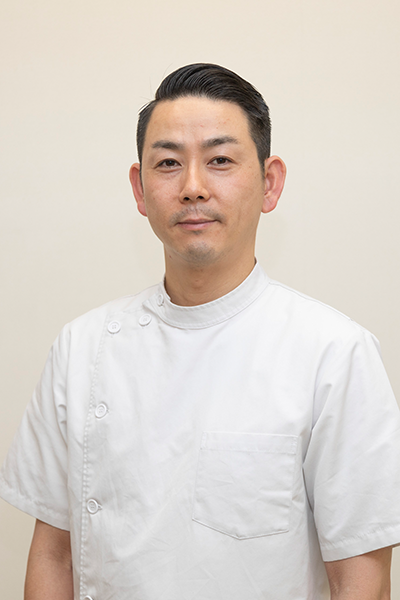
長引いた痛みを一人で治すのは困難なことが多いです。
困ったときは自身で判断せずに適切な処置を受けるために専門家に相談しましょう。
もし、お近くにお住まいで、困っているならば、一度ひまわり接骨院までお問い合わせください。腰痛・坐骨神経痛の専門家の新幡が、ご相談に乗ります。
気軽にご相談ください。

新着情報・お知らせ
平常通り営業致します。
日・祝休みです。
2026年9月のお休み
平常通り営業致します。
21日(月)~23(水)は祝日の為、
お休みになります。
日・祝休み
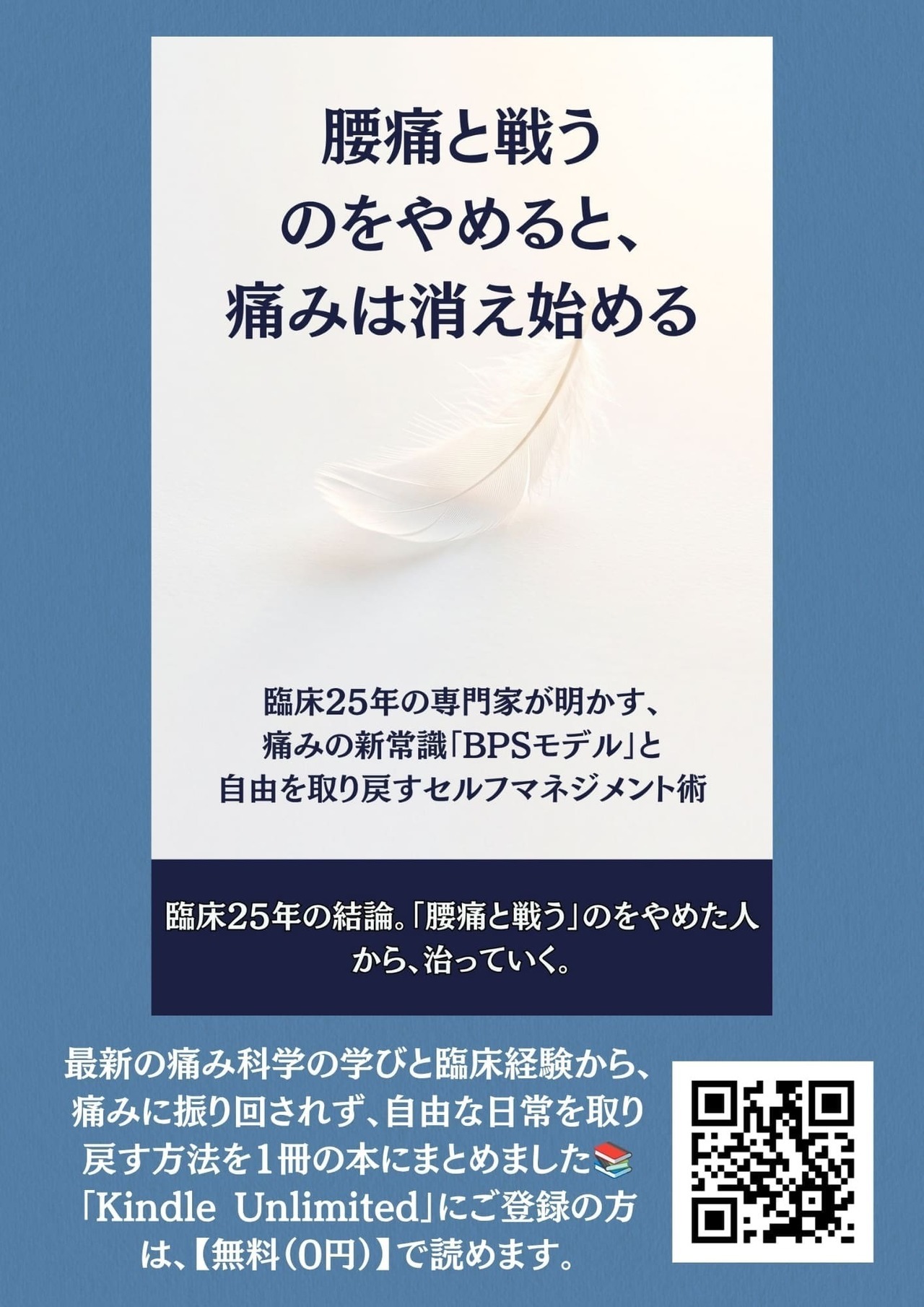
タイトル「腰痛は戦うのをやめると、痛みは消え始める」
Amazonの「Kindle Unlimited」にご登録の方は、【無料(0円)】で今すぐお読みいただけます!
↓↓
こちらから
タイトル「不安から逃げるのをやめると、腰痛は消え始める」」
Amazonの「Kindle Unlimited」にご登録の方は、【無料(0円)】で今すぐお読みいただけます!
↓↓
こちらから

お気軽にお問合せください

お電話でのお問合せ・相談予約
<受付時間>
月~土
9:00〜13:00 /15:00〜19:00
※日曜・祝日は除く
フォームは24時間受付中です。お気軽にご連絡ください。
ひまわり接骨院
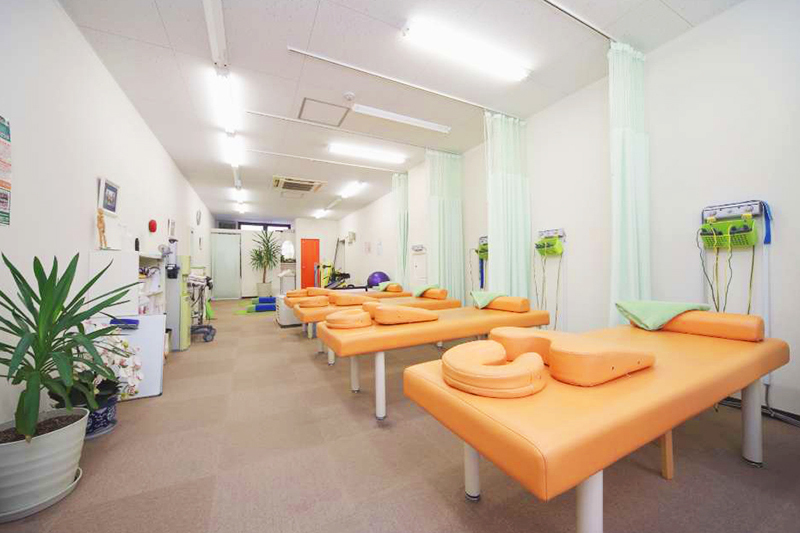
住所
〒213-0002
神奈川県川崎市高津区二子1丁目7−17 リバーサイドマンション杉崎 102
アクセス
二子新地駅 徒歩3分
駐車場:近隣にコインパーキングあり。自転車・バイクは店舗前に駐輪場がございます。
受付時間
月~土
9:00〜13:00 /15:00〜19:00
定休日
日曜・祝日