〒213-0002 神奈川県川崎市高津区二子1丁目7−17
リバーサイドマンション杉崎 102 二子新地駅 徒歩3分
| 月 | 火 | 水 | 木 | 金 | 土 | 日祝 | |
|---|---|---|---|---|---|---|---|
| 9:00〜13:00 | ● | ● | ● | ● | ● | ● | ─ |
| 15:00〜19:00 | ● | ● | ● | ● | ● | ● | ─ |
最新の坐骨神経痛診療における国際的なコンセンサス:2026年
公開日:2026/08/13
更新日:2026/00/00
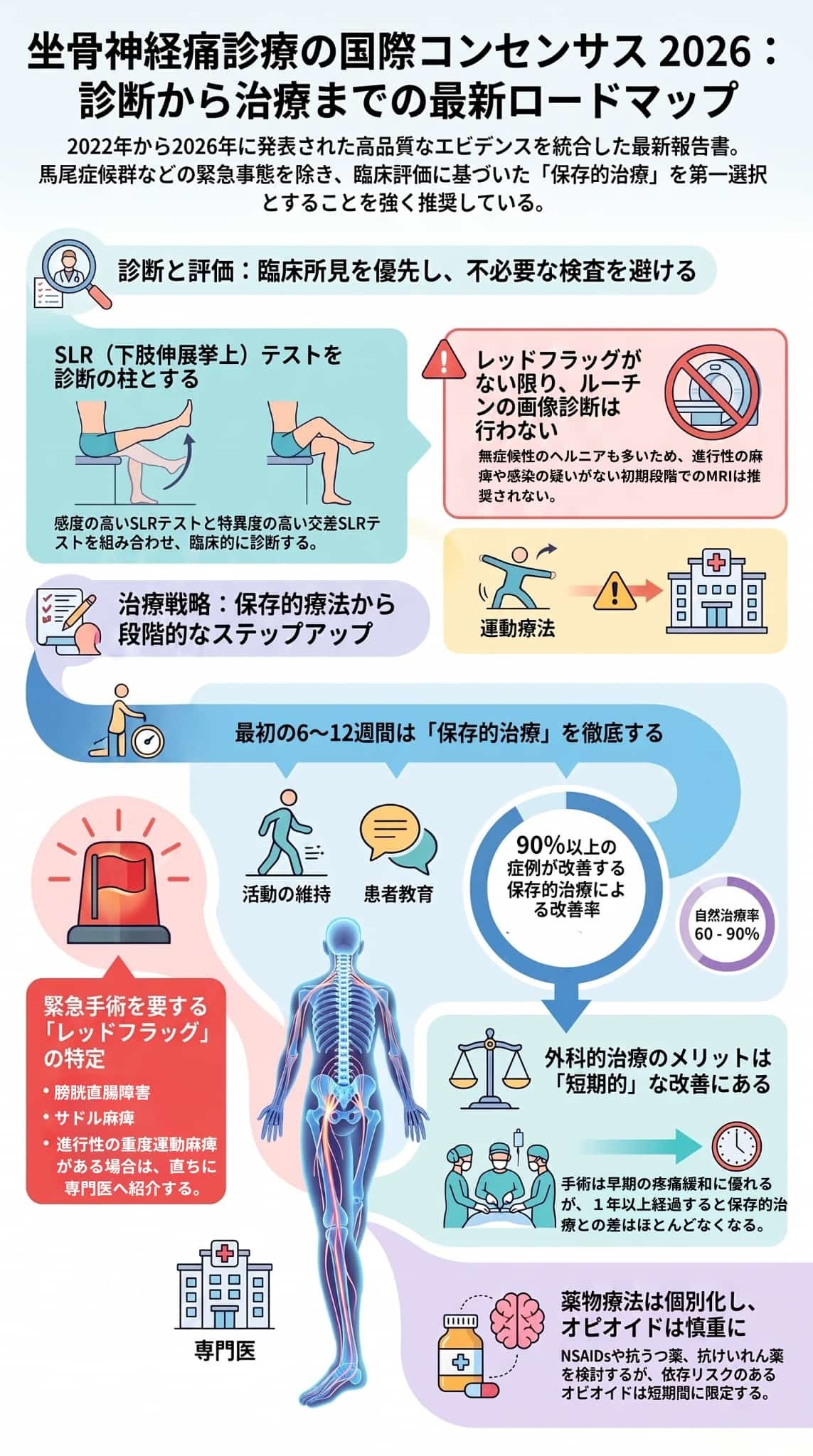
2022年から2026年に発表された最新の臨床研究を統合し、坐骨神経痛および腰仙部神経根症の診断と治療に関する国際的なコンセンサスをまとめた報告書です。
診断においては、過剰な画像検査を避け、身体所見を通じた臨床評価を優先することが強く推奨されています。
治療の第一選択は保存的療法であり、患者教育や理学療法、適切な薬物使用を組み合わせた多職種による包括的ケアの重要性が強調されています。
硬膜外ステロイド注射は短期的改善に有効ですが、長期的な効果については限定的なエビデンスに留まっています。
外科的治療は、重篤な麻痺がある場合や保存的治療が奏効しない場合に検討され、特に初期段階での痛み軽減に高い効果を発揮します。
最終的に本資料は、患者の心理社会的要因を考慮し、早期の社会復帰を目指す個別化された治療計画の策定を支援することを目的としています。
目次
2026年版の統合報告書に基づく、坐骨神経痛および腰仙部神経根症に関する最新の主要な知見は、**「不必要な検査や介入を避け、保存的治療と患者の活動維持を最優先する段階的なアプローチ」**に集約されます。以下に、主要なコンセンサスと推奨事項を分野別にまとめます。
- 初診時の画像診断は原則不要:馬尾症候群、進行性運動麻痺、感染、腫瘍、骨折などの**「レッドフラッグ(重篤な基礎疾患の兆候)」がない限り、初期評価でのルーチンな画像検査は推奨されません**。
- 臨床評価(身体診察)の重視:**Straight Leg Raise(SLR)テスト(ラセーグ徴候)**を中心とした臨床評価が診断の基本であり、高い推奨度(Grade A)を得ています。
- MRIの相関性と解釈の注意:画像診断が必要な場合のゴールドスタンダードはMRIですが、画像上の椎間板ヘルニアの所見と臨床症状は必ずしも一致しません。無症候性のヘルニアも一般集団に高頻度で見られるため、画像のみに依存した治療決定は避けるべきとされています。
- 良好な自然経過:重篤な神経学的欠損がない限り、保存的治療が第一選択です。腰椎椎間板ヘルニアの60〜90%は自然治癒し、90%以上が保存的治療で改善するため、通常は6〜12週間の保存的アプローチの継続が推奨されます。
- 活動維持と患者教育:長期の安静臥床は有害であり、避けるべきです。可能な限り早期の日常活動の再開と身体活動の維持を促すこと、そして良好な見通しを共有する患者教育が極めて重要です。
- 構造化された理学療法:個別化された運動療法(体幹安定化、段階的筋力強化など)や、McKenzie法などの理学療法プログラムが強く推奨されています。
- 薬物療法の限界と不一致:NSAIDs、抗うつ薬、抗けいれん薬(プレガバリンやガバペンチンなど)が推奨されていますが、ガイドライン間の合意は限定的です。アセトアミノフェンやベンゾジアゼピンは推奨されず、オピオイドは短期間の使用に限定して慎重に検討すべきです。
- 硬膜外ステロイド注射(ESI):短期的(1〜3ヶ月)な疼痛軽減や機能改善には有効性を示す中等度のエビデンス(Grade B)がありますが、長期的効果や費用対効果についてはエビデンスが一貫しておらず、議論が続いています。実施する場合は、正確性と安全性の観点からフルオロスコピー(透視)または超音波ガイド下で行うことが強く推奨されています。
- 緊急手術の絶対的適応:馬尾症候群(48時間以内)や、進行性または重度の運動麻痺がある場合は、緊急手術が必須となります。
- 相対的適応:6〜12週間の適切な保存的治療を行っても改善しない重度の持続痛や機能障害がある場合に手術(椎間板切除術など)が考慮されます。
- 長期的転帰における差の縮小:手術は短期的(2〜3ヶ月)には保存的治療より優れた疼痛改善を示しますが、長期的(1〜2年以上のフォローアップ)には保存的治療群との転帰の差はほぼ消失、または縮小します。
- 心理社会的要因の影響:抑うつ、不安、恐怖回避信念(痛みを恐れて動かないこと)、低い自己効力感などの心理社会的要因が、慢性化や予後不良に極めて重要な役割を果たしています。そのため、6週間以内に改善が見られない場合は、認知行動療法(CBT)の検討や集学的な職場復帰支援プログラムの導入を考慮することが推奨されています。
坐骨神経痛および腰仙部神経根症に関する研究は、これらの疾患が患者のQOL(生活の質)の低下だけでなく、労働生産性の低下や医療費の増大を招く重大な公衆衛生上の課題であるという認識を背景に発展してきました。
腰仙部神経根症は、椎間板ヘルニアや脊柱管狭窄症などによって神経根が圧迫・刺激され、下肢への放散痛や感覚異常、筋力低下などを引き起こす症候群です。
- 高い生涯リスクと良好な自然経過:腰椎椎間板ヘルニアの生涯リスクは1〜3%と推定されています。その60〜90%は自然治癒し、多くの患者は6〜12週間の保存的治療によって症状が改善します。
- 一部の遷延化と社会的損失:大半は良好な経過をたどる一方で、一部の患者では症状が長期化し、慢性疼痛や機能障害、それに伴う労働能力の低下を招きます。そのため、適切な早期介入や段階的な職場復帰支援が極めて重要視されるようになりました。
近年、世界各国の専門組織(世界脊椎神経外科学会連合(WFNS)、米国神経学会(AAN)、オランダ理学療法学会(KNGF)など)から、診断や治療に関する多数の臨床診療ガイドライン(CPG)やメタアナリシスが発表されてきました。
しかし、これらの推奨事項の一貫性やエビデンスの質、実際の臨床への適用可能性については議論が続いていました。
- 薬物療法の不一致:例えば、NSAIDs、抗うつ薬、抗けいれん薬(プレガバリンやガバペンチンなど)は一般的に使用されますが、ガイドライン間での推奨の合意は非常に限定的であり、使用を推奨しないガイドラインも存在します。
- 注射療法の長期効果の疑問:硬膜外ステロイド注射(ESI)は短期的な疼痛緩和には有効であるとされていますが、長期的な有効性や費用対効果に関してはエビデンスが一貫していません。
このように、研究やガイドラインが多数存在する一方で、実臨床において「何が本当に効果的で、何が不必要な医療費を招くのか」を整理した統合的な指針が求められていました。
これを受けて今回の2026年版報告書では、2022年から2026年までに発表された192件の文献から、厳格な基準で選定された17件の最高品質論文(国際的な診療ガイドラインや主要医学誌のシステマティックレビュー)のエビデンスを分析・統合しました。
この研究統合の背景には、臨床医が不必要な画像診断や過剰な介入を避け、理学療法や患者教育などの費用対効果の高い保存的治療を優先し、限られた医療資源を最も効率的かつ患者中心の形で活用できるように支援するという明確な目的があります。
2026年版の統合報告書において、坐骨神経痛および腰仙部神経根症の最新の診断推奨事項は、臨床評価(身体診察)を最優先し、レッドフラッグ(重篤な疾患の徴候)がない限りルーチンの画像検査を制限するという段階的なアプローチに集約されます。以下に、詳細な推奨事項を解説します。
- Straight Leg Raise(SLR)テスト(ラセーグ徴候): 感度が高く、陽性の場合は神経根症を示唆します。**推奨グレードA(強い推奨、中等度のエビデンス)**として位置づけられています。
- 交差SLR(Crossed SLR)テスト: 特異度が高く、陽性の場合は椎間板ヘルニアの可能性が高いと判断されます。
- 理学的検査の組み合わせ: 徒手筋力検査(MMT)、感覚検査、ラセーグ徴候を組み合わせることで、高い診断精度が得られます。ラセーグテスト以外にも、Slump(スランプ)テストやBowstring(ボウストリング)テストといった坐骨神経伸展テストも有用なスクリーニングツールです。
- 包括的な評価項目: 神経根レベルの特定に有用な「疼痛分布マッピング」、運動機能障害を検出するための「歩行評価」、および神経根レベルと臨床所見の整合性を確認(徴候と症状の一致)することが一貫して推奨されています。
- 初期評価での画像診断制限(推奨グレードA): 後述するレッドフラッグ(重篤な基礎疾患の疑い)がない限り、初診時におけるルーチンな画像診断は推奨されません。
- MRIの適切な使用(推奨グレードA): 画像診断が必要な病態である場合、MRIが診断のゴールドスタンダードとなります。3テスラMRIはより詳細な解剖学的情報を提供し診断精度を向上させます。
- 画像異常と臨床症状の不一致: 画像上の椎間板ヘルニアの所見と臨床症状の相関は必ずしも高くありません。健康な一般集団でも無症候性の椎間板ヘルニアが頻繁に認められるため、画像所見のみに基づいて治療方針を決定することは避けるべきです。
すべてのガイドラインが、初期評価において重篤な基礎疾患を除外するためのスクリーニングを**推奨グレードA(強い推奨、専門家コンセンサス)**として定めています。 見逃してはならない主なレッドフラッグは以下の通りです:
- 馬尾症候群の徴候(膀胱直腸障害、サドル麻痺(股の間の感覚異常)、両側性の下肢症状)
- 進行性または重度の運動麻痺(下垂足など)
- 感染または腫瘍の疑い(発熱、予期せぬ体重減少、夜間痛など)
- 骨折の疑い(明確な外傷歴、または高齢者における新規発症の腰痛)
- 電気神経筋電図(EMG/NCS)のルーチン使用制限: 神経根症の診断補助として使用されることはありますが、ルーチン検査としては推奨されていません。診断が極めて不明確な場合、複数レベルの神経根障害が疑われる場合、あるいは外科的治療を検討する際の補助的な位置づけにとどまります。
2026年版の統合報告書に示されている、坐骨神経痛および腰仙部神経根症における最新の保存的治療についての知見は、患者の自主性と身体活動の維持を促す多角的なプログラムが中心となっています。主要なアプローチと推奨事項は以下の通りです。
- 保存的治療の優先性:馬尾症候群、重度の運動麻痺、その他の重篤な神経学的欠損(レッドフラッグ)が認められない限り、保存的治療が第一選択となります。
- 高い自然治癒率と期間:腰椎椎間板ヘルニアに伴う症例の60〜90%は自然治癒し、90%以上の患者が保存的治療によって改善を示します。標準的な保存的治療の推奨期間は6〜12週間です。
- 安静臥床の回避と早期の活動再開:長期にわたる安静臥床は有害であり、避けるべきと一貫して推奨されています。可能な限り早期に日常活動を再開し、身体活動を維持する(stay active)ことが推奨されます。
- 患者教育(PEMs)の有効性:疾患の自然経過や良好な見通しを伝える患者教育資料は、患者の自己効力感を高め、恐怖回避信念(痛みを恐れて動かないこと)やストレス、不安を軽減する効果が示されています。また、サウジアラビアのガイドラインでは、痛みの神経科学教育(PNE)も条件付きで推奨されています。
■構造化された個別化運動プログラム:体幹コントロール、段階的筋力強化、柔軟性とモビリティの改善、機能的活動への段階的復帰を組み合わせた、患者個々に最適化された運動療法が治療の中核をなします。
■徒手療法とモビライゼーション:
- 脊椎マニピュレーション:運動や心理療法を含む治療パッケージの一部として考慮されます。
- 神経モビライゼーション:末梢神経の可動性を促す手技であり、疼痛軽減と機能障害改善に有効な可能性があります。
- McKenzie(マッケンジー)法:方向性のある運動と姿勢修正を組み合わせるアプローチであり、ガイドラインに基づく一般的なアドバイスと比較した長期(24ヶ月)の転帰が評価されています。
重要な点として、薬物療法の効果に関するガイドライン間の合意は限定的です。
■推奨される薬剤(条件付き推奨:Grade B):
- 抗うつ薬:特に神経障害性疼痛の成分が強い症例において、短期的な疼痛改善効果が示されています。
- 抗けいれん薬(プレガバリン、ガバペンチン):同じく神経障害性疼痛に対して推奨されます。
- NSAIDs(非ステロイド性抗炎症薬):急性期の痛みや強い炎症成分を大幅に改善する可能性がありますが、長期使用には注意が必要です。
■非推奨・注意が必要な薬剤:
- アセトアミノフェン、ベンゾジアゼピン、筋弛緩薬:エビデンス不足や依存性のリスクから推奨されません。
- オピオイド:依存性や有害事象のリスクを考慮し、使用は慎重に検討し、極めて短期間の使用に限定すべきです。
- 認知行動療法(CBT):6週間以内に改善が見られない場合には、予後を阻害する要因である恐怖回避信念や抑うつに対処するため、CBTや心理的介入の検討が推奨されます。
- 集学的職場復帰支援プログラム(Grade B):雇用主と協力し、業務内容の修正や段階的な職場復帰計画を早期に立てることが、労働参加の促進に有効です。
- 鍼治療(条件付き推奨:Grade C):慢性坐骨神経痛に対して、短期的な疼痛緩和や機能改善を目的とした安全な補完療法として考慮されます。
これまでに「診断」や「保存的治療」について見てきましたが、保存的治療を継続しても十分な効果が得られない場合、または重度の疼痛や機能障害がある場合に次のステップとして検討されるのが、インターベンション(注射)治療です。
坐骨神経痛に対して最も一般的に用いられるインターベンション治療ですが、その効果については「短期」と「長期」で評価が分かれています。
■短期的な効果(推奨グレードB:条件付き推奨、中等度のエビデンス):
- メタアナリシスやCochraneレビューの再分析において、1〜3ヶ月の時点における疼痛軽減と機能改善に対しては高い有効性(レベルI:強いエビデンス)が示されています。
- 急性・亜急性の強い放散痛を一時的にコントロールする手段として強く支持されています。
■長期的な効果(推奨グレードC:条件付き推奨、低いエビデンス):
- 6ヶ月から12ヶ月以上の長期的な有効性や費用対効果については、エビデンスが一貫しておらず、結論は限定的です。
- ただし、急性期の痛みを注射で和らげることで、オピオイド(医療用麻薬)の使用量を減らせる可能性が指摘されています。
- ブラインド(盲目的)投与の回避:硬膜外ステロイド注射は一般に安全ですが、感染や神経損傷などの合併症リスクを最小限に抑えるため、フルオロスコピー(透視)または超音波ガイド下で正確に実施すべきと強く推奨されています。これにより、薬剤を標的とする神経根の周辺に確実に届けることができます。
硬膜外注射には主に3つの経路(アプローチ)があります。
- 経椎間孔的アプローチ(Transforaminal)
- 椎間板外側(椎間板間)アプローチ(Interlaminar)
- 仙骨裂孔アプローチ(Caudal)
近年、ステロイド注射以外の新しい技術についても研究が進んでいます。
- パルス高周波治療(Pulsed Radiofrequency):腰部後根神経節に対して電気刺激を行うことで、組織を破壊せずに痛みの伝達を抑える治療法です。
- ラジオ波熱凝固術:サウジアラビアのガイドライン等で、難治性の痛みに対して条件付きで推奨(エビデンスの確実性は非常に低い)されています。
- 多血小板血漿(PRP)注射:患者自身の血液成分を用いて椎間板ヘルニアの吸収を促し、神経の修復・再生を刺激する可能性が示唆されていますが、まだエビデンスは限定的であり、今後の研究が待たれます。
ガイドラインでは、以下のような患者に対してインターベンション治療の実施を検討すべきとしています。
- 6週間以上の適切な保存的治療を行っても改善しない場合
- 画像診断(MRI)で明確な神経根圧迫が確認されており、症状と一致している場合
- 外科的治療を避けたい、または全身状態などから手術のリスクが高い患者
- 注射の効果を予測する因子として、事前の疼痛強度、心理社会的要因(抑うつ・恐怖回避信念)、画像と症状の整合性を包括的に評価することが、最適な患者選択に不可欠です。
保存的治療やインターベンション治療(注射)でも改善が見られない場合の選択肢となる、最新の外科的治療(手術)に関する知見を解説します。
手術の検討は、患者の神経学的状態に応じて「絶対的適応」と「相対的適応」に厳格に分類されます。
■絶対的適応(緊急手術):
- 馬尾症候群(膀胱直腸障害、サドル麻痺(股の間の感覚異常)、両側性の下肢症状を伴うもの。特に発症後48時間以内の対応が必要)
- 進行性または重度の運動麻痺(下垂足など) これらが認められる場合は、不可逆的な神経障害を防ぐために、迅速な専門医への紹介と緊急手術が強く推奨されています。
■相対的適応:
- 6〜12週間の適切な保存的治療を行っても症状が改善しない場合
- 持続する重度の下肢放散痛や機能障害があり、患者のQOL(生活の質)や就労に重大な支障をきたしている場合
手術の最大のメリットは「痛みの早期緩和」ですが、長期的には保存的治療との差が縮小する点が大きな特徴です。
■短期的(2〜3ヶ月)な優位性:手術(椎間板切除術など)は、保存的治療を継続した場合と比較して、治療後2〜3ヶ月時点での疼痛軽減や身体機能の改善において、中等度に優れているという強いエビデンスがあります。
■長期的(1〜2年以上)な転帰の収束:長期的なフォローアップにおいては、手術を行った患者も保存的治療(非手術的治療)を継続した患者もどちらも平均的に良好な改善を示し、両者の治療効果の差はほぼ消失、または大きく縮小します。
■持続期間による治療成績の違い:
- 代表的な「SPORT試験」の4年追跡では、手術群が非手術群より優れた転帰を示しました。
- 3〜6ヶ月持続する慢性坐骨神経痛に対する手術でも、2年間の追跡で優れた転帰が維持されたと報告されています。
- しかし、4〜12ヶ月持続する持続性坐骨神経痛患者を対象とした別の比較研究では、手術と保存的治療の間に有意な差は認められませんでした。
標準的な術式と、近年普及している低侵襲手術のそれぞれに特徴があります。
- 標準的術式:**標準的な椎間板切除術(open discectomy)および顕微鏡下椎間板切除術(microdiscectomy)**は、腰椎椎間板ヘルニアに伴う神経根症に対する標準的な外科的治療です。これら2つの術式の間で、臨床的なメリット(痛みの緩和効果など)に有意な差はありません。
- 低侵襲手術(MIS):**経皮的内視鏡的腰椎椎間板切除術(PELD)**などの低侵襲技術が開発されています。適切な患者選択を行うことで、組織損傷の最小化、術後合併症や再手術率の低下、早期の社会復帰が期待できます(推奨グレードC)。
- 術後経過の予測:腰椎椎間板切除術の直後から、下肢痛や機能障害レベルは劇的に改善し、この改善効果は最長7年間にわたって維持されることが示されています。ただし、術前に背部痛が強かった患者や、重度の心理社会的要因(抑うつ、不安、恐怖回避信念など)を抱える患者は、術後の予後が不良になりやすいことが指摘されています。
- 再発予防(WFNS推奨):術後の再発を防ぐためには、単に手術を行うだけでなく、術後の適切な段階的リハビリテーション、体重管理、禁煙、および日常生活における正しい動作や姿勢(身体力学)の教育を組み合わせることが不可欠です。
緊急手術が必要な状況(馬尾症候群など)を除き、手術を行うかどうかは、医師から「短期的な痛みの早期緩和というメリット」と「長期的には保存的治療と予後が変わらないという事実」の双方を説明した上で、患者自身の価値観、仕事、生活環境を考慮して決定するプロセスが強く推奨されています。
2026年版の統合報告書において、坐骨神経痛および腰仙部神経根症の**経過と予後を左右する因子(予後因子)**に関する知見は非常に体系化されています。
坐骨神経痛の自然経過は、一般に非常に良好であることが一貫して示されています。
- 高い自然治癒率: 腰椎椎間板ヘルニアによる症例の 60〜90%は自然治癒 します。
- 早期の改善: 多くの患者は、適切な保存的治療を継続することで 6〜12週間以内に有意な症状改善 を経験します。
- 保存療法の高い成功率: 理学療法を中心とした保存的治療により、90%以上の患者が改善 に至ります。画像上の椎間板ヘルニアが自然に縮小または消失することも頻繁に報告されています。
一部の患者で症状が遷延化し、慢性疼痛や長期の機能障害に移行するリスクを高める因子として、以下のものが特定されています。
- 疼痛の強さと持続期間: 発症時の高い疼痛強度 や、3ヶ月以上の長期にわたる症状の持続 は、予後不良の強力な予測因子です。
- 重度の神経学的欠損: 複数レベルの神経根障害や、下垂足歩行(足首が上がらない状態)などの明確な運動麻痺。
- 術前の状態: 外科的手術(椎間板切除術など)を検討する段階において、術前に背部痛や障害のレベルが強かった患者は、術後の転帰(回復の度合い)が不良になりやすいことが縦断的研究で示されています。
- 患者背景: 高齢、肥満、喫煙、重度の併存疾患、および訴訟や補償問題(労災補償など)への関与が予後を悪化させる因子として挙げられています。
- 抑うつと不安
- 恐怖回避信念(Fear-Avoidance Beliefs): 「動くと痛みが悪化する」という恐怖から活動を極端に制限してしまう心理
- 疼痛破局化(Catastrophizing): 痛みを過剰に脅威と捉え、最悪の事態ばかりを考えてしまう傾向
- 低い自己効力感(Self-Efficacy): 「自分自身で痛みをコントロールできる」という自信の欠如
- 社会的支援の欠如や、職場における心理社会的ストレス
一方で、以下のような因子を持つ患者は、良好な転帰をたどりやすいことが分かっています。
- 早期の症状改善(治療開始から早い段階での反応)
- 適切な保存的治療への良好な反応
- 高い自己効力感と積極的な対処戦略
- 適切な患者教育(PEMs)の受給: 疾患の良好な見通しや自己管理スキルを学ぶことで、恐怖回避信念が早期に和らぎます。
- 早期の職場復帰と良好な社会的支援
これらの予後因子を早期(特に発症から6週間以内)に正確に評価することは、以下の臨床実践に直結します。
- 患者選択の最適化: どの患者に保存的治療を継続し、どの患者に早期の手術やインターベンションを考慮すべきかのスクリーニングに役立ちます。
- 層別化されたアプローチ: 予後不良リスク(心理社会的リスク)が高い患者に対して、単なる物理的治療だけでなく、早期に認知行動療法(CBT)や集学的なリハビリを組み込む判断ができます。
- 現実的な期待の設定: 患者に対して「長期的には保存的治療も手術も効果に差がなくなること」などを予後因子を踏まえて説明し、共有意思決定を支援します。
これまで診断から治療、予後因子にいたる個々のテーマについて詳しくお話ししてきましたが、これらを包括する**「最新の国際的コンセンサス(2026年版統合報告書に基づく合意事項)」**を、一歩引いた大きな視野から総括して解説します。
- 身体診察を基本とする(Grade A):Straight Leg Raise(SLR)テスト(ラセーグ徴候)や交差SLRテストを中心とした、丁寧な臨床評価が診断の絶対的な基本です。
- 不要な画像検査は避ける(Grade A):馬尾症候群、進行性運動麻痺、感染、腫瘍、骨折などの**「レッドフラッグ(重篤な疾患の兆候)」がない限り、初期評価においてルーチンにレントゲンやMRIなどの画像検査を行うべきではない**、という点で国際的なコンセンサスが完全に一致しています。
- MRIは適切に解釈する(Grade A):画像が必要な場合のゴールドスタンダードはMRIですが、画像上の椎間板ヘルニア所見と臨床症状が一致しないケース(無症候性ヘルニアなど)が多いため、画像のみに基づいて治療決定を下してはなりません。
- 良好な自然経過への共通認識:椎間板ヘルニアに伴う症例の60〜90%は自然治癒し、90%以上が保存的治療によって改善を示します。
- 「安静」の否定と「活動維持」:長期にわたる安静臥床は回復を遅らせるため有害であり、可能な限り早期の日常活動の再開と、身体活動の維持を促すアプローチが強く支持されています。
- 患者教育と理学療法の提供:良好な見通しを共有して不安を和らげる「患者教育」と、個別の状態に最適化された「構造化された理学療法(運動療法など)」が治療の核心です。
- 硬膜外ステロイド注射(ESI)の役割:6週間以上の適切な保存的治療を継続しても改善が見られない重度の疼痛に対し、短期的(1〜3ヶ月)な痛みの軽減と機能改善を目的に実施すべきと合意されています。
- 長期的効果への慎重な評価:長期(6〜12ヶ月以上)の有効性や費用対効果についてはエビデンスが一貫しておらず、今後の更なる研究が必要な領域とされています。
- 画像ガイド下の実施(Grade A):安全性と正確性を担保するため、ブラインド(盲目的)投与を避け、フルオロスコピー(透視)や超音波ガイド下で実施すべきという点では高度な合意が得られています。
- 緊急手術の基準(Grade A):馬尾症候群(48時間以内)や、進行性・重度の運動麻痺(下垂足など)が認められる場合は、不可逆的な神経障害を防ぐために直ちに緊急手術を行う必要があります。
- 「手術の短期的優位性」と「長期的収束」の共有:6〜12週間の保存的治療が不成功に終わった場合は椎間板切除術などが考慮されます。ただし、**「手術は短期的(2〜3ヶ月)には痛みを素早く和らげるが、長期的(1〜2年以上)には保存的治療を続けた場合と転帰(回復度)の差はほぼ消失、または大きく縮小する」**という臨床的事実を、患者と共有(共同意思決定:Shared Decision-Making)することが国際的に強く推奨されています。
- 予後を阻害する因子の重視:痛みの慢性化や治療の不成功には、抑うつ、不安、恐怖回避信念(痛みを恐れて動かないこと)、低い自己効力感などの心理社会的要因(イエローフラッグ)が深く関わっています。
- 多職種連携と早期職場復帰支援(Grade B):6週間以内に改善の兆しが見られない場合は、認知行動療法(CBT)などの心理的アプローチや、雇用主と連携した集学的な職場復帰支援プログラムを導入すべきという認識が国際的に共有されています。
主要な国際ガイドライン(WFNS、オランダKNGF、サウジアラビア、韓国、国際レビュー等)を横断的に比較すると、「臨床評価の優先」「保存的治療の優先(安静回避・理学療法・患者教育)」については100%の完全な合意が得られています。
これまでに詳しく解説してきた「診断」「保存的治療」「インターベンション(注射)治療」「外科的治療(手術)」、そして「経過・予後因子」にいたる一連の知見に基づき、**2026年版統合報告書が定義する「最新の主要推奨事項(Main Recommendations)」**をエビデンスレベルと推奨グレード(Grade)とともに体系的に総括します。
国際的なガイドライン間で100%の合意が得られており、日常診療で最も優先される原則です。
■臨床評価(身体診察)の優先:
- Straight Leg Raise(SLR)テスト(ラセーグ徴候)交差SLRテストを中心とした丁寧な臨床評価を診断の基本とする。
■ルーチン画像診断の制限:
- 「レッドフラッグ(重篤な基礎疾患の兆候)」がない限り、初期評価においてルーチンの画像診断(レントゲンやMRIなど)は行わない。
■レッドフラッグの確実なスクリーニング:
- 馬尾症候群(膀胱直腸障害、サドル麻痺など)、進行性運動麻痺、感染、腫瘍、骨折の疑いを初期評価で確実に除外する。
■MRIの適切な使用と慎重な解釈:
- 画像診断が必要な場合のゴールドスタンダードとしてMRIを使用するが、画像上の椎間板ヘルニア所見と臨床症状は必ずしも一致しないため、画像のみに基づいた治療決定は避ける。
■保存的治療を第一選択とする:
- 馬尾症候群や進行性運動麻痺などの重篤な神経学的欠損がない限り、保存的治療を第一選択とする。
■患者教育と活動維持:
- 疾患の良好な自然経過を説明する患者教育を行い、長期の安静臥床を避け、身体活動の維持と早期の日常活動復帰を強く促す。
■構造化された理学療法の提供:
- 個別化された運動プログラム(体幹安定化、段階的筋力強化など)や徒手療法を中核とする理学療法を提供する。
■画像ガイド下での硬膜外注射:
- 硬膜外ステロイド注射(ESI)を実施する際は、正確性と安全性を担保するため、ブラインド(盲目的)投与を避け、フルオロスコピー(透視)または超音波ガイド下で実施する。
■重篤な症状に対する緊急手術:
- 馬尾症候群や進行性・重度の運動麻痺に対しては、不可逆的な神経障害を防ぐために**緊急手術(発症後48時間以内)**を行う。
中等度のエビデンスに基づき、患者の病態や経過に応じて適切に組み合わせる推奨事項です。
■薬物療法の個別選択:
- NSAIDs(急性期・炎症が強い場合)、および抗うつ薬・抗けいれん薬(プレガバリン、ガバペンチンなど)(神経障害性疼痛が強い場合)を、患者の特性に合わせて段階的に検討する。
■硬膜外ステロイド注射の短期的活用:
- 6週間以上の適切な保存的治療で十分な改善が得られない重度の疼痛に対し、短期的(1〜3ヶ月)な疼痛緩和と機能改善を目的に硬膜外ステロイド注射を考慮する。
■保存的治療不成功後の手術検討:
- 6〜12週間の適切な保存的治療を行っても改善しない持続性重度疼痛に対し、椎間板切除術(顕微鏡下含む)を考慮する。その際、**「手術は短期的には痛みを早期に緩和するが、長期的(1〜2年以上)には非手術的治療と転帰の差はほぼ消失・縮小する」**という事実を共有し、患者の希望を踏まえた「共有意思決定(SDM)」を通じて決定する。
■早期職場復帰支援の実施:
- 6週間以内に改善の兆しがない場合、雇用主と連携した集学的職場復帰プログラムを導入し、業務内容の修正や段階的な復帰計画を立てる。
■硬膜外ステロイド注射の長期的効果への期待:
- 6〜12ヶ月以上の長期的な有効性を目的として行うことは推奨しない(長期的効果に関するエビデンスは不十分・限定的)。
■選択的神経根ブロック(SNRB)の活用:
- 診断の不確実な難治性疼痛において、責任神経根を特定する診断目的、および標的を絞った治療目的に限定して実施を検討する。
■鍼治療やその他の補完代替療法:
- 慢性坐骨神経痛に対して、短期的な疼痛緩和を目的とした安全な補完手段として鍼治療を考慮する(24ヶ月にわたる長期的な効果のエビデンスは不確実)。
■オピオイドなどの強力な鎮痛薬の使用:
- 依存性や有害事象のリスクを考慮し、非薬理学的療法を優先した上で、使用する場合は極めて短期間の使用に限定して慎重に検討する。
これまでに整理してきた診断・治療・予後のエビデンスを踏まえ、2026年版ガイドラインが示す**「日常の臨床実践(Clinical Implications)における具体的な行動指針」**を体系的に解説します。
不要な検査を避け、医療資源を効率化するために、外来における診断フローを以下のように標準化(プロトコル化)します。
■ステップ1:病歴聴取
- 疼痛の性質、部位、放散パターン、発症様式。
- 「レッドフラッグ」(膀胱直腸障害、サドル麻痺、しびれ、筋力低下、体重減少、発熱、外傷歴など)の有無を最優先で確認。
■ステップ2:理学的検査
- SLR(ラセーグ)テスト(感度重視)および交差SLRテスト(特異度重視)を実施。
- 徒手筋力検査(MMT)、感覚検査、歩行評価、疼痛分布の確認を組み合わせる。
■ステップ3:画像診断の適応判断
- **「レッドフラッグがない初期段階(発症後6週間未満)では、画像検査を一切行わない」**を徹底する。
- 画像診断(MRIがゴールドスタンダード)を依頼するのは、①レッドフラッグがある場合、②6〜12週間の保存的治療が失敗した場合、③外科的治療を具体的に検討する場合に限定する。
- MRI異常(無症候性ヘルニアなど)は健康な一般集団にも高頻度に見られるため、**「画像上のヘルニア所見と臨床症状(神経根レベル)が完全に一致しているか」**を慎重に確認し、画像のみに基づいた治療決定を避ける。
■患者教育(最重要):疾患の良好な自然経過(60〜90%は自然治癒する)を説明し、安心感を与える。
■活動性の維持:**「長期の安静臥床は回復を遅らせるため有害である」**と明確に伝え、可能な限り日常活動を継続するよう指導する。
■薬物療法の個別化:
- 急性疼痛や強い炎症がある場合は NSAIDs を検討。
- 神経障害性疼痛の成分(激しい放散痛や電撃痛)が強い場合は、**抗うつ薬や抗けいれん薬(プレガバリン、ガバペンチンなど)**を初期から検討。
- ※アセトアミノフェン単独、ベンゾジアゼピン、長期のオピオイド使用は避ける。
■早期の理学療法紹介:プライマリケアから早期に理学療法士に紹介し、体幹コントロールや段階的な運動療法を開始する。
6週間経過しても改善の兆しがない場合は、アプローチを強化します:
- 理学療法の個別メニューを強化・調整。
- 硬膜外ステロイド注射(ESI)の検討:重度の疼痛や機能障害が残る場合、フルオロスコピー(透視)または超音波ガイド下で実施を検討(1〜3ヶ月の短期的な疼痛緩和・オピオイド使用量減少を目的とする)。
- **心理社会的要因(イエローフラッグ)**の評価を行い、**認知行動療法(CBT)**の導入を検討。
12週間以上経過しても改善しない難治性症例に対しては:
- 学際的(マルチディシプリナリー)なリハビリテーションプログラムを考慮。
- 脊椎外科専門医に紹介し、外科的治療(椎間板切除術など)を具体的に検討する。
臨床医は物理的な神経圧迫だけでなく、予後を阻害する「心理的障壁」をスクリーニングし、対処する必要があります。
- スクリーニング:抑うつ、不安、恐怖回避信念(痛みを恐れて動かないこと)、自己効力感の低さを検証済みリスクツールで評価する。
- 患者への語りかけ(痛みの神経科学教育:PNE):「動いて痛むのは、組織が破壊されているからではなく、神経が過敏になっているから」といった痛みのメカニズムを分かりやすく説明し、恐怖心を和らげる。
長期休職に伴う社会的・経済的損失を防ぐため、臨床と職場をつなぐ連携を行います。
- 段階的職場復帰計画:発症早期から、雇用主や産業医と協力して職場復帰計画を立てる。
- 業務調整:重い物を持つ作業の制限や、立ち・座り姿勢の適度な交代、全身振動曝露の回避など、職務内容の修正を指示する。
- 多職種カンファレンス:プライマリケア医、理学療法士、疼痛専門医、脊椎外科医、産業医が「活動維持と段階的負荷アップ」という共通のゴールを共有し、一貫したメッセージを患者に伝える。
馬尾症候群などの「絶対的緊急手術(48時間以内)」を除き、相対的適応(保存治療の不成功)での手術決定は、以下の対話プロセス(SDM)を経て行います:
- 情報提示:「手術は短期的(2〜3ヶ月)には痛みを劇的に和らげますが、1〜2年の長期で見ると、保存的治療を続けた場合と回復の度合いは変わりません」という事実をエビデンス(SPORT試験など)に基づいて客観的に伝える。
- 価値観のすり合わせ:患者自身の「早く職場に戻りたい」「手術のリスクを避けたい」といった価値観や、家庭・仕事環境を踏まえ、保存治療の継続か、手術に踏み切るかを共同で決定する。
2026年版の統合報告書が、これまでの膨大な研究エビデンスを分析・統合した結果として提示している**「科学的結論(Scientific Conclusions)」**は、これまでの個別テーマ(診断、保存的治療、注射、手術、予後)に横たわるエビデンスの確実性を厳格に格付けしたものであり、今後の標準的な医療のあり方を決定づけるものです。
- 身体診察が最も信頼できる基準(Grade A):坐骨神経痛の診断においては、Straight Leg Raise(SLR/ラセーグ)テストや交差SLRテストを中心とした丁寧な理学的検査の組み合わせが、最も高い診断精度を持つことが科学的に立証されています。
- 画像と症状の不一致:MRIは神経根圧迫を確認するゴールドスタンダードですが、椎間板の変形やヘルニアなどの「画像上の異常」は健康な(症状のない)一般集団にもきわめて高頻度に見られます。したがって、「画像上の異常=痛みの原因」と自動的に結びつけて治療(特に手術)を決定することは、科学的に否定されています。
- 「時間」が最大の治療薬:腰椎椎間板ヘルニアに伴う症例の 60〜90%は自然治癒 し、90%以上の患者が保存的治療によって改善を経験します。
- 「安静」の治療的価値の否定(Grade A):急性期であっても長期間の安静臥床は回復を遅らせ、むしろ有害です。可能な限り活動性を維持し、日常活動を再開させることが科学的に最も支持されています。
- 薬物療法の限界:臨床で頻用されるNSAIDs、抗うつ薬、抗けいれん薬には一定の有効性があるものの、薬物療法に関する国際ガイドライン間の合意は驚くほど限定的であり、強力なエビデンスは存在しません。アセトアミノフェンやベンゾジアゼピンは推奨されず、オピオイドは依存性の観点から極めて限定的にすべきです。
- 短期的な有用性(Grade B):硬膜外ステロイド注射(ESI)は、1〜3ヶ月の時点における疼痛軽減と機能改善において高い有効性(強いエビデンス)が実証されています。急性期の耐え難い痛みを和らげ、オピオイド使用量を減らすためのツールとして価値があります。
- 長期効果の欠如(Grade C):6〜12ヶ月以上の長期的な視点では、注射を行った患者と行わなかった患者の間で有意な差は認められません。また、費用対効果も決して高くないことが示されています。
- 緊急手術の絶対的基準(Grade A):馬尾症候群や進行性・重度の運動麻痺が認められる場合は、不可逆的な神経損傷を防ぐために48時間以内の緊急減圧手術が必須です。
- 選択的手術(椎間板切除術など)の真実(Grade B):適切な保存的治療を6〜12週間行っても改善しない慢性痛に対しては、手術が考慮されます。手術は2〜3ヶ月の短期的スパンでは保存的治療よりも劇的に痛みを和らげますが、1〜2年以上の長期的スパンで追跡すると、保存的治療を続けた患者と回復の度合い(転帰)の差はほぼ完全に消失、または極めて小さくなります。
- イエローフラッグの決定的な影響:坐骨神経痛が慢性化したり、治療が不成功に終わったりする最大の要因は、神経の圧迫度合いなどの物理的因子ではなく、抑うつ、不安、恐怖回避信念(痛むのを恐れて動かないこと)、および低い自己効力感といった心理社会的因子です。
- 科学的結論として、発症から6週間経過しても改善が見られない難治性症例には、物理的なアプローチ(薬や注射)を増やすのではなく、認知行動療法(CBT)や集学的な職場復帰支援プログラムなどの介入を早期に導入することが強く推奨されています。
2026年版統合報告書の最大の科学的結論は、**「重篤な神経学的欠損(馬尾症候群など)がない限り、不必要な画像診断や過剰な介入(早期の手術や漫然とした注射・投薬)を避け、患者教育・理学療法・活動維持を中心とした『患者中心の段階的ケア』に徹することが、医療資源の観点からも患者の長期予後の観点からも最も最適である」**という点に集約されます。
[1]M. Price et al., “Medication recommendations for treatment of lumbosacral radiculopathy: A systematic review of clinical practice guidelines.,” Apr. 2024, doi: 10.1002/pmrj.13142.
[2]A. K. Khorami et al., “Recommendations for Diagnosis and Treatment of Lumbosacral Radicular Pain: A Systematic Review of Clinical Practice Guidelines,” Journal of Clinical Medicine, vol. 10, no. 11, p. 2482, June 2021, doi: 10.3390/JCM10112482.
[3]C. Armon et al., “Epidural steroids for cervical and lumbar radicular pain and spinal stenosis systematic review summary: report of the AAN guidelines subcommittee,” Neurology, Mar. 2025, doi: 10.1212/wnl.0000000000213361.
[4]F. Zaina, P. Cote, C. Cancelliere, and F. D. Felice, “A systematic review of clinical practice guidelines for persons with non-specific low back pain with and without radiculopathy: identification of best evidence for …”, [Online]. Available: https://www.sciencedirect.com/science/article/pii/S0003999323001600
[5]A. Nagington, N. Foster, K. I. E. Snell, K. Konstantinou, and S. Stynes, “Prognostic factors associated with outcome following an epidural steroid injection for disc-related sciatica: a systematic review and narrative synthesis,” European Spine Journal, vol. 32, no. 3, pp. 1029–1053, Jan. 2023, doi: 10.1007/s00586-023-07528-4.
[6]O. Yaman, A. Guchkha, S. Vaishya, M. Zileli, C. C. Zygourakis, and J. Oertel, “The role of conservative treatment in lumbar disc herniations: WFNS spine committee recommendations,” Feb. 2024, doi: 10.1016/j.wnsx.2024.100277.
[7]Zaina et al., “A Systematic Review of Clinical Practice Guidelines for Persons With Non-specific Low Back Pain With and Without Radiculopathy: Identification of Best Evidence for Rehabilitation to Develop the WHO’s Package of Interventions for Rehabilitation.,” Archives of physical medicine and rehabilitation, 2023, doi: 10.1016/j.apmr.2023.02.022.
[8]E. Thoomes, D. Falla, J. A. Cleland, C. Fernández-de-las-Peñas, A. Gallina, and M. de Graaf, “Conservative management for lumbar radiculopathy based on the stage of the disorder: a Delphi study.,” Disability and Rehabilitation, pp. 1–10, Oct. 2022, doi: 10.1080/09638288.2022.2130448.
[9]M. Aldera et al., “Saudi Clinical Practice Guideline for the Assessment and Management of Low Back Pain and Sciatica in Adults,” Journal of Clinical Medicine, Jan. 2026, doi: 10.3390/jcm15020528.
[10]J. J. Lee et al., “Evidence-based clinical practice guidelines for patients with lumbar disc herniation with radiculopathy in South Korea,” Neurospine, June 2025, doi: 10.14245/ns.2550094.047.
[11]A. T. Apeldoorn, N. M. Swart, D. Conijn, G. Meerhoff, and R. Ostelo, “Management of low back pain and lumbosacral radicular syndrome: the Guideline of the Royal Dutch Society for Physical Therapy (KNGF).,” European Journal of Physical and Rehabilitation Medicine, Feb. 2024, doi: 10.23736/s1973-9087.24.08352-7.
[12]S. Stynes, N. E. Foster, J. Dowd, R. Ostelo, and K. Konstantinou, “Predictors of outcome following an epidural steroid injection for disc-related sciatica: a Delphi consensus study,” European Spine Journal, June 2024, doi: 10.1007/s00586-024-08342-2.
[13]Luites et al., “The Dutch Multidisciplinary Occupational Health Guideline to Enhance Work Participation Among Low Back Pain and Lumbosacral Radicular Syndrome Patients.,” Journal of occupational rehabilitation, 2022, doi: 10.1007/s10926-021-09993-4.
[14]Lewandrowski et al., “Personalized Interventional Surgery of the Lumbar Spine: A Perspective on Minimally Invasive and Neuroendoscopic Decompression for Spinal Stenosis.,” Journal of personalized medicine, 2023, doi: 10.3390/jpm13050710.
[15]R. Chou, J. L. Baisden, E. J. Carragee, D. K. Resnick, W. O. Shaffer, and J. D. Loeser, “Surgery for Low Back Pain: A Review of the Evidence for an American Pain Society Clinical Practice Guideline,” Spine, vol. 34, no. 10, pp. 1094–1109, May 2009, doi: 10.1097/BRS.0B013E3181A105FC.
[16]A. Hammed et al., “Surgical vs. Conservative Management of Chronic Sciatica (>3 Months) Due to Lumbar Disc Herniation: Systematic Review and Meta-Analysis,” Cureus, May 2024, doi: 10.7759/cureus.59617.
[17]C. Liu et al., “Surgical versus non-surgical treatment for sciatica: systematic review and meta-analysis of randomised controlled trials,” BMJ, vol. 381, pp. e070730–e070730, Apr. 2023, doi: 10.1136/bmj-2022-070730.
[18]A. Rushton, N. R. Heneghan, M. W. Heymans, J. B. Staal, and P. C. Goodwin, “Clinical course of pain and disability following primary lumbar discectomy: systematic review and meta-analysis.,” European Spine Journal, vol. 29, no. 7, pp. 1660–1670, Jan. 2020, doi: 10.1007/S00586-019-06272-Y.
[19]M. S. Danazumi, B. Bello, S. A. Rufai, and M. A. Abdulrahman, “Surgery versus conservative management for lumbar disc herniation with radiculopathy: A systematic review and meta-analysis,” Journal of Health Science, vol. 8, no. 1, pp. 42–53, Apr. 2018, doi: 10.17532/JHSCI.2018.479.
[20]B. C. ter Meulen, “The acute lumbosacral radicular syndrome,” Feb. 2024, doi: 10.5463/thesis.591.
[21]Z. Zhu, T. Schouten, R. Strijkers, B. W. Koes, A. Chiarotto, and H. Gerger, “Effectiveness of Non-surgical Interventions for Patients With Acute and Subacute Sciatica: A Systematic Review With Network Meta-Analysis,” Journal of Orthopaedic & Sports Physical Therapy, vol. 55, no. 6, pp. 1–12, Apr. 2025, doi: 10.2519/jospt.2025.13068.
[22]В. П. Губенко, S. S. Sovhyra, A. A. Vasylkov, A. V. Fedosenko, D. E. Lytvynenko, and N. P. Slobodyanyuk, “Modern principles of patient management with lumbosacral radiculopathy (literature review),” Клінічна та профілактична медицина, no. 7, pp. 164–177, Nov. 2024, doi: 10.31612/2616-4868.7.2024.20.
[23]L. Manchikanti et al., “Comparative Systematic Review and Meta-Analysis of Cochrane Review of Epidural Injections for Lumbar Radiculopathy or Sciatica.,” Pain Physician, vol. 25 7, pp. E889–E916, Oct. 2022, [Online]. Available: https://www.painphysicianjournal.com/current/pdf?article=NzU0Nw%3D%3D&journal=147&utm_campaign=share&utm_medium=email&utm_source=email_share_mailer
[24]Y. A. Mahmoud et al., “Efficacy and Safety of Acupuncture versus Sham in Patients with Chronic Sciatica: A Systematic review and Meta-analysis with GRADE assessment,” June 2025, doi: 10.21203/rs.3.rs-6797552/v1.
[25]M. Pojskic, E. Bisson, J. Oertel, T. Takami, C. C. Zygourakis, and F. Costa, “Lumbar disc herniation: Epidemiology, clinical and radiologic diagnosis WFNS spine committee recommendations,” vol. 22, Feb. 2024, doi: 10.1016/j.wnsx.2024.100279.
[26]B. Furlong, H. Etchegary, K. Aubrey-Bassler, M. Swab, A. Pike, and A. Hall, “Patient education materials for non-specific low back pain and sciatica: A systematic review and meta-analysis,” PLOS ONE, vol. 17, no. 10, pp. e0274527–e0274527, Oct. 2022, doi: 10.1371/journal.pone.0274527.
[27]T. Olivier, B. B. Nelson, T. Pham, K. Trivedi, and A. Patel, “Quality of clinical practice guidelines on interventional management of low back pain: a systematic review”, [Online]. Available: https://onlinelibrary.wiley.com/doi/abs/10.1002/pmrj.12760
[28]D. Y. Kwon, K. S. Kim, D. H. Kim, and C. Kwak, “Comparing the effectiveness of pregabalin and gabapentin in patients with lumbar radiculopathy: A systematic review and meta‐analysis,” Pain Practice, Oct. 2024, doi: 10.1111/papr.13424.
[29]J.-H. Park et al., “Pulsed radiofrequency of lumbar dorsal root ganglion versus epidural neuroplasty for lumbar radicular pain: a systematic review and network meta-analysis.,” Regional Anesthesia and Pain Medicine, July 2025, doi: 10.1136/rapm-2025-106723.
[30]Z. Zhang et al., “The efficacy and safety of acupuncture therapy for sciatica: A systematic review and meta-analysis of randomized controlled trails,” Frontiers in neuroscience, vol. 17, Feb. 2023, doi: 10.3389/fnins.2023.1097830.
[31]L.-H. Lin, T.-Y. Lin, K. V. Chang, W. T. Wu, and L. Özçakar, “Neural Mobilization for Reducing Pain and Disability in Patients with Lumbar Radiculopathy: A Systematic Review and Meta-Analysis,” Nov. 2023, doi: 10.3390/life13122255.
[32]Z. Yun et al., “Comparative Effects of Different Epidural Injection Approaches on Lumbosacral Radicular Pain: A Systematic Review and Network Meta-analysis.,” Pain Physician, vol. 25 8, pp. 531–542, Nov. 2022.
[33]Qu, Ju, Qin, Ding, and Peng, “Effectiveness of acupuncture in the treatment of chronic sciatica from herniated disks: a systematic review and meta-analysis.,” Frontiers in medicine, 2026, doi: 10.3389/fmed.2026.1689124.
[34]J. Zhang, R. Zhang, Y. Wang, and X. Dang, “Efficacy of epidural steroid injection in the treatment of sciatica secondary to lumbar disc herniation: a systematic review and meta-analysis,” Frontiers in Neurology, May 2024, doi: 10.3389/fneur.2024.1406504.
[35]Vale et al., “The Role of Systemic Steroids in Sciatica Due to Herniated Lumbar Disc: A Systematic Review and Meta-analysis.,” Spine, 2023, doi: 10.1097/BRS.0000000000004801.
[36]M. Zileli, J. Oertel, S. Sharif, and C. C. Zygourakis, “Lumbar disc herniation: Prevention and treatment of recurrence: WFNS spine committee recommendations,” Feb. 2024, doi: 10.1016/j.wnsx.2024.100275.
[37]S. Kilpikoski et al., “The McKenzie Method versus guideline-based advice in the treatment of sciatica: 24-month outcomes of a randomised clinical trial,” Clinical Rehabilitation, vol. 38, no. 1, pp. 72–84, Aug. 2023, doi: 10.1177/02692155231196393.
[38]A. Stępień and A. Łabuda, “Systemic use of glucocorticoids in the treatment of sciatica – a review,” Aktualności Neurologiczne, vol. 25, no. 1, pp. 14–18, Aug. 2025, doi: 10.15557/an.2025.0003.
[39]L. A. Corrêa et al., “Neural management plus advice to stay active on clinical measures and sciatic neurodynamic for patients with chronic sciatica: Study protocol for a controlled randomised clinical trial,” PLOS ONE, vol. 17, no. 2, pp. e0263152–e0263152, Feb. 2022, doi: 10.1371/journal.pone.0263152.
[40]Dr. Md. N. Kamal, Prof. Dr. M. A. Shakoor, Z. Chowdhury, A. K. Azad, and N. Rahman, “Efficacy and Outcomes of Selective Nerve Root Blocks in Diagnosis: A Systematic Review,” Scholars journal of applied medical sciences, vol. 12, no. 09, pp. 1178–1186, Sept. 2024, doi: 10.36347/sjams.2024.v12i09.011.
[41]J. J. Hébert et al., “Outcome prediction following lumbar disc surgery: a longitudinal study of outcome trajectories, prognostic factors, and risk models,” Journal of neurosurgery, pp. 1–10, Oct. 2024, doi: 10.3171/2024.6.spine24430.
[42]C. S. Bailey et al., “Surgery versus Conservative Care for Persistent Sciatica Lasting 4 to 12 Months.,” The New England Journal of Medicine, vol. 382, no. 12, pp. 1093–1102, Mar. 2020, doi: 10.1056/NEJMOA1912658.
[43]A. J. Haugen et al., “Prognostic factors for non-success in patients with sciatica and disc herniation,” BMC Musculoskeletal Disorders, vol. 13, no. 1, pp. 183–183, Sept. 2012, doi: 10.1186/1471-2474-13-183.
[44]J. M. Fritz et al., “Physical Therapy Referral From Primary Care for Acute Back Pain With Sciatica : A Randomized Controlled Trial.,” Annals of Internal Medicine, vol. 174, no. 1, pp. 8–17, Jan. 2021, doi: 10.7326/M20-4187.
[45]D. Kerr, W. Zhao, and J. D. Lurie, “What Are Long-term Predictors of Outcomes for Lumbar Disc Herniation? A Randomized and Observational Study,” Clinical Orthopaedics and Related Research, vol. 473, no. 6, pp. 1920–1930, June 2015, doi: 10.1007/S11999-014-3803-7.
[46]J. N. Weinstein et al., “Surgical versus nonoperative treatment for lumbar disc herniation: four-year results for the Spine Patient Outcomes Research Trial (SPORT).,” Spine, vol. 39, no. 1, pp. 3–16, Dec. 2008, doi: 10.1097/BRS.0000000000000088.
[47]T. Iversen et al., “Outcome prediction in chronic unilateral lumbar radiculopathy: prospective cohort study,” BMC Musculoskeletal Disorders, vol. 16, no. 1, pp. 17–17, Feb. 2015, doi: 10.1186/S12891-015-0474-9.
[48]C. S. Bailey et al., “Discectomy Compared with Standardized Nonoperative Care for Chronic Sciatica Due to a Lumbar Disc Herniation: A Secondary Analysis of a Randomized Controlled Trial with 2-Year Follow-up.,” Journal of Bone and Joint Surgery, American Volume, vol. 103, no. 23, pp. 2161–2169, Oct. 2021, doi: 10.2106/JBJS.21.00448.
[49]A. A. Abd-Elaal, M. A.-E.-B. Hegazy, and M. E. Massoud, “Surgery versus Conservative Care for Persistent Sciatica Lasting 3 to 6 Months,” The Egyptian Journal of Hospital Medicine, vol. 88, no. 1, pp. 3681–3683, July 2022, doi: 10.21608/ejhm.2022.250655.
[50]J. C. R. Yang, S.-T. Chiu, J. Y.-L. Oh, and A.-K. Kaliya-Perumal, “Selective Nerve Root Block in Treatment of Lumbar Radiculopathy: A Narrative Review,” Surgeries, vol. 3, no. 3, pp. 259–270, Sept. 2022, doi: 10.3390/surgeries3030028.
[51]N. Kontakiotis, A. Rushton, E. Billis, G. Papathanasiou, and G. Gioftsos, “Development of a clinical prediction model to inform clinical decision making for classification of patients with sciatica, based on their clinical characteristics, in the Greek health system: protocol for a prospective predictive exploratory study,” BMJ Open, vol. 12, no. 1, pp. e052119–e052119, Jan. 2022, doi: 10.1136/bmjopen-2021-052119.
[52]H. Wang et al., “Study on the efficacy and safety of the combination of Shi’s manual therapy and percutaneous endoscopic lumbar diskectomy for lumbar disc herniation with radiculopathy: study protocol for a multicenter randomized controlled trial,” Trials, vol. 23, no. 1, Apr. 2022, doi: 10.1186/s13063-022-06195-y.
[53]C. A. Hincapié et al., “Incidence of and risk factors for lumbar disc herniation with radiculopathy in adults: a systematic review,” European Spine Journal, Oct. 2024, doi: 10.1007/s00586-024-08528-8.
[54]G. Lei-lei, L. Jun, H. XiaoXia, L. Tao, and T. Yong, “Research Progress of Selective Nerve Root Block in the Treatment of Lumbosacral Radiculopathy,” May 2025, doi: 10.12290/xhyxzz.2024-0631.
[55]“Effectiveness of smartphone apps for the self-management of low back pain in adults: a systematic review,” Dec. 2021, doi: 10.6084/m9.figshare.17112450.
[56]T. J. Olivier et al., “Clinical Practice Guidelines on Interventional Management of Low Back Pain: A Synthesis of Recommendations.,” Pm&r, Dec. 2022, doi: 10.1002/pmrj.12930.
[57]A. Sood et al., “Lumbosacral Disc Injuries: A Physical Therapy–Centered Framework for Assessment and Rehabilitation,” Dec. 2025, doi: 10.64483/202522370.
ごあいさつ
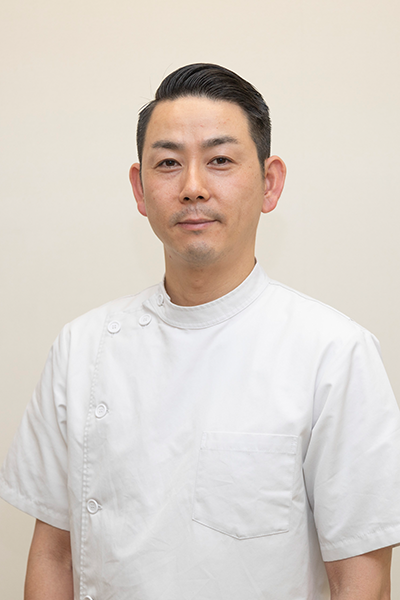
長引いた痛みを一人で治すのは困難なことが多いです。
困ったときは自身で判断せずに適切な処置を受けるために専門家に相談しましょう。
もし、お近くにお住まいで、困っているならば、一度ひまわり接骨院までお問い合わせください。腰痛・坐骨神経痛の専門家の新幡が、ご相談に乗ります。
気軽にご相談ください。

新着情報・お知らせ
平常通り営業致します。
日・祝休みです。
2026年9月のお休み
平常通り営業致します。
21日(月)~23(水)は祝日の為、
お休みになります。
日・祝休み
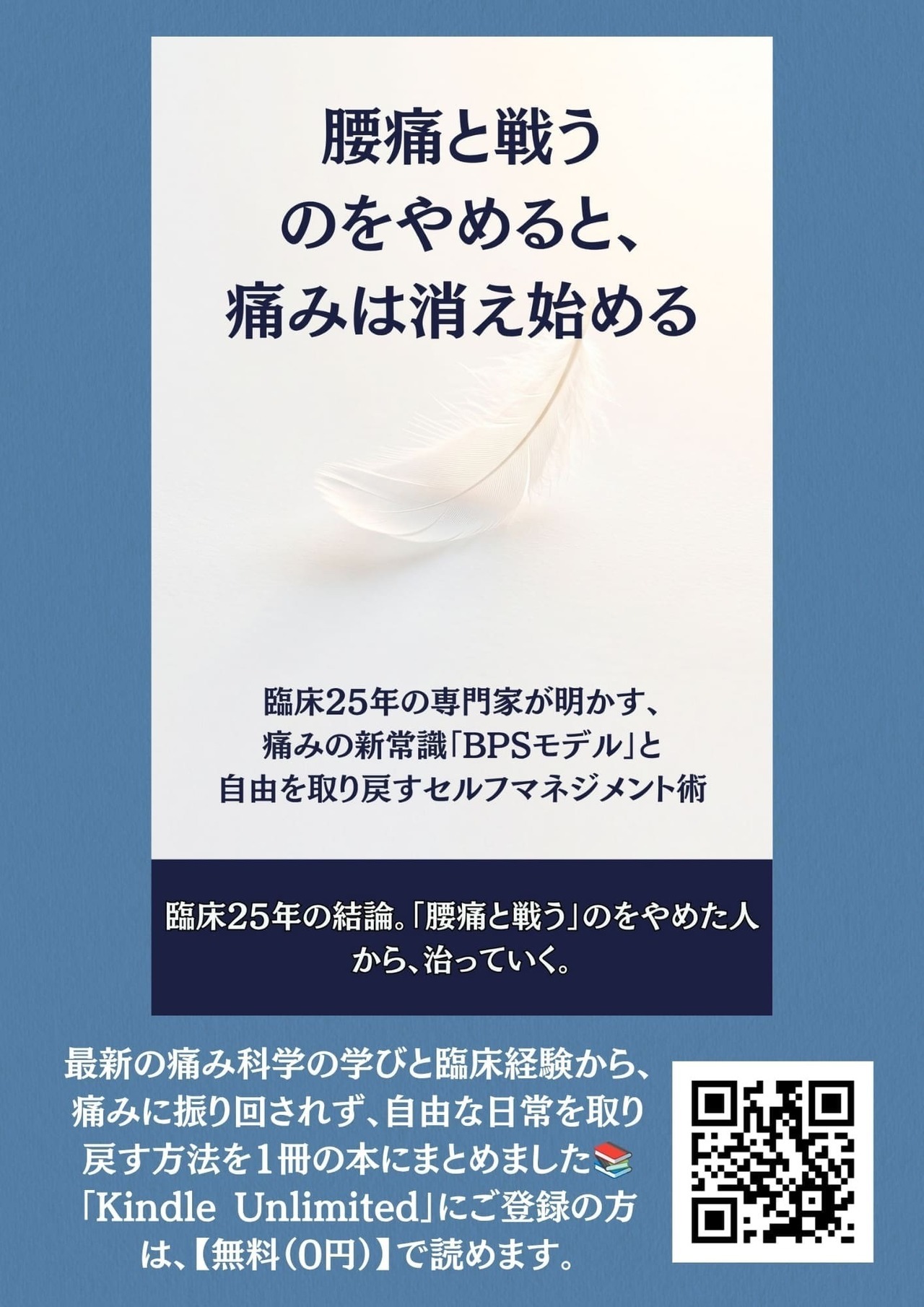
タイトル「腰痛は戦うのをやめると、痛みは消え始める」
Amazonの「Kindle Unlimited」にご登録の方は、【無料(0円)】で今すぐお読みいただけます!
↓↓
こちらから
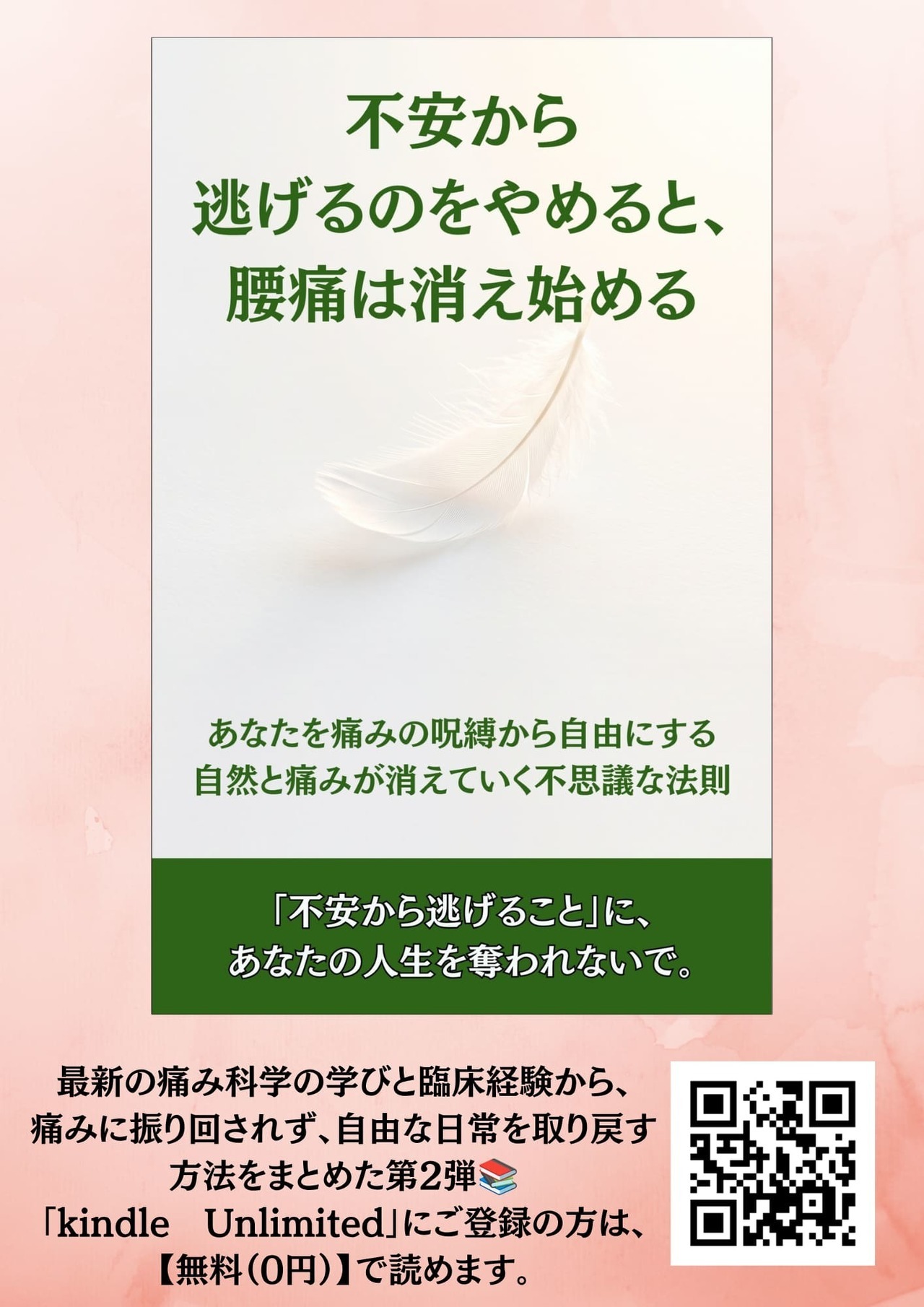
タイトル「不安から逃げるのをやめると、腰痛は消え始める」」
Amazonの「Kindle Unlimited」にご登録の方は、【無料(0円)】で今すぐお読みいただけます!
↓↓
こちらから
お気軽にお問合せください

お電話でのお問合せ・相談予約
<受付時間>
月~土
9:00〜13:00 /15:00〜19:00
※日曜・祝日は除く
フォームは24時間受付中です。お気軽にご連絡ください。
ひまわり接骨院
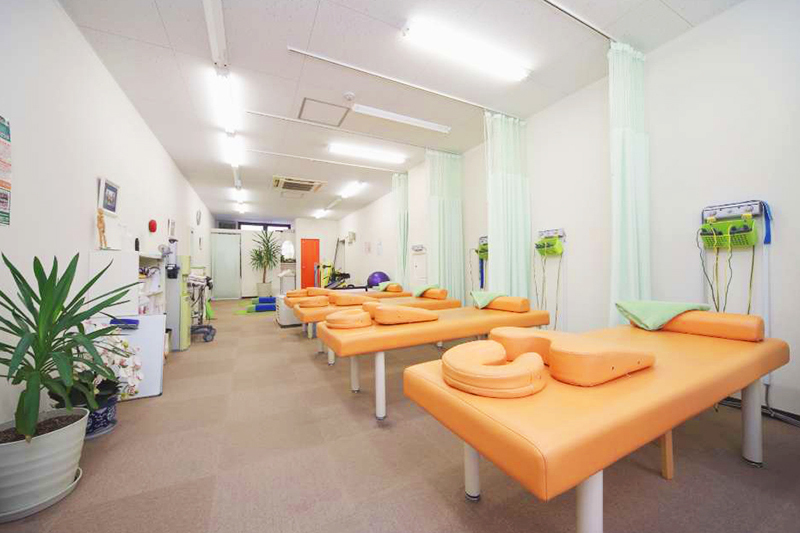
住所
〒213-0002
神奈川県川崎市高津区二子1丁目7−17 リバーサイドマンション杉崎 102
アクセス
二子新地駅 徒歩3分
駐車場:近隣にコインパーキングあり。自転車・バイクは店舗前に駐輪場がございます。
受付時間
月~土
9:00〜13:00 /15:00〜19:00
定休日
日曜・祝日