〒213-0002 神奈川県川崎市高津区二子1丁目7−17
リバーサイドマンション杉崎 102 二子新地駅 徒歩3分
| 月 | 火 | 水 | 木 | 金 | 土 | 日祝 | |
|---|---|---|---|---|---|---|---|
| 9:00〜13:00 | ● | ● | ● | ● | ● | ● | ─ |
| 15:00〜19:00 | ● | ● | ● | ● | ● | ● | ─ |
最新の腰椎椎間板ヘルニア診療における国際的なコンセンサス:2026年
公開日:2026/08/14
更新日:2026/00/00
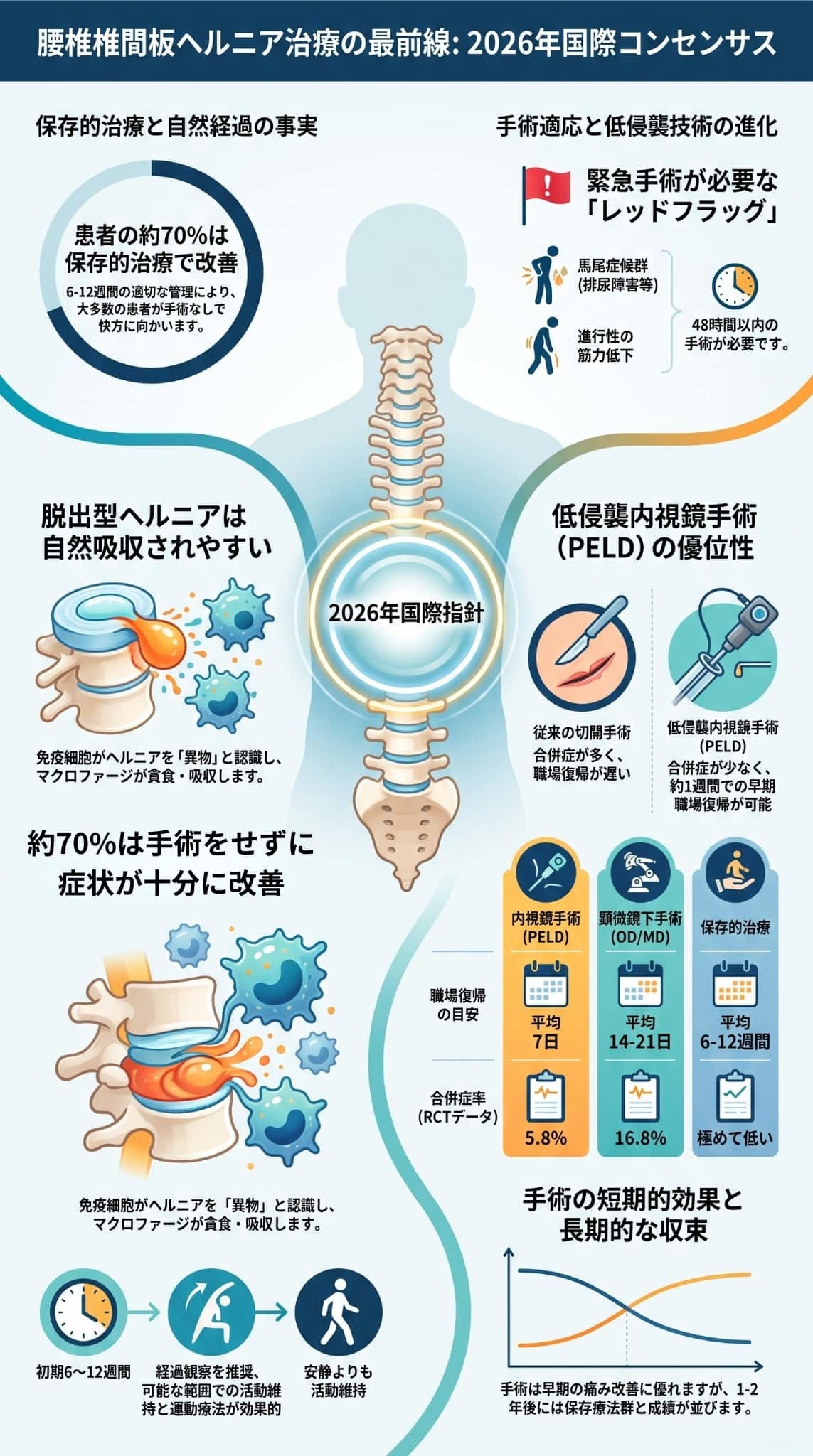
この資料は、2020年から2026年までの膨大な高品質データを統合した、腰椎椎間板ヘルニア(LDH)診療に関する国際的な最新コンセンサスをまとめたものです。
主な内容は、保存的治療が第一選択であることの強調と、特に脱出型ヘルニアにおいて高い頻度で見られるヘルニアの自然吸収メカニズムの解説です。
治療法については、薬物療法や運動療法の有効性に加え、従来の切開手術よりも合併症が少なく早期復帰が可能な低侵襲の内視鏡手術(PELD)の進歩と推奨が示されています。
また、緊急を要する馬尾症候群などの手術適応基準や、高齢者や妊婦といった特殊な症例への個別化された配慮についても詳細に触れています。
全体を通して、MRI診断と臨床症状の相関を重視し、患者の価値観を尊重した共同意思決定の重要性が説かれています。最後には、将来の研究課題としてAIを用いた予後予測や再生医療の可能性が展望されています。
2020年から2026年に発表された570本以上の高品質な診療ガイドライン、システマティックレビュー、メタアナリシスを統合した**「2026年国際的コンセンサス」**に基づき、腰椎椎間板ヘルニア(LDH)診療における最新の主要な知見を以下の6つのテーマに整理して解説します。
- 保存的治療が第一選択:腰椎椎間板ヘルニア患者の約70%は保存的治療により症状の改善を経験するため、馬尾症候群や進行性神経脱落症状を伴わない大多数の患者において、6〜12週間の保存的管理が強く推奨されます(Grade A)。
- 自然吸収の高い発生率:症候性ヘルニアの約66.66%が保存的治療後に有意な退縮(自然吸収)を示すことが報告されています。特に、後縦靭帯を破って飛び出した**「脱出型(Sequestrated/Extrusion)」**、ヘルニアサイズが大きい、後縦靭帯の破裂、若年、MRI T2強調画像での高信号、およびガドリニウム造影での増強効果がある場合に、より高い自然吸収率が期待できます(Grade A/B)。
- 吸収の生物学的プロセス:脱出した髄核組織は免疫系から「異物」とみなされ、マクロファージによる貪食が促進されます。このプロセスには、ヘルニア周囲の新生血管形成や、炎症性サイトカイン(TNF-α、IL-1β、IL-6など)、マトリックスメタロプロテアーゼ(MMPs)による細胞外マトリックスの分解が関与しています。
- 画像のみに依存しない慎重な判断:MRIは診断のゴールドスタンダード(Grade A)ですが、無症候性ヘルニアが一般集団の20〜30%に認められるため、画像所見のみで治療方針を決定してはならず、必ず下肢放散痛や身体診察(下肢伸展挙上(SLR)テストなど)といった臨床症状と一致しているかを評価する必要があります(Grade A)。
- レッドフラッグサインの除外:馬尾症候群(膀胱直腸障害、サドル麻痺)や、進行性の重度な神経脱落(筋力低下など)といった危険信号(レッドフラッグサイン)が認められる場合は、緊急での評価および早期画像診断が必須です。
- 薬物療法:急性期の疼痛緩和には、**NSAIDsの短期・最小有効量使用が強く推奨(Grade A)**されます。神経根性疼痛にはガバペンチノイドが考慮されます(Grade B)。一方、依存性リスクや長期有効性の欠如から、**オピオイドの使用は避けるべき(推奨されない:Grade A)**とされています。
- 運動療法と理学療法:体幹深層筋(多裂筋、腹横筋など)の活性化を図る**「運動制御訓練(Motor Control Training)」が疼痛および機能障害を有意に改善(Grade A)**します。ストレッチや筋力強化を含む一般的な運動療法も強く推奨されますが(Grade A)、牽引療法は一貫した有効性が示されておらず、日常的な使用は推奨されません(Grade C)。
- 硬膜外ステロイド注射(ESI):6週間以上の保存的治療に抵抗する神経根痛に対して考慮され、画像ガイド下で実施される**経椎間孔アプローチ(Transforaminal ESI)が最も高い有効性(Grade A)**を示します。ESIにより、約50〜60%の患者で手術を回避可能です。
■手術の適応基準:
- 絶対的(緊急)適応:馬尾症候群(48時間以内の緊急手術、Grade A)や、進行性の重度筋力低下(MMT 2以下、Grade A)では迅速な手術が必要です。
- 相対的適応:6〜12週間の適切な保存的治療に抵抗する重度の坐骨神経痛があり、日常生活に著しい支障がある場合、画像と症状が一致していれば手術が推奨されます(Grade A)。
■内視鏡手術の台頭とメリット:**経皮的内視鏡下椎間板切除術(PELD)**などの低侵襲手術は、従来の開放手術と比較して臨床成績は同等ながら、合併症率が有意に低く(5.8% vs 16.8%)、小切開による早期離床や、**早期の職場復帰(平均7日 vs 14〜21日)**を可能にします(Grade A)。ただし、術者には一定の学習曲線が要求され、再ヘルニア率がやや高い可能性がある点への考慮が必要です。
- 早期改善の手術、長期的には同等:高品質なメタアナリシスによると、短期(3〜6ヶ月)および中期(1〜2年)では、手術群が保存的治療群に比べて疼痛や機能改善において有意に優れます(Grade A)。しかし、**長期(4〜10年)が経過すると両群の成績差は縮小・消失(Grade B)**します。
- 慢性坐骨神経痛における優位性:ただし、坐骨神経痛の症状が3ヶ月以上持続している慢性期患者においては、手術治療が保存的治療を上回る疼痛、機能、QOL改善をもたらすため、手術が積極的に考慮されます(Grade A)。
■特殊集団への個別アプローチ:年齢、職業、心理社会的因子(うつ・不安は予後不良因子:Grade A)に応じたアプローチが必要です。
- アスリート:早期手術(PELDなど)は競技復帰(平均3〜6ヶ月、復帰率85-90%)を早める選択肢として推奨されます(Grade A)。
- 妊婦:可能な限り保存的治療を最大限に試みることが強く推奨(Grade A)され、鎮痛薬はアセトアミノフェンが最も安全(Grade A)、NSAIDsは妊娠後期禁忌となります。
■共同意思決定(Shared Decision Making)の重視:手術と保存的治療のそれぞれのメリット・リスクを十分に提示し、**患者の価値観や希望を尊重した共同意思決定を行うこと(Grade A)**が、最終的な満足度と治療アウトカムを最大化するために必要不可欠です。
腰椎椎間板ヘルニア(LDH)診療における研究の背景には、**「社会経済的負担の増大」「治療パラダイムの転換(保存的療法の再評価)」「医療技術の進歩」**という3つの大きな潮流があります。2020年から2026年にかけて570本以上の高品質な研究が統合されるに至った歴史的・学術的な背景を、以下のポイントに整理して解説します。
腰椎椎間板ヘルニアは、先進国における腰痛および下肢放散痛(坐骨神経痛)の最も一般的な原因の一つです。
- 活動世代への影響:年間発生率は人口1,000人あたり約5〜20例と推定され、特に社会的・経済的に最も活動的な30〜50歳代に好発します(男女比では男性にやや多い)。
- 経済的インパクト:好発部位の約90%がL4-L5またはL5-S1レベルに集中し、重労働や長時間の座位姿勢、喫煙、肥満などがリスクを高めます。これによる長期の休業や労働生産性の低下は、患者個人だけでなく社会全体にとっても重大な経済的損失となるため、早期かつ効率的な社会復帰をもたらす診療指針の確立が強く求められてきました。
過去の医療現場では、ヘルニアによる神経圧迫を解除するために早期の手術が選択されやすい時代もありました。しかし、近年の科学的解明によって治療方針は大きく保存的治療へとシフトしています。
- 保存的治療の圧倒的エビデンス:急性期のヘルニア患者の約70%が保存的治療のみで症状改善を経験することが明らかになりました。
- 「自然吸収」プロセスの分子レベルでの証明:症候性ヘルニアの約66.66%が保存的治療後に自発的に縮小または消失(自然吸収)することがシステマティックレビューで示されました。脱出した髄核をマクロファージが「異物」として貪食する免疫学的応答や、周囲の新生血管形成、炎症性サイトカインの役割が分子レベルで解明されたことで、「安易に手術をせず、まずは6〜12週間の保存的治療期間を設けるべきである」という国際的な合意(Grade A)が形成されました。
MRI技術の普及は正確な病態把握を可能にしましたが、同時に新たな診療課題も生み出しました。
- 無症候性ヘルニアの存在:MRIはゴールドスタンダードとして極めて高い診断精度を持つ一方、まったく症状のない一般集団の20〜30%にも画像上はヘルニアが認められることが研究で判明しました。
- 臨床症状との相関重視へ:画像所見の異常だけで手術などの治療を決定すると、真の痛みの原因(責任病巣)を見誤る危険性があります。そのため、患者の訴える放散痛の分布や、下肢伸展挙上(SLR)テストなどの身体診察と「画像所見」を厳密に照らし合わせる、丁寧な臨床評価の必要性が改めて背景として議論されるようになりました。
手術が必要とされる「保存的治療抵抗性の重症例」や「緊急性の高い馬尾症候群」において、従来の大きな切開を伴う手術(標準的開放椎間板切除術)には、術後疼痛や筋肉へのダメージ、長期の入院といったデメリットが伴っていました。
- 内視鏡技術の技術革新:より体に優しい治療を求めて、**経皮的内視鏡下椎間板切除術(PELD)**や双ポータル内視鏡(UBE)などの低侵襲な手技の開発と評価が進められました。これにより、従来の術式と同等の治療効果を維持しながら、合併症率を約3分の1に抑え、職場復帰を劇的に早める(平均14〜21日から平均7日へ)ことが可能となり、手術をめぐる研究の主眼は「いかに患者の身体的負担を減らすか」に置かれるようになっています。
現代の研究は、「すべての患者に同じ治療を行う」のではなく、**「患者一人ひとりの背景に応じた最適な医療(個別化医療)」**の提供へと向かっています。
- 特殊集団の研究不足の解消:高齢者、アスリート、妊婦など、画一的な治療プランを適用しにくい特殊な集団における最適な管理方法の確立が進められてきました。
- 将来へのアプローチ:さらに近年では、PRP(多血小板血漿)や幹細胞を用いた「椎間板再生医療(生物学的治療)」の開発、AI・機械学習を用いた「術後予後や再発の予測モデル」の構築など、未来を見据えた先進的な研究が診療背景を支えています。
腰椎椎間板ヘルニア(LDH)の**「疫学的特徴」と「自然経過(自然吸収を含む)」**について、2026年の国際的コンセンサスレポートに示された最新のエビデンスに基づいて詳しく解説します。
■発生率と好発年齢:
- 成人における年間発生率は、人口1,000人あたり約5〜20例と推定されています。
- 最も好発する年齢層は30〜50歳代であり、性別では男性にやや多い傾向があります。
■好発部位:
- 椎間板ヘルニアの約90%は、下部腰椎であるL4-L5(第4・第5腰椎間)およびL5-S1(第5腰椎・第1仙椎間)レベルに集中して発生します。
■確立されている危険因子:
- 世界脊椎神経外科連盟(WFNS)の推奨によれば、以下の因子が発症リスクを増加させます:
- 重労働および反復的な腰部負荷
- 長時間の座位姿勢
- 喫煙
- 肥満
- 遺伝的素因
■自然吸収の高い頻度:
- システマティックレビューとメタアナリシスによると、症状を伴うヘルニア(症候性LDH)の約66.66%が保存的治療後に有意な退縮(自然吸収)を示すことが報告されています。
- 大多数の患者において保存的治療は極めて有効であり、約70%の患者が6〜12週間の保存的管理によって症状の改善を経験します。
■自然吸収の生物学的メカニズム:
- 免疫学的応答:椎間板から飛び出した髄核組織は、本来接することのない免疫系から「異物」として認識され、これによってマクロファージによる貪食作用が活発に引き起こされます。
- 新生血管形成:ヘルニア組織の周囲に新たな血管が作られる(血管新生)ことで、血流を介して免疫細胞の浸潤が促され、吸収プロセスが加速します。
- 炎症性サイトカイン:TNF-α、IL-1β、IL-6などの炎症性サイトカインが局所で分泌され、組織の分解を誘導します。
- マトリックスメタロプロテアーゼ(MMPs):酵素であるMMPsが、ヘルニアの主成分である細胞外マトリックスを細かく分解・媒介します。
ヘルニアが自然に消えやすいかどうかは、画像のタイプや患者の要因からある程度予測可能です。
■ヘルニアのタイプ(最重要因子):
- 脱出型(Extrusion)/遊離型(Sequestration):最も高い吸収率を示し、**70〜90%**が自然吸収されます(Grade A)。繊維輪や後縦靭帯を破って飛び出しているものほど、血流や免疫系に曝露されやすいためです。
- 突出型(Protrusion):中等度の吸収率で、約40〜60%にとどまります(Grade B)。
- 膨隆型(Bulging):周囲性にわずかに膨らんでいるタイプで、吸収率は10〜30%と最も低くなります(Grade B)。
■画像所見におけるその他の予測因子:
- 大きなヘルニアサイズ:サイズが大きいほど、より強い免疫反応と炎症反応が誘発されるため、かえって高い吸収率を示します(Grade B)。
- 後縦靭帯の破裂:靭帯を破ることで血管新生や免疫細胞のアクセスが容易になり、吸収が促進されます(Grade A)。
- MRIでの信号変化:T2強調画像での高信号(水分含有量が多く活発な炎症がある証拠)や、ガドリニウム造影での増強効果(血管新生が豊富な証拠)が認められる場合、高い吸収率と関連します(Grade B)。
■患者自身の因子:
- 若年者であるほど、自然吸収率が高い傾向にあります(Grade B)。
これらのエビデンスから、馬尾症候群や進行性神経麻痺(重度の筋力低下など)といったレッドフラッグサインがない限り、急性期の患者に対してはまず6〜12週間の保存的治療期間を十分に設けることが強く推奨されています(Grade A)。
ヘルニアが自然に吸収されるプロセスを理解することは、患者の心理的不安(「切らなければ治らないのではないか」という懸念)を和らげ、不要な早期手術を回避するための極めて重要な鍵となります。
2026年の国際的コンセンサスにおける腰椎椎間板ヘルニア(LDH)の診断(画像診断および臨床評価)に関する主要な研究知見は、以下の4つの柱に整理されます。
世界脊椎神経外科連盟(WFNS)ガイドライン等のエビデンスに基づき、詳細な臨床評価を行うことが強く推奨されています(Grade A)。
■病歴聴取の重要項目:
- 下肢放散痛(坐骨神経痛)の有無とその正確な分布
- 腰痛の性質と強度
- 神経学的症状(しびれ、筋力低下、感覚障害)の有無
- 膀胱直腸障害(馬尾症候群の疑い)の有無
■身体診察における客観的指標:
- 下肢伸展挙上(SLR)テスト:感度 80〜90% と極めて高く、ヘルニアの除外診断(スクリーニング)に非常に有用です。
- 交叉性SLRテスト:特異度 90%以上 と非常に高く、陽性であれば該当レベルのヘルニアが存在する強い根拠となります。
- その他の検査:腱反射、感覚、筋力の系統的な評価や、肛門周囲感覚・肛門括約筋トーヌスの評価(馬尾症候群のスクリーニング)が必要です。
迅速な対応が遅れると不可逆的な神経障害を残すリスクがあるため、以下の**「危険信号(レッドフラッグサイン)」**が認められる場合は、速やかな専門医評価と緊急MRI等の早期画像診断が必須とされています:
- 馬尾症候群の兆候(尿閉・便失禁などの膀胱直腸障害、サドル麻痺(股の間の感覚障害))
- 進行性の神経学的欠損
- 重度の筋力低下(徒手筋力テスト MMT 3以下)
- その他の随伴症状(発熱、予期せぬ体重減少、悪性腫瘍の既往など:感染症や脊椎腫瘍の鑑別のため)
■MRIの極めて高い精度:
- 感度:90〜97%、特異度:85〜95% を誇り、ヘルニアのタイプ、サイズ、位置、神経根の圧迫度合いを正確に描写できます。
■臨床症状との相関評価(Grade A)の重要性:
- 非常に重要な知見として、**「まったく症状のない一般集団の20〜30%にも画像上ヘルニアが認められる(無症候性ヘルニア)」**という事実があります。したがって、MRIの画像所見のみで治療方針(特に手術)を決定してはならず、必ず患者の臨床症状や神経学的所見と完全に一致しているかを評価しなければなりません。
■先進技術(AI)の導入:
- **深層学習(Deep Learning)モデルの補助的使用(Grade B)**が進んでおり、画像診断におけるAIの分類精度はすでに放射線科医と同等レベルに達しており、診断精度のさらなる向上が示されています。
臨床現場では、MRIに加え、状況に応じた補助診断や標準化された分類が活用されます。
■補助的画像診断:
- CT(コンピュータ断層撮影):骨性構造の評価、石灰化ヘルニアの同定、およびペースメーカー装着者などのMRI禁忌例において有用です。
- 単純X線撮影:椎間板高の減少や脊椎不安定性の評価、他病態(骨折や腫瘍)の除外のために行われます。
- 電気生理学的検査:多発性神経障害や末梢神経障害との鑑別や、神経根障害の客観的な重症度評価に用いられます。
■画像に基づくヘルニアの4分類: 画像診断時のヘルニアの形態は、その後の自然吸収予測や治療方針決定に直結するため、以下のように標準化されています。
- 膨隆型(Bulging):椎間板が周囲性に広くはみ出している状態。
- 突出型(Protrusion):局所的なはみ出しで、ヘルニアの基部(接続部)が突出部よりも広い状態。
- 脱出型(Extrusion):はみ出した部分が、椎間板の基部(接続部)よりも大きくなっている状態。
- 遊離型(Sequestration):ヘルニア組織が椎間板本体から完全に切り離され、脊柱管内を移動している状態。
腰椎椎間板ヘルニア(LDH)に対する最新の保存的治療は、**「馬尾症候群や進行性の重篤な神経脱落症状を伴わない大多数の患者に対する第一選択」**として確立されています。
近年のメタアナリシスは、受動的な治療(安静や牽引など)から、患者が主体的に体を動かす能動的な治療へのシフトを強く支持しています。
- 運動制御訓練(Motor Control Training):【推奨度:Grade A】 16件のRCT(ランダム化比較試験・計861名)を統合した最新のメタアナリシスにより、体幹深層筋(多裂筋、腹横筋など)を選択的に活性化させる訓練が、疼痛および腰椎機能障害の双方を有意に改善することが証明されています。
- 一般的な運動療法:【推奨度:Grade A】 ストレッチング、筋力強化、有酸素運動を組み合わせた包括的なプログラムは、痛みの軽減、機能改善、さらに長期的な再発予防に極めて有効です。
- マッケンジー法(McKenzie Method):【推奨度:Grade B】 特定の方向(多くは腰椎伸展)へ運動を繰り返すことで、下肢の遠位部にあった痛みが腰の中心部へと集まっていく「症状の中心化(centralization)」を指標としたアプローチであり、この中心化が得られる患者において良好な予後が期待できます。
- 徒手療法(脊椎マニピュレーション/モビライゼーション):【推奨度:Grade B】 単独で使用するのではなく、運動療法と併用して実施することが推奨されます。ただし、馬尾症候群や重度な神経欠損を伴う場合は禁忌となります。
- 牽引療法:【推奨度:Grade C】 メタアナリシスでは一貫した有効性が示されておらず、日常診療におけるルーチンの使用は推奨されません。一部の患者で一時的な緩和が得られる可能性はありますが、エビデンスは限定的です。
薬物療法は急性期の疼痛管理において不可欠ですが、安全性と依存性リスクの観点から推奨度が明確に区別されています。
- 非ステロイド性抗炎症薬(NSAIDs):【推奨度:Grade A】 急性期における疼痛緩和の第一選択薬です。ただし、胃腸障害、腎機能障害、心血管リスクなどを考慮し、**「最小有効量を短期間使用すること」**が強く求められます。
- アセトアミノフェン:【推奨度:Grade B】 軽度から中等度の疼痛に使用されますが、疼痛緩和効果はNSAIDsより劣ります(1日最大4,000mgまで、肝機能障害に注意)。
- ガバペンチノイド(プレガバリン、ガバペンチン):【推奨度:Grade B】 下肢のしびれや放散痛(神経障害性疼痛・神経根性疼痛)に対して中等度の効果を示します。副作用として眠気やめまい、体重増加に注意が必要です。
- オピオイド:【強く推奨されない:Grade A】 薬物依存や耐性のリスク、長期的な有効性を示すエビデンスの欠如、有害事象の懸念から、腰椎椎間板ヘルニアの管理において使用は避けるべきと明記されています。
- 全身性ステロイド:【推奨度:Grade C】 短期的な痛みの緩和効果は限定的であり、全身性副作用のリスクが勝るため、日常的な使用は推奨されません。
6週間以上の保存的治療を行っても改善しない、あるいは痛みが強くて運動療法が進められない神経根性疼痛に対して、注射療法は非常に強力な選択肢となります。
■硬膜外ステロイド注射(ESI):【推奨度:Grade A】 72件のRCT(計7,701名)のエビデンス統合により、**1〜3ヶ月の短期的疼痛緩和において極めて高い効果(Grade A)**が示されています。この介入により、約50〜60%の患者で手術を回避することが可能になります。
- 経椎間孔アプローチ(Transforaminal ESI):【推奨度:Grade A】 他のアプローチと比較して最も高い治療効果を示します。透視やCTなどの画像ガイド下で、病変のある神経根へ直接薬剤を届ける手法が推奨されます。
- 椎間板内アプローチ(Interlaminar)/ 仙骨裂孔アプローチ(Caudal):【推奨度:Grade B】 多レベル病変やL5-S1レベルの病変に対して考慮され、比較的安全に実施可能です。
■選択的神経根ブロック(SNRB):【推奨度:Grade B】 診断的価値(どの神経が痛みの原因か特定する)と治療的価値を併せ持ち、実施により約54%の患者で手術を回避できたとのデータがあります。
単一の治療をバラバラに行うのではなく、ガイドラインは以下のステップを組み合わせた**「構造化された包括的プログラム」**を推奨しています。
- 患者教育と自己管理(セルフマネジメント)の指導(Grade B):ヘルニアの約66.66%が自然吸収されることや良好な自然経過について正しく説明し、不安を取り除きます。
- 過度な安静の回避(Grade A):長期のベッド上安静は回復を遅らせるため、可能な限り日常活動を維持させます。
- 段階的な活動向上と職場復帰支援:痛みのコントロールに合わせ、理学療法士の指導のもとで段階的に動ける範囲を広げていきます。
腰椎椎間板ヘルニア(LDH)に対する最新の外科的治療(手術療法)についても、2026年の国際的コンセンサスにおいて重要な知見が示されています。保存的治療が第一選択であることは変わりありませんが、手術が必要な患者に対して、術式の選択や適応基準、最新テクノロジーの活用に関するエビデンスが明確に整理されています。
手術の適応は、緊急性を伴う「絶対的適応」と、保存的治療の効果を見極めて判断する「相対的適応」に厳格に区分されています。
■絶対的(緊急)適応:【推奨度:Grade A】
- 馬尾症候群(膀胱直腸障害、サドル麻痺):発症から48時間以内の緊急手術が強く推奨されます。
- 進行性の重度な神経脱落症状:徒手筋力テスト(MMT)で 2以下の著しい筋力低下が進行している場合、可及的速やかな手術が必要です。
■相対的適応:【推奨度:Grade A】
- 6〜12週間の適切な保存的治療(理学療法やブロック注射など)に抵抗する重度の坐骨神経痛。
- 日常生活動作(ADL)に著しい支障をきたす持続的疼痛。
- MRI等の画像所見と臨床症状(責任病巣)が完全に一致していること。
- 患者本人の希望と手術リスクの十分な対比。
現在、さまざまな手術手技が存在しますが、最新のネットワークメタアナリシスにより各術式の特徴とリスク・ベネフィットが科学的に比較されています。
■経皮的内視鏡下椎間板切除術(PELD):【推奨度:Grade A】
- 特徴:7〜8mmの小切開から局所麻酔下で実施できる最小侵襲アプローチです。
- 臨床的メリット:従来の標準的開放手術(OD/MD)と比較して、**全体的な合併症率が有意に低い(5.8% vs 16.8%)**ことがRCTデータで示されています。また、術後疼痛が軽く、早期離床が可能で、**職場復帰が劇的に早い(平均7日 vs 14〜21日)**という特徴を持ちます。
- 留意点:術者の技術的な学習曲線(習得期間)が必要です。また、開放手術と比較して**再ヘルニア率がやや高い傾向(相対リスク 1.67)**があります。
■標準的開放・顕微鏡下椎間板切除術(OD/MD):【推奨度:Grade A】
- 特徴:長年のゴールドスタンダードであり、85〜95%の高い成功率を誇ります。視野が良好で、高度な石灰化や大きく移動した複雑なヘルニアにも確実に対応できる強みがあります。
■双ポータル内視鏡(UBE):【推奨度:Grade B】
- 特徴:2つの穴(ポータル)から内視鏡と器具を別々に入れて操作します。PELDと同等の優れた臨床成績と低い合併症率を示し、良好な視野と操作性が特徴です。
■顕微鏡下内視鏡椎間板切除術(MED):【推奨度:Grade B】
- 特徴:内視鏡と顕微鏡の中間的な手法ですが、保存的治療を必要とする中等度の合併症(Type III)のリスクが、従来の開放手術よりも高いことが指摘されています(合併症率21.2%)。
■手技別の比較サマリー:
- 合併症の低さ:PELD < PLDD(レーザー)< OD/MD < MED < Tubular(管状)
- 入院・職場復帰の短さ:PELD < MED < OD/MD
大規模な臨床試験(BMJ 2023などのメタアナリシス)により、手術と保存的治療のどちらが優れているかが、経過期間ごとに明らかになっています。
- 短期・中期(発症〜2年):【推奨度:Grade A】
- 手術群の有意な優位性:術後3〜6ヶ月の短期、および1〜2年の中期においては、手術を選択した患者の方が、疼痛緩和や機能改善において有意に優れた結果を示します。
- 手術群の有意な優位性:術後3〜6ヶ月の短期、および1〜2年の中期においては、手術を選択した患者の方が、疼痛緩和や機能改善において有意に優れた結果を示します。
- 長期(4〜10年):【推奨度:Grade B】
- 治療成績の収束:4年〜10年といった長期追跡では、手術群と保存的治療群の差は縮小し、最終的にはほぼ同等になります。これは、保存的治療を続けた患者の多くも、時間の経過(自然吸収など)とともに十分に回復することを示しています。
- 治療成績の収束:4年〜10年といった長期追跡では、手術群と保存的治療群の差は縮小し、最終的にはほぼ同等になります。これは、保存的治療を続けた患者の多くも、時間の経過(自然吸収など)とともに十分に回復することを示しています。
- 慢性坐骨神経痛(3ヶ月以上持続)における優位性:【推奨度:Grade A】
- ただし、下肢放散痛が3ヶ月以上慢性化している患者においては、手術治療が保存的治療を長期にわたって上回るQOL・機能改善をもたらすため、早期の手術介入が強く推奨されます。
■遊離髄核のみの摘出(Sequestrectomy):【推奨度:Grade B】
- ヘルニア部分(遊離した髄核)のみを摘出し、椎間板内部の正常な組織を極力残す術式です。通常の椎間板切除術(Discectomy)と臨床成績に有意差はありませんが、理論的に椎間板の機能を温存できるメリットがあるとされています。
■再発・石灰化・高位移動ヘルニア:【推奨度:Grade B】
- 再発ヘルニアに対しても、内視鏡手術(PELD)は初回手術と同等の良好な成績を収められます。ただし、ヘルニアが激しく骨のように硬くなっている「高度石灰化例」では、内視鏡での削骨が困難なため、従来型の開放手術が推奨される場合があります。
■AIによる術後予測モデル:【推奨度:Grade C】
- 近年、機械学習(AI)を用いて、患者一人ひとりの術前データ(画像所見、疼痛期間、心理社会的因子など)から、術後の痛みや機能障害の回復度を個別予測するモデルの開発が進んでいます。
- 画像診断の自動分類においては、すでにAIが放射線科医と同等の精度(Grade B)に達しており、将来的に最適な手術術式の選択や「手術 vs 保存」の意思決定を支援するシステムの臨床実装が期待されています。
腰椎椎間板ヘルニア(LDH)における「手術療法」と「保存的治療」の比較については、最新の包括的なシステマティックレビューやメタアナリシスにより、非常に精密なデータが蓄積されています。
最も信頼性の高いエビデンスとされる「BMJ 2023のメタアナリシス(Liuら)」などにより、手術と保存的治療の臨床成績は、経過期間によって以下のように変化することが明らかになっています。
■短期(3〜6ヶ月):【推奨度:Grade A】
- 手術群が有意に優位:下肢痛や腰痛の緩和、および身体機能の改善において、手術群が保存的治療群を明確に上回る成績を示します。「早く痛みを取り除き、動けるようにする」という点では手術に圧倒的なアドバンテージがあります。
■中期(1〜2年):【推奨度:Grade A】
- 手術群の優位性は維持されるが、差は縮小:手術群が依然として有意に優れた結果を示しますが、保存的治療群も徐々に追いついてくるため、両者の差は小さくなります。
■長期(4〜10年):【推奨度:Grade B】
- 両群の差が消失(収束):長期的な追跡調査では両群の差はさらに縮小し、統計的な有意差は認められなくなります。これは、適切な保存的治療を続けた患者の多くも、時間の経過やヘルニアの自然吸収(退縮)によって十分に回復することを示しています。
一方で、「痛みがすでに長期化しているケース」においては、手術の妥当性が極めて高くなります。
■慢性期での明確な優位性:【推奨度:Grade A】
- 「Cureus 2024のメタアナリシス(Hammedら)」によると、坐骨神経痛の症状が3ヶ月以上持続している患者に限定した場合、手術群は保存的治療群と比較して、疼痛、身体機能、およびQOL(生活の質)のすべてにおいて有意かつ中等度〜大規模な効果量で優れることが示されています。
- つまり、長引く慢性痛に対しては「保存的治療をこれ以上漫然と続けるよりも、手術を選択した方が明確に良好な予後を得られる」という強力なエビデンスが存在します。
患者がどの段階(フェーズ)にいるかにより、国際ガイドラインは以下のように推奨を分けています。
- 急性期(発症6週間以内):【推奨度:Grade A】
- 保存的治療を最優先とします。この時期は自然吸収のポテンシャルが最も高いため、緊急のレッドフラッグサインがない限り手術は避けるべきです。
- 保存的治療を最優先とします。この時期は自然吸収のポテンシャルが最も高いため、緊急のレッドフラッグサインがない限り手術は避けるべきです。
- 亜急性期(6〜12週間):【推奨度:Grade A】
- 基本的には保存的治療を継続しますが、症状の改善傾向が全く見られない場合は、この段階での手術を考慮に入れ始めます。
- 基本的には保存的治療を継続しますが、症状の改善傾向が全く見られない場合は、この段階での手術を考慮に入れ始めます。
- 慢性期(3ヶ月以上):【推奨度:Grade A】
- 保存的治療への抵抗性が示されているため、患者のQOL改善のために手術を積極的に考慮・推奨します。
単なる痛みの数値だけでなく、労働生産性や社会的コストの面からも比較研究が行われています。
■職場復帰までの平均期間:
- 手術群(特に低侵襲手術:PELDなど):**平均1〜2週間(PELDでは平均7日)**で早期の職場復帰が可能です。
- 保存的治療群:復帰までに平均6〜12週間を要します。
■経済的評価(費用対効果):
- 手術療法は初期費用(手術・入院コスト)が高くなりますが、早期に職場復帰できるため、休業による損失や生産性低下といった間接的コストも含めた総社会的コストは、長期的に手術群の方が低くなる可能性が指摘されています。
- また、QALY(質調整生存年:生活の質を加味した生存年数)の観点からも、適切な適応例における手術群は高い費用対効果を示します。
世界脊椎神経外科連盟(WFNS)などの主要ガイドラインは、これらの比較エビデンスに基づいて、医師と患者が十分に情報を共有し**「共同意思決定(Shared Decision Making)」を行うことを強く推奨(Grade A)**しています。
- 手術療法は「早期の疼痛改善と社会復帰」という確実なベネフィットがある一方、麻酔や合併症(内視鏡手術で約5.8%、開放手術で約16.8%)のリスクを伴います。
- 保存的治療は「時間がかかる」ものの、合併症リスクを避けられ、最終的には同等の回復が見込めます。
- 患者の職業、競技活動、家庭環境、リスク許容度、そして「早期改善を望むか、時間はかかっても手術を避けたいか」という価値観を天秤にかけ、納得のいく選択を行うことが最良のアウトカムにつながります。
腰椎椎間板ヘルニア(LDH)における「予後予測因子」は、患者が「保存的治療で治るか」「手術がうまくいくか」「再発するリスクがあるか」を見極め、個別化された治療戦略を立てる上で極めて重要な指標です。
■ヘルニアの形態タイプ(最重要):後縦靭帯を破って飛び出した**脱出型/遊離型は70〜90%**という最も高い自然吸収率を示します(Grade A)。一方、突出型は40〜60%(Grade B)、膨隆型は10〜30%(Grade B)にとどまります。
■解剖学的・画像的特徴:
- 大きなヘルニアサイズ:サイズが大きいものほど、強い免疫応答と炎症反応が引き起こされるため、高い自然吸収率を示します(Grade B)。
- 後縦靭帯の破裂(あり):靭帯が破れていると血管新生や免疫細胞の浸潤が促され、貪食プロセスが活性化するため高い吸収率と関連します(Grade A)。
- MRI画像での特徴:T2強調画像での高信号(水分含有量が多く活発な炎症がある証拠)や、ガドリニウム造影での増強効果(血管新生が豊富な証拠)は、高い吸収率と関連します(Grade B)。
■患者因子:若年者であるほど自然吸収率が高く(Grade B)、また発症から急性期(6週間以内)に高い吸収が認められます(Grade B)。
■良好な予後(保存的治療の成功)に関連する因子:
- 画像所見:ヘルニアサイズが小さい、脱出型(自然吸収の可能性が高い)、軽度な神経根圧迫。
- 臨床・患者因子:軽度〜中等度の症状(Grade B)、短い症状持続期間(6週間未満:Grade A)、若年(Grade B)、非喫煙(Grade C)、良好な心理社会的因子(Grade B)。
- 治療・行動因子:早期の理学療法介入、患者教育とセルフマネジメント、適切な疼痛管理、高い治療アドヒアランス(治療への協力度)(いずれもGrade B)。
■不良な予後(難治性・保存的治療の失敗)に関連する因子:
- 症状が3ヶ月以上長期化している(Grade A)。
- 重度の神経学的欠損(麻痺など:Grade A)、大きな中心性ヘルニア(Grade B)、脊柱管狭窄症の併存(Grade B)。
- 心理社会的因子(うつ、不安、職場への不満)(Grade B)、喫煙(Grade C)、肥満(Grade C)。
手術(椎間板切除術など)を選択した場合に、術後の痛みや機能障害が十分に改善するかどうかを予測する因子です。
■良好な手術成績と関連する因子:
- 術前状態:腰痛よりも下肢痛(坐骨神経痛)が優位である(Grade A)、MRIの画像所見と臨床症状が完全に一致している(Grade A)、症状の持続期間が比較的短い(Grade B)、術前の全身機能状態が良好、非喫煙(Grade C)。
- 画像所見:単一レベルの病変(Grade B)、明確な神経根圧迫(Grade A)、脱出型ヘルニア(Grade B)。
- 心理社会的・背景:良好な精神状態、現実的な術後期待値、高い職場満足度(いずれもGrade B)、社会的支援がある(Grade C)。
■不良な手術成績と関連する因子:
- 症状の持続期間が1年以上と長期(Grade B)、下肢痛よりも腰痛が優位(Grade B)、多レベル病変(Grade C)、脊柱管狭窄症の併存(Grade B)。
- 術前からのうつや不安(Grade A)、労災や訴訟が係争中である(Grade B)、喫煙(Grade C)、肥満(Grade C)。
手術後に同じ部位が再びヘルニアを起こす(再ヘルニア)リスク(発生率は約5〜15%)を予測する因子です。
■再発リスクを高める因子:
- 画像所見:高い椎間板高(Grade B)、Modic変化の欠如(Grade B)、大きな椎間板欠損(Grade C)。
- 患者因子:50歳未満の若年(Grade B)、男性(Grade C)、肥満(Grade B)、喫煙(Grade B)、重労働(Grade B)。
- 手術・術後因子:過度な、あるいは不十分な椎間板切除量、術後早期の過度な活動(いずれもGrade C)。
- 高精度な画像自動分類:椎間板変性やヘルニア、Modic変化を自動分類するAIの精度は、すでに放射線科医と同等レベルに達しています(Grade B)。
- 個別化予測モデルの臨床実装へ:術前のデータから「術後の疼痛や機能障害の回復度」を個別予測するアルゴリズム(Grade C) や、治療方針決定支援システム(保存治療か手術治療かの選択支援:Grade C)の開発が進んでおり、今後の臨床実践に大きな変革をもたらすと考えられています。
このように、ヘルニアの予後は単に画像上の「ヘルニアの形」だけで決まるわけではなく、「症状の持続期間(3ヶ月以上は保存治療に抵抗性を示す強い指標)」「うつ・不安といった心理社会的因子」、さらに**「喫煙・肥満といった生活習慣」**が極めて強く影響していることが科学的に実証されています。
026年の国際的コンセンサスでは、腰椎椎間板ヘルニア(LDH)診療における**「個別化医療(Individualized Care)」**が極めて重視されています。患者の年齢や職業、ライフステージなどの特性に応じたアプローチ(特殊集団への配慮)について、ガイドラインが示す具体的な研究知見と推奨事項を解説します。
高齢者のLDHは、全身の併存疾患や脊柱管狭窄症との合併が多くみられるため、特段の配慮が必要です。
■診断上の特徴:
- 若年者と比べて**非典型的な症状を提示することが多い(Grade C)**ため注意が必要です。
- 脊柱管狭窄症の併存を正確に評価する(Grade B)とともに、血管性疾患や腫瘍といった他の高齢者好発疾患を適切に除外する(Grade B)必要があります。
■治療方針:
- 高齢者であっても、基本は**保存的治療が第一選択(Grade A)**です。
- 薬物療法では、腎機能低下や心血管リスクを考慮し、**NSAIDsの使用を極めて慎重に行う(Grade A)**必要があります。理学療法は、高齢者の運動機能や転倒リスクに十分配慮したプログラムを構築します(Grade B)。
- 手術療法は、適切な適応があれば年齢のみを理由に手術を禁忌とすべきではなく(Grade B)、高齢者でも良好な術後成績が期待できます(Grade B)。ただし、周術期管理や骨粗鬆症の評価(Grade A/B)、術後せん妄リスクの評価(Grade B)を多職種で徹底的に行うことが求められます。手術が必要な場合は、身体への負担が少ない**低侵襲手術(PELD)を優先的に考慮(Grade B)**します。
エリートアスリートのヘルニア管理では、「いかに競技へ早期に復帰させ、パフォーマンスレベルを維持するか」が重要な課題です。
■保存的治療と手術療法の成績比較(エビデンスベース):
- 手術群:競技復帰率 85〜90%(Grade A)、競技復帰までの期間:平均3〜6ヶ月(Grade A)、元の競技レベルの維持率:80〜85%(Grade A)。
- 保存的治療群:競技復帰率 70〜75%(Grade B)、競技復帰までの期間:平均6〜12ヶ月(Grade B)、元の競技レベルの維持率:60〜70%(Grade B)。
■治療推奨事項:
- 競技スケジュールや重症度に応じた**個別化された治療計画(Grade A)**を立てます。
- 早期の競技復帰を最優先する場合、早期の手術介入は復帰期間を短縮する有効な手段となり得ます(Grade A)。
- 術式としては低侵襲手術(PELDなど)を優先し(Grade B)、復帰にあたっては段階的なアスレティックリハビリテーションプログラム(Grade B)と、再発予防を目的とした体幹強化プログラム(Grade B)を必ず並行します。
■画像診断の制限:
- 放射線被曝を避けるため、**造影剤を使用しないMRIが唯一の推奨画像診断(Grade A)**です。
- **ガドリニウム造影剤は妊娠中禁忌(Grade A)**とされています。
■徹底した保存的管理:
- 妊婦のLDHでは、保存的治療が強く推奨されます(Grade A)。多くの妊婦は保存的治療で改善し、分娩後に症状が自然軽快する傾向があります(Grade B)。
- 薬物療法では、**アセトアミノフェンが最も安全な鎮痛薬(Grade A)**として使用されます。**NSAIDsは妊娠後期には禁忌(Grade A)**であり、オピオイドや硬膜外ステロイド注射も可能な限り避けるべきです(Grade A/B)。
■手術の適応:
- 外科的手術は、**馬尾症候群または重度・進行性の神経脱落症状(麻痺など)が認められる場合にのみ限定(Grade A)**し、可能であれば分娩後まで延期します(Grade A)。
- 万が一、馬尾症候群などの緊急事態が生じた場合は、産科・脊椎外科・麻酔科からなる多職種チームを即座に結成し、胎児モニタリングを徹底しながら緊急手術を実施します(Grade A)。
■職業的リスク因子:
- 重量物の持ち上げ(Grade A)
- 反復的な腰部への機械的負荷(Grade A)
- 長時間の座位または立位(Grade B)
- 移動体などの振動暴露(Grade B)
- 心理社会的な職場でのストレス(Grade B)
■治療アプローチ別の職場復帰の平均期間:
- 保存的治療:平均 6〜12週間(Grade B)
- 従来の開放手術(OD/MD):平均 4〜6週間(Grade B)
- 内視鏡手術(PELD):平均 1〜2週間(Grade A)
■復帰支援のポイント: 早期復帰、および再発防止のためには、段階的な職場復帰プログラムの導入(Grade B)や、重量物の取り扱い指導、デスク環境等のエルゴノミクス(人間工学的)調整を職場と連携して行うこと(Grade B)が強く推奨されています。
■糖尿病患者:
- 硬膜外ステロイド注射を打つ場合は、一時的な血糖上昇が起こるため厳重な血糖管理(Grade A)が求められます。また、手術時には術後感染や創傷治癒遅延(傷の治りが遅くなる)のリスクを念頭に置いた管理が必要です(Grade B)。
■抗凝固療法中(ワーファリンやDOACなど内服)の患者:
- 注射や手術による血腫形成(硬膜外血腫)のリスクが高いため、適切な休薬・再開プロトコルを徹底して遵守(Grade A)しなければなりません。
■精神疾患合併(うつ・不安など)の患者:
- **術前からの「うつ・不安」は治療後の予後不良因子(Grade A)**となることが証明されています。したがって、精神的な介入(認知行動療法など)を並行して行うこと(Grade B)や、治療に対する非現実的な期待を事前に修正(Grade B)しておくことが良好な治療成績につながります。
腰椎椎間板ヘルニア(LDH)診療の未来を見据えた**「将来の研究課題」**について、2026年の国際的コンセンサスレポートが示す今後の展望と研究フロンティアを解説します。
ヘルニアが自然に縮小・消失するプロセス(自然吸収)は現在の臨床でも重要な治療根拠となっていますが、その詳細な分子機構には未解明な部分が多く残されています。
- 分子レベルのメカニズム解明:特定のサイトカイン(TNF-α、IL-1β、IL-6など)やケモカインの詳細な役割、マクロファージのサブタイプ(M1/M2)の動的変化、およびヘルニア周囲の新生血管形成を制御する因子のさらなる特定が必要です。
- 予測バイオマーカーの開発:患者の血清や脳脊髄液中の特定のバイオマーカー、またはMRIなどの画像バイオマーカーを標準化し、受診初期の段階で「自然吸収しやすいヘルニアかどうか」を正確に予測する技術の確立を目指します。
- 吸収促進療法の開発:単に待つ(自然経過を観察する)だけでなく、生物学的製剤や新規の薬理学的介入によって、ヘルニアの吸収プロセスを人為的に加速・促進させる治療法の開発が課題となっています。
- 多血小板血漿(PRP)療法:椎間板内にPRPを注射する治療法の有効性評価、および内視鏡手術(PELD)とPRP注射を組み合わせた併用療法の有効性・長期成績の検証が進められています(推奨度:Grade C)。
- 幹細胞治療と成長因子療法:椎間板再生療法としての幹細胞移植や、椎間板の修復を促す成長因子を用いた治療において、臨床における安全性と有効性の確立が求められています(推奨度:Grade C)。
- 新規酵素療法の開発:現在導入されている**コンドリアーゼ(Condoliase)**の有効性と安全性のさらなる評価(推奨度:Grade C)や、髄核を標的とした新たな低侵襲の酵素製剤の開発が進められています。
膨大な多変数データ(臨床症状、画像所見、患者背景、心理社会的因子など)をAIに学習させ、診療をサポートするシステムの臨床実装が課題です。
- 画像診断AIの高度化:ヘルニアのタイプや椎間板変性の自動分類精度を向上させ、放射線科医と高度に協働するモデルの構築を進めます。
- 意思決定支援システム(CDSS)の改善:患者ごとに「手術を行うべきか、保存的治療を続けるべきか」「どの術式(PELD、OD、UBEなど)が最適か」を個別予測し、医師と患者の共同意思決定(SDM)を強力に支援するモデルの開発と、その外部検証が急務となっています(推奨度:Grade C)。
既存の臨床研究の多くは短期・中期(1〜2年)の評価にとどまっており、超長期的な追跡研究が不足しています。
- 超長期(10年以上)の追跡研究:各手術手技(特に内視鏡手術)の10年以上の成績、隣接椎間障害(手術した場所の上下の椎間板が傷む病態)の発生率、椎間板変性の長期的な進行具合を検証する必要があります。
- 患者報告アウトカム(PRO)と費用対効果の長期検証:QOLの長期的な変化、患者満足度、および早期職場復帰がもたらす長期的な生産性向上を含めた**総社会的コスト・費用対効果(QALYに基づく評価)**の算出が不可欠です。
これまでの臨床試験の枠組みから除外されがちであった特殊な患者背景を持つ集団に対する最適な治療戦略の確立が必要です。
- 小児・思春期のLDH:成長期におけるヘルニアの特性、骨成長への治療の影響、最適な保存・手術療法の選択基準の確立。
- 超高齢者(80歳以上):超高齢社会において、手術の安全性、効果的な周術期管理プロトコル、術後のQOL改善度を精緻に検証する必要があります。
- 妊婦:大規模な疫学データの蓄積や、胎児への影響を考慮した保存的治療プロトコルの最適化。
ヘルニアの発症を防ぐ「一次予防」と、治療後の再発を防ぐ「二次予防(再発予防)」の科学的アプローチの構築です。
- 一次予防:効果的な腰痛予防プログラムの開発、職場における人間工学的(エルゴノミクス)介入の有効性評価。
- 二次予防:再発リスクの層別化モデルに基づき、患者ごとに個別化された再発予防リハビリテーションプログラムや長期運動プログラムの効果検証を行います。
優れたエビデンスやガイドラインが作成されても、それが実際の現場で遵守されなければ患者のアウトカムは向上しません。
- ガイドラインの社会実装:実臨床におけるガイドライン遵守率を高めるための医療者教育、患者向けデジタルヘルスツールの開発、意思決定支援ツールの普及が必要です。
- 国際的データベース(レジストリ)の構築:多国籍レジストリを確立してデータを共有し、地域差を考慮しつつも、治療の標準化と個別化のバランスを取る国際的コンセンサスを継続的に更新していく必要があります。
2026年の国際的コンセンサスにおいて定められた、腰椎椎間板ヘルニア(LDH)診療におけるエビデンスに基づく主要推奨事項を、臨床現場で直ちに活用できるよう推奨度(Grade A〜C)とともに体系的に解説します。
- 臨床評価の徹底:詳細な病歴聴取と神経学的診察を必ず実施します**(Grade A)**。
- 身体診察の実施:下肢伸展挙上(SLR)テスト(感度80〜90%)および交叉性SLRテスト(特異度90%以上)を行い、臨床症状と神経学的所見の一致を確認します**(Grade A)**。
- レッドフラッグ(危険信号)の迅速なスクリーニング:馬尾症候群、進行性神経学的欠損、感染症、悪性腫瘍といった重大な他疾患の除外評価を即座に行います**(Grade A)**。
- MRIによるゴールドスタンダード診断:MRIは臨床症状や神経学的所見と一致する場合にのみ実施すべきです**(Grade A)**。無症候性ヘルニアが一般集団の20〜30%に認められるため、画像所見のみを根拠に治療方針を決定してはなりません(Grade A)。
■保存的治療を第一選択とする:馬尾症候群や進行性神経学的欠損がない場合は、保存的治療が最優先です**(Grade A)**。急性期の患者に対しては、まず6〜12週間の構造化された保存的治療期間を設ける必要があります**(Grade A)**。
■不必要な安静の回避:過度な長期安静臥床は回復を遅らせるため避け、可能な範囲で日常活動を維持させます**(Grade A)**。
■薬物療法の厳格な管理:
- NSAIDs:急性期の疼痛管理のために、短期かつ最小有効量で使用します**(Grade A)**。
- ガバペンチノイド:神経障害性疼痛・神経根性疼痛を伴う場合に考慮します**(Grade B)**。
- オピオイドの回避:薬物依存や長期有効性欠如のリスクから、**オピオイドの使用は避けるべき(強く推奨されない:Grade A)**とされています。
■運動療法と理学療法の推進:
- 運動制御訓練(Motor Control Training):体幹深層筋(多裂筋、腹横筋など)の選択的活性化を図るアプローチは、疼痛および機能障害を有意に改善するため強く推奨されます**(Grade A)**。
- 一般的運動療法:ストレッチや筋力強化、有酸素運動を組み合わせた運動は、回復や再発予防に極めて有効です**(Grade A)**。
- 牽引療法:メタアナリシスでは一貫した有効性が示されておらず、日常的なルーチンでの使用は推奨されません(Grade C)。
■硬膜外ステロイド注射(ESI)の適応:
- アプローチの優先:6週間以上の保存的治療に抵抗する神経根性疼痛に対し、画像ガイド(透視またはCT)下で実施する経椎間孔アプローチ(Transforaminal ESI)を優先的に考慮します(Grade A)。
■絶対的適応(緊急手術)の基準:
- 馬尾症候群(膀胱直腸障害、サドル麻痺):発症から48時間以内の緊急手術が強く推奨されます**(Grade A)**。
- 進行性の重度筋力低下(MMT 2以下):可及的速やかな手術が必要です**(Grade A)**。
■相対的適応の基準:
- 6〜12週間の適切な保存的治療を行っても重度の坐骨神経痛が持続し、画像所見(MRI)と臨床症状が完全に一致している場合に、手術が推奨されます**(Grade A)**。
■低侵襲手術(内視鏡)の優先:
- 経皮的内視鏡下椎間板切除術(PELD)や双ポータル内視鏡(UBE)は、従来の開放手術と比較して臨床成績は同等ながら、合併症率が有意に低く、早期の回復と職場復帰(平均7日)を可能にするため、優先的に考慮すべきです(Grade A)。
■術後の早期離床とリハビリ:
- 術後早期の離床と活動開始を推奨し**(Grade A)**、構造化された術後リハビリテーションプログラムを実施します**(Grade B)**。
- 高齢者:高齢者であっても保存的治療を第一選択とし、薬物療法では腎機能や心血管リスクを考慮してNSAIDsの使用を極めて慎重に行います**(Grade A)**。手術を行う場合は、合併症リスクや周術期管理の徹底的な事前評価を行います**(Grade A)**。
- アスリート:競技スケジュールや特性を考慮し**(Grade A)**、早期復帰を重視する場合は、回復期間を短縮できる早期手術を選択肢として強く考慮します**(Grade A)**。
- 妊婦:可能な限り保存的治療を最大限に試みることが推奨され**(Grade A)**、鎮痛薬はアセトアミノフェンを優先し、NSAIDsは妊娠後期禁忌とします**(Grade A)**。手術適応は馬尾症候群や進行性の重度神経麻痺といった緊急例にのみ限定します**(Grade A)**。
- 自然経過と予後の説明:患者に対し、約70%は保存的治療で十分に改善し、ヘルニアの多くが自然吸収され得るという良好な経過を正しく説明し、心理的不安を取り除きます**(Grade A)**。
- 共同意思決定の徹底:治療方針の決定に際しては、手術と保存的治療のそれぞれのメリット・リスクをエビデンスに基づいて提示し、患者の価値観やライフスタイル、希望を尊重した意思決定(共同意思決定)を行います(Grade A)。
これまで診断、治療、個別化医療などの各領域について詳しく見てきましたが、それらを踏まえた**「2026年国際的コンセンサス」における科学的結論(主要な結論)**は、主に以下の5つの極めて重要な柱に集約されます。
大多数の腰椎椎間板ヘルニア(LDH)患者において、保存的治療が最も有効な治療アプローチであり、診療の「第一選択」として確立されています。
- 高い有効性:臨床症状を伴う患者の約70%が、6〜12週間の構造化された保存的管理によって十分に症状が改善することが確認されています。
- 自然吸収の解明:ヘルニアが自然に縮小・消失する「自然吸収」の免疫学的・生物学的メカニズムが科学的に証明されました。特に繊維輪や後縦靭帯を破って飛び出している**「脱出型(Extrusion)/遊離型(Sequestration)ヘルニア」においては、最も高い確率(70〜90%)で自然吸収が期待できます**。
- 手術の推奨基準:馬尾症候群(膀胱直腸障害やサドル麻痺など)、進行性で重度な神経欠損、または適切な保存的治療を6〜12週間継続しても改善が得られない重度な坐骨神経痛を有する患者に対してのみ、手術が強く推奨されます。
- 時間軸による成績の推移:手術は短期〜中期(3ヶ月〜2年程度)にかけて、保存的治療に比べて有意に早く優れた疼痛緩和や機能改善をもたらします。しかし、長期(4〜10年)の追跡調査においては、保存的治療を継続した群と手術群の間で治療成績の差は縮小し、最終的にはほぼ同等(有意差なし)に収束するという強固な結論が得られています。
手術が必要となった場合の術式選択において、低侵襲な手技の臨床的優位性が実証されました。
- 低侵襲性のメリット:経皮的内視鏡下椎間板切除術(PELD)に代表される最小侵襲アプローチは、従来の標準的開放手術(OD/MD)と比較して、**全体的な合併症率が有意に低い(5.8% vs 16.8%)**ことが明らかになっています。
- 社会復帰の早さ:術後疼痛が軽く、筋肉の損傷も最小限に抑えられるため、**早期の離床と極めて迅速な職場復帰(内視鏡手術群で平均7日、開放手術群で平均14〜21日)**を可能にします。これにより、内視鏡手術は今後の腰椎椎間板ヘルニア治療における「新たなゴールドスタンダード(標準治療)」となる可能性が示唆されています。
すべての患者に画一的なアプローチを適用するのではなく、患者が持つ多様な背景を考慮した治療計画が不可欠であると結論づけられています。
- 考慮すべき因子:年齢(高齢者での非典型的な症状や周術期管理)、職業(物理的な負荷)、活動レベル(アスリートにおける早期復帰の必要性)、併存疾患(糖尿病、抗凝固療法)、および「うつ・不安」といった心理社会的因子(予後不良に関連する因子)が挙げられます。
- 層別化の推進:画像データと患者個々の予後予測因子を組み合わせてリスク層別化を行うことで、最適な治療方針を個別選択する重要性が強調されています。
最良の治療アウトカムと患者満足度を達成するための最大の鍵は、医師と患者が十分な情報共有のもとで合意を形成するプロセスにあります。
- 患者中心の医療:画像所見(MRI)のみに頼る治療方針決定は避け(無症候性ヘルニアが一般集団の20〜30%に存在するため)、手術と保存的治療のそれぞれの具体的なメリット・リスクを客観的に提示した上で、患者のライフスタイルや価値観、治療に対する期待値を尊重した「共同意思決定」を必ず実践すべきであると強く推奨されています。
[1]M. Zileli, J. Oertel, S. Sharif, and C. C. Zygourakis, “Lumbar disc herniation: Prevention and treatment of recurrence: WFNS spine committee recommendations,” Feb. 2024, doi: 10.1016/j.wnsx.2024.100275.
[2]A. Hammed et al., “Surgical vs. Conservative Management of Chronic Sciatica (>3 Months) Due to Lumbar Disc Herniation: Systematic Review and Meta-Analysis,” Cureus, May 2024, doi: 10.7759/cureus.59617.
[3]“Surgical vs non-surgical management of lumbar disc prolapse: a systematic review of randomized and observational studies (2010–2025),” Nov. 2025, doi: 10.5281/zenodo.17542097.
[4]O. Yaman, A. Guchkha, S. Vaishya, M. Zileli, C. C. Zygourakis, and J. Oertel, “The role of conservative treatment in lumbar disc herniations: WFNS spine committee recommendations,” Feb. 2024, doi: 10.1016/j.wnsx.2024.100277.
[5]C. Liu et al., “Surgical versus non-surgical treatment for sciatica: systematic review and meta-analysis of randomised controlled trials,” BMJ, vol. 381, pp. e070730–e070730, Apr. 2023, doi: 10.1136/bmj-2022-070730.
[6]F. Costa, J. Oertel, M. Zileli, F. Restelli, C. C. Zygourakis, and S. Sharif, “Role of surgery in primary lumbar disk herniation: WFNS spine committee recommendations,” vol. 22, Feb. 2024, doi: 10.1016/j.wnsx.2024.100276.
[7]P. Sedrak, M. Shahbaz, C. Gohal, K. Madden, I. S. Aleem, and M. Khan, “Return to Play After Symptomatic Lumbar Disc Herniation in Elite Athletes: A Systematic Review and Meta-analysis of Operative Versus Nonoperative Treatment.,” Sports Health: A Multidisciplinary Approach, vol. 13, no. 5, pp. 1941738121991782–1941738121991782, Feb. 2021, doi: 10.1177/1941738121991782.
[8]P. S. Gadjradj et al., “Percutaneous Transforaminal Endoscopic Discectomy versus Open Microdiscectomy for Lumbar Disc Herniation: A Systematic Review and Meta-analysis,” Spine, vol. 46, no. 8, pp. 538–549, Apr. 2021, doi: 10.1097/BRS.0000000000003843.
[9]H. Toyoda, “The Essence of Clinical Practice Guidelines for Lumbar Disc Herniation, 2021: 5. Prognosis,” Spine surgery and related research, vol. 6, no. 4, pp. 333–336, July 2022, doi: 10.22603/ssrr.2022-0046.
[10]Y. Wang, G. Dai, L. Jiang, and S. Liao, “The incidence of regression after the non-surgical treatment of symptomatic lumbar disc herniation: a systematic review and meta-analysis,” BMC Musculoskeletal Disorders, vol. 21, no. 1, pp. 1–12, Aug. 2020, doi: 10.1186/S12891-020-03548-Z.
[11]X. Qin et al., “An evidence-based guideline on treating lumbar disc herniation with traditional Chinese medicine.,” Journal of Evidence-based Medicine, Mar. 2024, doi: 10.1111/jebm.12598.
[12]S. Muthu, E. Ramakrishnan, E. Ramakrishnan, and G. Chellamuthu, “Is Endoscopic Discectomy the Next Gold Standard in the Management of Lumbar Disc Disease? Systematic Review and Superiority Analysis:,” Global Spine Journal, vol. 11, no. 7, pp. 1104–1120, Sept. 2021, doi: 10.1177/2192568220948814.
[13]M. Pojskic, E. Bisson, J. Oertel, T. Takami, C. C. Zygourakis, and F. Costa, “Lumbar disc herniation: Epidemiology, clinical and radiologic diagnosis WFNS spine committee recommendations,” vol. 22, Feb. 2024, doi: 10.1016/j.wnsx.2024.100279.
[14]N. Chan, M. Le, S. Reinecker, M. K. Prince, and G. Murphy, “Lumbar disk herniation in pregnancy: its incidence, presentation and management: a systematic review,” Journal of spine surgery, vol. 10, no. 2, pp. 274–285, June 2024, doi: 10.21037/jss-24-3.
[15]L. Ambrosio et al., “Discectomy vs. sequestrectomy in the treatment of lumbar disc herniation: a systematic review and meta-analysis,” The Spine Journal, Sept. 2024, doi: 10.1016/j.spinee.2024.09.007.
[16]Z.-X. Cheng, Y.-J. Zheng, Z.-Y. Feng, H. Fang, J. Zhang, and X. Wang, “Chinese Association for the Study of Pain: Expert consensus on diagnosis and treatment for lumbar disc herniation,” World Journal of Clinical Cases, vol. 9, no. 9, pp. 2058–2067, Mar. 2021, doi: 10.12998/WJCC.V9.I9.2058.
[17]M. Echt et al., “Surgical Outcomes for Upper Lumbar Disc Herniations: A Systematic Review and Meta-analysis.,” Global Spine Journal, vol. 11, no. 5, pp. 802–813, June 2021, doi: 10.1177/2192568220941815.
[18]Y. Zhang, J. Ju, and J. Wu, “Efficacy of platelet-rich plasma injection with percutaneous endoscopic lumbar discectomy for lumbar disc herniation: a systematic review and meta-analysis,” Frontiers in Pharmacology, vol. 16, Sept. 2025, doi: 10.3389/fphar.2025.1622974.
[19]J. Schol et al., “Enzymatic chemonucleolysis for lumbar disc herniation—an assessment of historical and contemporary efficacy and safety: a systematic review and meta-analysis,” Dental science reports, vol. 14, no. 1, June 2024, doi: 10.1038/s41598-024-62792-8.
[20]T. Alanazi et al., “Updates in the Role of MRI in Diagnosis of Lumbar Disc Herniation: A Systematic Review Article,” Journal of Advances in Medicine and Medical Research, pp. 22–30, Dec. 2022, doi: 10.9734/jammr/2022/v34i244900.
[21]M. Zhang, S. Cai, Y. Wang, and W. Wu, “Comparison of different treatments for lumbar disc herniation: a network meta-analysis and systematic review,” BMC Surgery, vol. 25, July 2025, doi: 10.1186/s12893-025-02992-9.
[22]H. Lu, Y. Yao, and L. Shi, “Percutaneous Endoscopic Lumbar Discectomy for Recurrent Lumbar Disc Herniation: An Updated Systematic Review and Meta-Analysis,” Indian Journal of Orthopaedics, vol. 56, no. 6, pp. 983–995, June 2022, doi: 10.1007/s43465-022-00636-1.
[23]Z. Huang et al., “The efficacy and safety of condoliase for lumbar disc herniation: a systematic review and meta-analysis.,” Frontiers in Pharmacology, vol. 14, pp. 1151998–1151998, Aug. 2023, doi: 10.3389/fphar.2023.1151998.
[24]V. Singh, M. Malik, J. Kaur, S. Kulandaivelan, and S. Punia, “A systematic review and meta-analysis on the efficacy of physiotherapy intervention in management of lumbar prolapsed intervertebral disc.,” International journal of health sciences, vol. 15, no. 2, pp. 49–57, Mar. 2021, [Online]. Available: https://pmc.ncbi.nlm.nih.gov/articles/PMC7934127/
[25]T. Saito and Y. Yamamoto, “The Essence of Clinical Practice Guidelines for Lumbar Disc Herniation, 2021: 3. Diagnosis,” Spine surgery and related research, vol. 6, no. 4, pp. 325–328, July 2022, doi: 10.22603/ssrr.2022-0044.
[26]M. R. Pourahmadi et al., “Does motor control training improve pain and function in adults with symptomatic lumbar disc herniation? A systematic review and meta-analysis of 861 subjects in 16 trials,” British Journal of Sports Medicine, vol. 56, no. 21, pp. 1230–1240, June 2022, doi: 10.1136/bjsports-2021-104926.
[27]X. Chen et al., “Complication rates of different discectomy techniques for symptomatic lumbar disc herniation: a systematic review and meta-analysis,” European Spine Journal, vol. 29, no. 7, pp. 1752–1770, Apr. 2020, doi: 10.1007/S00586-020-06389-5.
[28]X. Zhao, A. F. Chen, X. Lou, and Y. Zhang, “Comparison of Three Common Intervertebral Disc Discectomies in the Treatment of Lumbar Disc Herniation: A Systematic Review and Meta-Analysis Based on Multiple Data,” Stomatology, vol. 11, Nov. 2022, doi: 10.3390/jcm11226604.
[29]G. Liu and Q. Cao, “Application and mechanism of percutaneous puncture disc platelet-rich plasma injection for lumbar disc herniation: a systematic review and meta-analysis,” Journal of Orthopaedic Surgery and Research, vol. 20, July 2025, doi: 10.1186/s13018-025-06025-2.
[30]G. Zhou et al., “Percutaneous Endoscopic Lumbar Discectomy for Calcified Lumbar Disc Herniation: A Retrospective Cohort Study, Systematic Review and Meta-Analysis,” Pain Physician, vol. 27, no. 1, pp. E1–E15, Jan. 2024, doi: 10.36076/ppj.2024.27.e1.
[31]H. Yoshida et al., “Comparative effectiveness of minimally invasive endoscopic discectomy versus conventional surgical techniques for lumbar disc herniation: a systematic review and meta-analysis,” Annals of medicine and surgery, vol. 87, no. 10, pp. 6661–6674, Aug. 2025, doi: 10.1097/ms9.0000000000003689.
[32]Hussein et al., “Lumbar Disc Herniation and Cauda Equina Syndrome During Pregnancy: A Systematic Review.,” Acta neurochirurgica, 2024, doi: 10.1007/s00701-024-06377-4.
[33]W. Wang, F. Long, X. Wu, S. Li, and J. Lin, “Clinical Efficacy of Mechanical Traction as Physical Therapy for Lumbar Disc Herniation: A Meta-Analysis,” Computational and Mathematical Methods in Medicine, vol. 2022, pp. 1–7, June 2022, doi: 10.1155/2022/5670303.
[34]Rashed, Vassiliou, Starup-Hansen, and Tsang, “Systematic review and meta-analysis of predictive factors for spontaneous regression in lumbar disc herniation.,” Journal of neurosurgery. Spine, 2023, doi: 10.3171/2023.6.SPINE23367.
[35]Thavarajasingam et al., “Exercise, manipulation and traction physiotherapy in the conservative management of lumbar disc herniation: A systematic review and meta-analysis.,” Brain & spine, 2025, doi: 10.1016/j.bas.2025.105632.
[36]K. Zhao, L. Da-Li, T. Li, and Y. Xiong, “Percutaneous Endoscopic Lumbar Discectomy for the Treatment of Recurrent Lumbar Disc Herniation: A Meta-analysis,” BioMed Research International, vol. 2022, pp. 1–9, Sept. 2022, doi: 10.1155/2022/6488674.
[37]Yang et al., “Complications of Full-Endoscopic Lumbar Discectomy versus Open Lumbar Microdiscectomy: A Systematic Review and Meta-Analysis.,” World neurosurgery, 2022, doi: 10.1016/j.wneu.2022.06.023.
[38]F.-L. Wei et al., “Eight Surgical Interventions for Lumbar Disc Herniation: A Network Meta-Analysis on Complications.,” Frontiers in Surgery, vol. 8, p. 679142, Jan. 2021, doi: 10.3389/FSURG.2021.679142.
[39]B.-T. Cai, F. Yang, and D. Wang, “Is Endoscopic Surgery a Safe and Effective Treatment for Lumbar Disc Herniation? A Meta-Analysis of Randomized Controlled Trials,” Global Spine Journal, Nov. 2024, doi: 10.1177/21925682241299326.
[40]Yun et al., “Comparative Effects of Different Epidural Injection Approaches on Lumbosacral Radicular Pain: A Systematic Review and Network Meta-analysis.,” Pain physician, 2022, [Online]. Available: https://pubmed.ncbi.nlm.nih.gov/36375181
[41]Qin, Jiang, Zhao, Guo, and You, “A Comparison of Minimally Invasive Surgical Techniques and Standard Open Discectomy for Lumbar Disc Herniation: A Network Meta-analysis.,” Pain physician, 2024, [Online]. Available: https://pubmed.ncbi.nlm.nih.gov/38506677
[42]L. Xie et al., “Prevalence, clinical predictors, and mechanisms of resorption in lumbar disc herniation: a systematic review,” Orthopedic Reviews, vol. 16, Sept. 2024, doi: 10.52965/001c.121399.
[43]W. Fan, Y. Wang, and Y. Zhao, “Effects of Enhanced Recovery Rehabilitation Surgery Concepts on the Surgical Process, Postoperative Pain, Complications, and Prognosis of Discectomy in Patients with Lumbar Disc Herniation: A Systematic Review and Meta-Analysis,” Computational and Mathematical Methods in Medicine, vol. 2022, pp. 1–9, June 2022, doi: 10.1155/2022/9736470.
[44]Ahn, Lee, Son, and Kim, “Learning Curve for Interlaminar Endoscopic Lumbar Discectomy: A Systematic Review.,” World neurosurgery, 2021, doi: 10.1016/j.wneu.2021.03.128.
[45]Wang, Liu, Gao, Tuo, Zhang, and Liu, “Clinical effects and biological mechanisms of exercise on lumbar disc herniation.,” Frontiers in physiology, 2024, doi: 10.3389/fphys.2024.1309663.
[46]T. Manni et al., “Rehabilitation after lumbar spine surgery in adults: a systematic review with meta-analysis,” Archives of physiotherapy, vol. 13, Oct. 2023, doi: 10.1186/s40945-023-00175-4.
[47]M. Brooks, M. Brooks, A. Dower, A. Dower, M. F. A. Jalil, and S. Kohan, “Radiological predictors of recurrent lumbar disc herniation: a systematic review and meta-analysis,” Journal of Neurosurgery, vol. 34, no. 3, pp. 1–11, Mar. 2021, doi: 10.3171/2020.6.SPINE20598.
[48]C. A. Hincapié et al., “Incidence of and risk factors for lumbar disc herniation with radiculopathy in adults: a systematic review,” European Spine Journal, Oct. 2024, doi: 10.1007/s00586-024-08528-8.
[49]Zou et al., “Incidence of Spontaneous Resorption of Lumbar Disc Herniation: A Meta-analysis.,” Clinical spine surgery, 2024, doi: 10.1097/BSD.0000000000001490.
[50]Brotis, Kalogeras, Spiliotopoulos, Fountas, and Demetriades, “Physical therapies after surgery for lumbar disc herniation- evidence synthesis from 55 randomized controlled trials (RCTs) and a total of 4,311 patients.,” Brain & spine, 2025, doi: 10.1016/j.bas.2025.104238.
[51]R. Compte, I. G. Smith, A. Isaac, N. P. Danckert, T. McSweeney, and P. Liantis, “Are current machine learning applications comparable to radiologist classification of degenerate and herniated discs and Modic change? A systematic review and meta-analysis,” European Spine Journal, pp. 1–24, May 2023, doi: 10.1007/s00586-023-07718-0.
[52]A. Zhang et al., “Lumbar Disc Herniation: Diagnosis and Management.,” The American journal of medicine, vol. 136, no. 7, pp. 645–651, Apr. 2023, doi: 10.1016/j.amjmed.2023.03.024.
[53]Y. Zhao, Z. Jia, A. Aili, and A. Muheremu, “Mechanisms and management of self-resolving lumbar disc herniation: bridging molecular pathways to non-surgical clinical success,” Journal of Orthopaedic Surgery and Research, vol. 20, no. 1, May 2025, doi: 10.1186/s13018-025-05959-x.
[54]A. L. Hornung et al., “Resorption of Lumbar Disk Herniation: Mechanisms, Clinical Predictors, and Future Directions.,” Jbjs reviews, vol. 11 1, Jan. 2023, [Online]. Available: https://journals.lww.com/jbjsreviews/fulltext/2023/01000/Resorption_of_Lumbar_Disk_Herniation__Mechanisms,.1.aspx
[55]A. M. E. Melhat, A. S. A. Youssef, M. R. Zebdawi, M. A. Hafez, L. H. Khalil, and D. E. Harrison, “Non-Surgical Approaches to the Management of Lumbar Disc Herniation Associated with Radiculopathy: A Narrative Review,” Journal of Clinical Medicine, Feb. 2024, doi: 10.3390/jcm13040974.
[56]Y. Chai et al., “Lumbar disc herniation reabsorption: a review of clinical manifestations, mechanisms, and conservative treatments,” Frontiers in Medicine, vol. 12, July 2025, doi: 10.3389/fmed.2025.1633762.
[57]D. Karn, “Comparative evaluation of endoscopic discectomy and lumbar laminectomy in lumbar disc diseases,” vol. 4, no. 7, July 2020, doi: 10.32553/IJMBS.V4I7.1380.
[58]X. Xie et al., “Comparison of unilateral biportal endoscopy (UBE) and percutaneous endoscopic lumbar discectomy (PELD) for the treatment of single-level lumbar disc herniation,” Sept. 2025, doi: 10.21203/rs.3.rs-7290428/v1.
[59]R. J. Trager, C. J. Daniels, J. A. Perez, R. M. Casselberry, and J. A. Dusek, “Association between chiropractic spinal manipulation and lumbar discectomy in adults with lumbar disc herniation and radiculopathy: retrospective cohort study using United States’ data,” BMJ Open, vol. 12, no. 12, pp. e068262–e068262, Dec. 2022, doi: 10.1136/bmjopen-2022-068262.
[60]R. Li, D. Fu, H. J. Han, Z. Zhan, Y. Wu, and B. Meng, “Comparative analysis of percutaneous endoscopic interlaminar discectomy for highly downward-migrated disc herniation,” Journal of Orthopaedic Surgery and Research, vol. 18, no. 1, Aug. 2023, doi: 10.1186/s13018-023-04090-z.
[61]J. S. Lee, S. Lee, K.-Y. Kang, S. Oh, and D. Chae, “Review of Recent Treatment Strategies for Lumbar Disc Herniation (LDH) Focusing on Nonsurgical and Regenerative Therapy,” Jan. 2025, doi: 10.20944/preprints202501.0427.v1.
[62]C. P. D. Montenegro, L. de S. G. Veloso, M. das G. D. Miguel, and M. A. S. P. Moreira, “Scientific evidence on disk hernia in elderly person / Evidências científicas sobre hérnia de disco na pessoa idosa,” Revista de Pesquisa : Cuidado é Fundamental Online, vol. 13, pp. 1664–1670, Sept. 2021, doi: 10.9789/2175-5361.RPCFO.V13.10352.
[63]Y. Shiga, “The Essence of Clinical Practice Guidelines for Lumbar Disc Herniation, 2021: 1. Epidemiology and Natural Course,” Spine surgery and related research, vol. 6, no. 4, pp. 319–321, July 2022, doi: 10.22603/ssrr.2022-0042.
[64]T. Kanaan et al., “The Efficacy of Therapeutic Selective Nerve Block in Treating Lumbar Radiculopathy and Avoiding Surgery,” Journal of Pain Research, vol. 13, pp. 2971–2978, Nov. 2020, doi: 10.2147/JPR.S276331.
[65]A. Wirries, F. Geiger, A. Hammad, L. Oberkircher, I. Blümcke, and S. Jabari, “Artificial intelligence facilitates decision-making in the treatment of lumbar disc herniations,” European Spine Journal, vol. 30, no. 8, pp. 2176–2184, Aug. 2021, doi: 10.1007/S00586-020-06613-2.
[66]M. S. Danazumi, A. M. Yakasai, S. U. Ibrahim, A. B. Hassan, U. U. Zakari, and U. T. Shehu, “Spinal manipulation or mobilization for lumbar disc herniation with radiculopathy : a protocol for a systematic review and meta-analysis,” Middle East Journal of Rehabilitation and Health, vol. 7, no. 1, Jan. 2020, doi: 10.5812/MEJRH.98983.
[67]Berg et al., “Machine Learning Models for Predicting Disability and Pain Following Lumbar Disc Herniation Surgery.,” JAMA network open, 2024, doi: 10.1001/jamanetworkopen.2023.55024.
[68]Oster, Kikanloo, Levine, Lian, and Cho, “Systematic Review of Outcomes Following 10-Year Mark of Spine Patient Outcomes Research Trial for Intervertebral Disc Herniation.,” Spine, 2020, doi: 10.1097/BRS.0000000000003400.
[69]M. Price et al., “Medication recommendations for treatment of lumbosacral radiculopathy: A systematic review of clinical practice guidelines.,” Apr. 2024, doi: 10.1002/pmrj.13142.
[70]A. K. Khorami et al., “Recommendations for Diagnosis and Treatment of Lumbosacral Radicular Pain: A Systematic Review of Clinical Practice Guidelines,” Journal of Clinical Medicine, vol. 10, no. 11, p. 2482, June 2021, doi: 10.3390/JCM10112482.
[71]Vanti et al., “Effectiveness of Mechanical Traction for Lumbar Radiculopathy: A Systematic Review and Meta-Analysis.,” Physical therapy, 2021, doi: 10.1093/ptj/pzaa231.
ごあいさつ
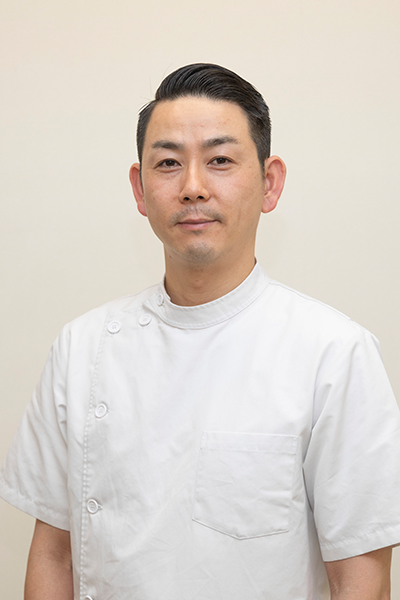
長引いた痛みを一人で治すのは困難なことが多いです。
困ったときは自身で判断せずに適切な処置を受けるために専門家に相談しましょう。
もし、お近くにお住まいで、困っているならば、一度ひまわり接骨院までお問い合わせください。腰痛・坐骨神経痛の専門家の新幡が、ご相談に乗ります。
気軽にご相談ください。

新着情報・お知らせ
平常通り営業致します。
日・祝休みです。
2026年9月のお休み
平常通り営業致します。
21日(月)~23(水)は祝日の為、
お休みになります。
日・祝休み
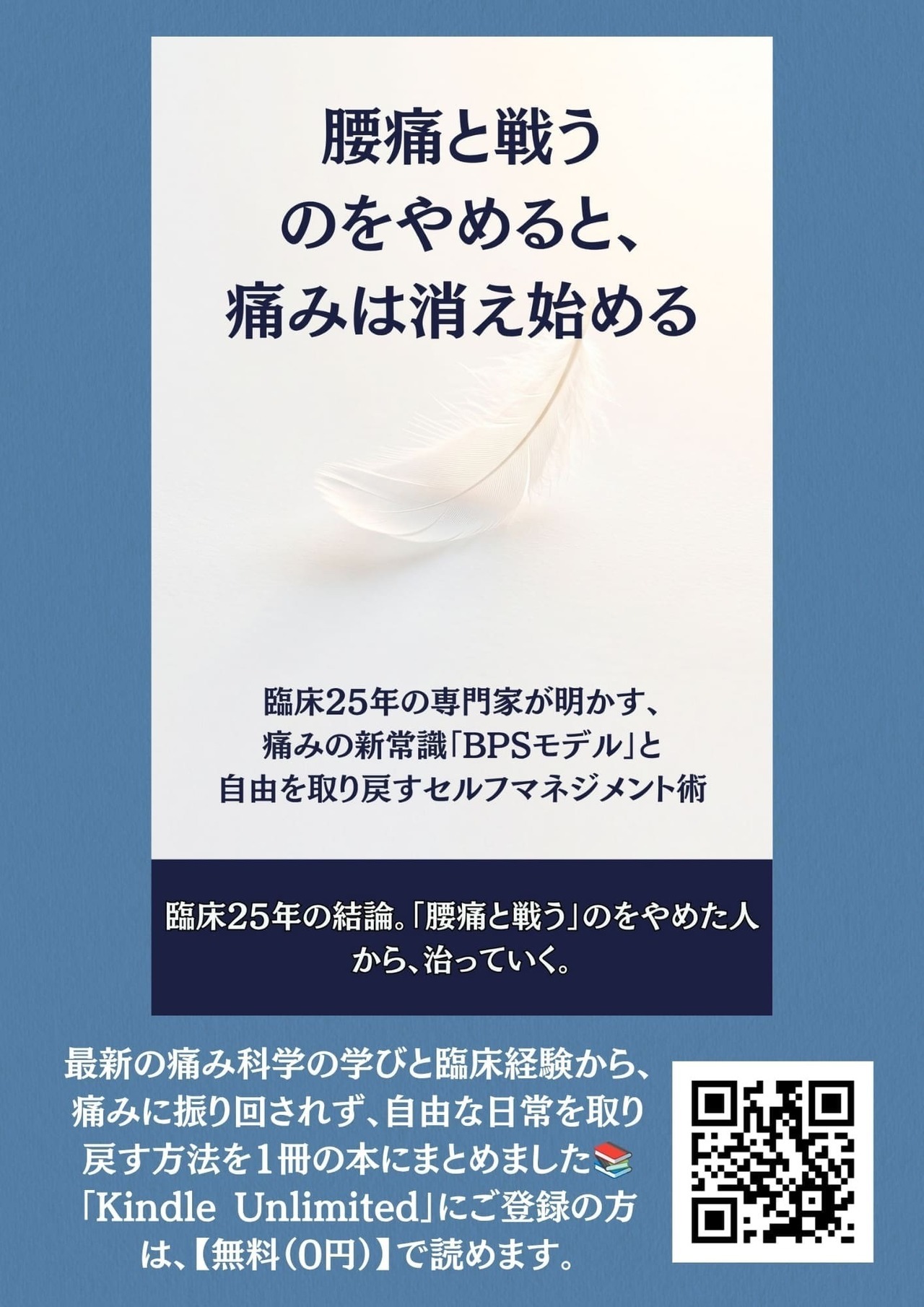
タイトル「腰痛は戦うのをやめると、痛みは消え始める」
Amazonの「Kindle Unlimited」にご登録の方は、【無料(0円)】で今すぐお読みいただけます!
↓↓
こちらから
タイトル「不安から逃げるのをやめると、腰痛は消え始める」」
Amazonの「Kindle Unlimited」にご登録の方は、【無料(0円)】で今すぐお読みいただけます!
↓↓
こちらから

お気軽にお問合せください

お電話でのお問合せ・相談予約
<受付時間>
月~土
9:00〜13:00 /15:00〜19:00
※日曜・祝日は除く
フォームは24時間受付中です。お気軽にご連絡ください。
ひまわり接骨院
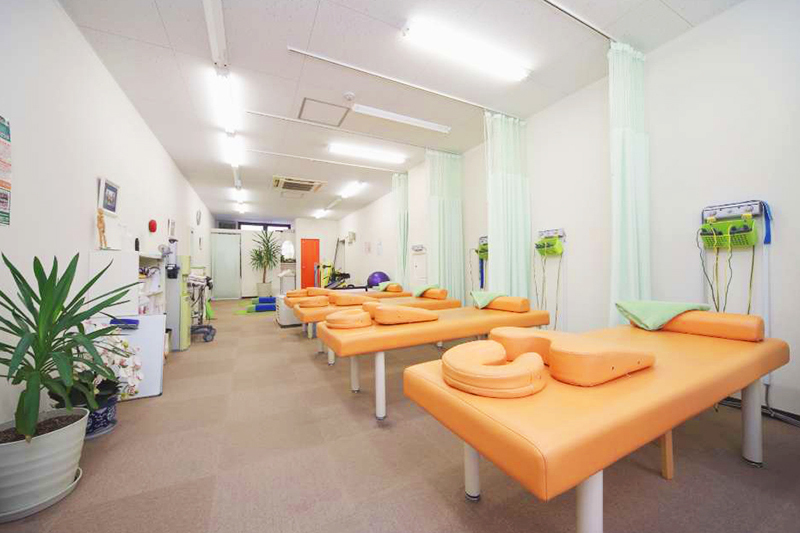
住所
〒213-0002
神奈川県川崎市高津区二子1丁目7−17 リバーサイドマンション杉崎 102
アクセス
二子新地駅 徒歩3分
駐車場:近隣にコインパーキングあり。自転車・バイクは店舗前に駐輪場がございます。
受付時間
月~土
9:00〜13:00 /15:00〜19:00
定休日
日曜・祝日