〒213-0002 神奈川県川崎市高津区二子1丁目7−17
リバーサイドマンション杉崎 102 二子新地駅 徒歩3分
| 月 | 火 | 水 | 木 | 金 | 土 | 日祝 | |
|---|---|---|---|---|---|---|---|
| 9:00〜13:00 | ● | ● | ● | ● | ● | ● | ─ |
| 15:00〜19:00 | ● | ● | ● | ● | ● | ● | ─ |
最新の腰部脊柱管狭窄症診療における国際的なコンセンサス:2026年
公開日:2026/08/15
更新日:2026/00/00
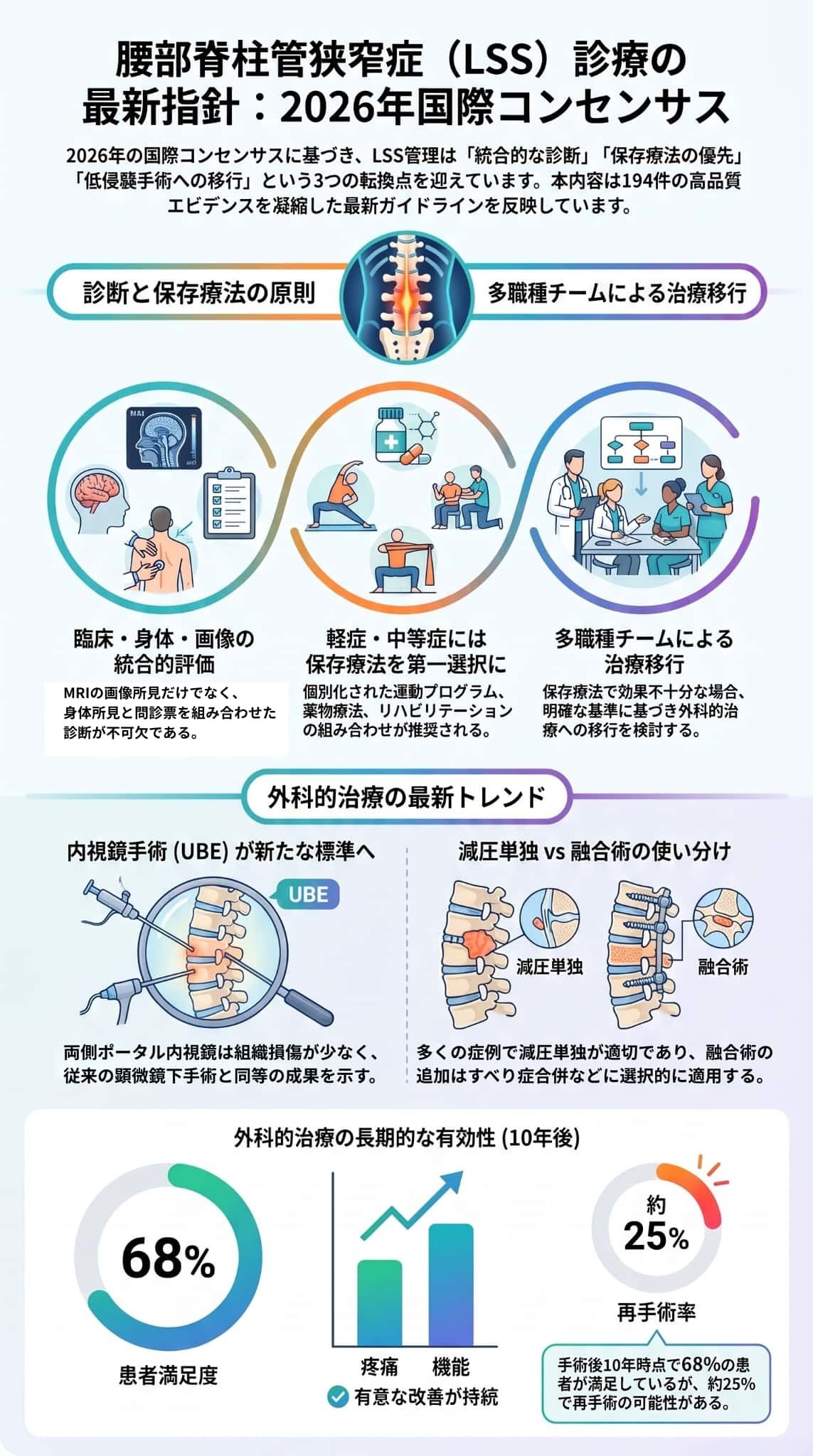
2026年の国際的コンセンサスに基づき、腰部脊柱管狭窄症(LSS)の最新の診断と治療に関するエビデンスを体系的にまとめた報告書です。
保存的治療が軽症から中等症の第一選択とされる一方で、抵抗性の症例には長期的な改善が見込める外科的減圧術が推奨されています。
特に、組織損傷を抑える両側ポータル内視鏡(UBE)などの低侵襲技術が新たな標準として高く評価されています。
また、議論の多い融合術の追加については、脊椎すべり症の有無や患者の年齢に応じて慎重に選択すべきであると結論づけています。
さらに、人工知能(AI)を活用した診断の自動化や、高齢者の併存疾患を考慮した個別化医療の重要性についても展望を示しています。臨床医が最新の知見に基づき、患者ごとに最適な意思決定を行うための包括的な指針となっています。
目次
**腰部脊柱管狭窄症(LSS)**の診療における2026年時点の最新コンセンサスおよび主要な知見は、診断プロトコルの高度化、低侵襲な内視鏡技術の確立、そして融合術(固定術)の個別最適化に要約されます。主な知見を領域別に整理します。
- 統合的評価の徹底と画像の限界: LSSの診断には、臨床症状、身体所見、画像所見(MRIなど)を統合して評価することが不可欠です。MRIは依然として診断の金標準ですが、画像上の狭窄レベルと実際の臨床症状の重症度は必ずしも一致しないため、慎重な相関評価が求められます。
- 診断ツールの実用化: 標準化された「診断支援ツール」や「自己記入式問診票」の活用が推奨されています。
- 人工知能(AI)の導入: MRI画像の解析における機械学習・深層学習を用いた自動診断技術が進歩しているほか、ChatGPTやDeepSeek、マルチモーダル深層学習を活用した意思決定や手術予測のモデル構築が進んでいます。
- 個別化プログラムと多職種連携: 軽度から中等度のLSS患者において、保存的治療が第一選択と位置づけられています。特に、個別化された運動プログラムに徒手療法や患者教育を組み合わせた、多職種チームによるアプローチが有効です。
- 疼痛管理(ASPNガイドライン2.0): 硬膜外ステロイド注射や神経根ブロックなどの低侵襲な介入的疼痛管理技術について、米国疼痛・神経科学会(ASPN)が最新の推奨基準(ベストプラクティスガイドライン2.0)を提示し、実臨床への適応が体系化されています。
- 長期的な有効性: 保存的治療に抵抗性の症候性LSSにおいて、外科的減圧術は長期的に優れた症状改善をもたらします。術後10年経過時点でも、約68%の患者が手術結果に満足していることが示されています。ただし、長期的には軽度の症状再燃が起こり得ることや、10年間で約25%(4分の1)の患者が再手術を必要とする点に留意が必要です。
- 内視鏡手術(特にUBE)の標準化: 両側ポータル内視鏡(UBE)技術は、従来の顕微鏡下手術と同等の良好な臨床成績と安全性を維持しながら、より低侵襲(出血量減少、入院期間短縮、早期回復)に手術を行える新たな標準治療として台頭しています。
- 合術の追加は慎重に、選択的に適用すべきであるというコンセンサスが強化されています。融合術を追加しても、長期的な機能的成績は減圧単独と同等であるとされています。
- すべり症合併例での意思決定: 変性脊椎すべり症を合併している場合、一般に融合術の役割が重要になりますが、65歳以上の高齢患者においては、合併症の少なさから減圧単独も極めて有効な選択肢になります。ただし、減圧単独を選択した場合は術後にすべり症が進行するリスクが大きく高まる(オッズ比: 8.63)ため、適応の慎重な見極めが必要です。
- 併存疾患の影響: うつ病や骨粗鬆症などの併存疾患は、外科治療後の予後に悪影響を及ぼす重要なリスク因子として指摘されています。
- 発育性腰部脊柱管狭窄症(DLSS): 多椎間狭窄を呈し、隣接椎間の再手術率が約21.7%と高いことが特徴的なこの病態に対しては、より厳格な診断と標準的アプローチの適用が求められています。
腰部脊柱管狭窄症(LSS)診療に関する研究が世界的に活発化し、2026年の国際コンセンサス形成に至った背景には、人口高齢化に伴う急激な疾患負担の増大、技術革新による診療パラダイムの大きな変化、そして外科的治療の選択肢(減圧単独 vs 固定術追加)を巡る長期的な議論があります。
- 世界規模での有病率の上昇: LSSは、高齢者における腰痛および下肢痛(坐骨神経痛や神経性間欠跛行)を引き起こす最も一般的な原因です。現在、世界中で推定1億300万人もの人々が罹患しており、有病率は60歳以上の高齢層で最も高くなります。
- 莫大な医療需要: 米国だけでも年間約60万件ものLSS外科手術が実施されており、超高齢社会の進展とともにその医療・経済的負担(疾患負担)は世界的に拡大し続けています。
- 他疾患との併存問題: 高齢患者では、膝や股関節の変形性関節症、無症候性の頸部脊髄圧迫といった他の骨関節変性疾患を高頻度で併存しており、これらが症状を複雑化させるため、包括的かつ全身的な評価基準の確立が求められてきました。
- 画像診断の限界とAIの必要性: MRIはLSS診断の金標準ですが、「画像上の狭窄の深刻さ」と「実際の臨床症状の重症度」が必ずしも一致しないという乖離が長年の課題でした。これを解決するため、近年は機械学習や深層学習を用いた画像診断の自動化、さらには生成AI(ChatGPTやDeepSeekなど)やマルチモーダル深層学習を用いた臨床的意思決定支援モデルの構築に関する研究が急速に進展しています。
- 低侵襲外科手術(内視鏡)の急速な台頭: 従来の開放椎弓切除術に代わり、組織への侵襲(ダメージ)を最小限に抑える技術が進化しました。特に「両側ポータル内視鏡(UBE)」や「単一ポータル内視鏡」は、従来の顕微鏡下手術と同等の良好な長期成績を維持しながら、出血量の減少や早期回復を可能にする画期的な選択肢として登場し、その標準化に向けた検証が強く求められてきました。
- 固定術(融合術)を追加すべきか: 外科治療において、狭窄した脊柱管を広げるだけの「減圧術」で十分なのか、それとも金属製インプラント等で骨を固定する「融合術(固定術)」を追加すべきかという問いは、LSS治療における最も議論の多いテーマの一つです。
- 長期成績と適応基準の再評価: 融合術は再手術率を低下させる可能性がある一方で、長期的な機能的成績は減圧単独と差がないとの報告もあり、不要な追加固定を減らすための選択基準(特に変性脊椎すべり症を併発した高齢患者などへの適応基準)の明確化が求められていました。
- これまで各国で診療ガイドラインが発行されてきましたが、エビデンスに基づく推奨事項が実臨床に十分に浸透しきれていない(適用にギャップがある)という現実が指摘されていました。そのため、2015年以降に蓄積された数多くの高品質なシステマティックレビューや臨床試験のエビデンスを網羅的に統合し、世界中の脊椎外科医やプライマリケア医が共通して利用できる明確な国際的コンセンサスを提示する必要がありました。
2026年の国際コンセンサス報告書に示されている、腰部脊柱管狭窄症(LSS)に関する最新の疫学知見を整理して解説します。人口高齢化を背景に、LSSは世界的に極めて大きな医療・社会課題となっています。
- 推定1億300万人以上の罹患者: LSSは、高齢者の腰痛や下肢痛を引き起こす最も一般的な原因であり、現在世界で推定1億300万人が罹患しているとされています。
- 年齢との強い相関: LSSの有病率は年齢とともに増加し、60歳以上の高齢層で最も高くなります。
- 外科的治療の需要増: 米国だけでも年間約60万件の外科手術が実施されており、超高齢社会の進展に伴って、社会的な疾患負担(経済的・医療インフラ的負担)は急速に増大し続けています。
- 膝・股関節変形性関節症の併存: LSS患者における膝または股関節の変形性関節症の併存が高頻度で報告されており、歩行障害や疼痛の要因が複数絡み合っている実態が示されています。
- 無症候性頸部脊髄圧迫の合併: 自覚症状がないものの、検査上は首の神経が圧迫されている「無症候性頸部脊髄圧迫」もLSS患者に高頻度で認められます。このため、腰だけでなく脊椎全体を包括的に評価することの重要性が高まっています。
- 進行性と変動性: 世界脳神経外科学会連盟(WFNS)の推奨等において、LSSは基本的に進行性の疾患であると再確認されています。ただし、その症状の重症度は時間とともに変動する性質(良くなったり悪くなったりを繰り返すなど)があることも疫学的に示されています。
- 生まれつきの狭窄(DLSS)に伴う高い再手術リスク: 生まれつき脊柱管が狭い「発育性腰部脊柱管狭窄症(DLSS)」の疫学的・臨床的特徴も整理されています。DLSSは複数の椎間で狭窄(多椎間狭窄)が起こりやすく、外科手術を行った場合でも、隣接する椎間の再手術率が約21.7%に達するなど、一般的な変性LSSと比較して高い再手術リスクを有することが分かっています。
2026年の国際コンセンサスにおいて、腰部脊柱管狭窄症(LSS)に対する**保存的治療(非手術的治療)は、特に軽度から中等度の患者における「第一選択(ファーストライン)」**として位置づけられています。
- 個別化された運動プログラム: 運動療法は保存的治療の基盤(中核)です。画一的なリハビリではなく、患者一人ひとりの病態や能力に合わせた**「個別化された運動プログラム」の提供**が強く推奨されています。
- 多角的な組み合わせ治療: 単一の運動を行うだけでなく、「運動療法」「徒手療法(マニュアルセラピー)」「患者教育プログラム」を組み合わせた多職種チームによる包括的アプローチが、より高い臨床効果をもたらすことが示されています。
- 薬物療法の選択肢: 日常的な疼痛コントロールとして、NSAIDs(非ステロイド性抗炎症薬)、神経障害性疼痛治療薬(ガバペンチノイド)、筋弛緩薬などが広く使用されています。また、カルシトニンの有効性についてもレビューによる評価が行われています。
- ASPN 2.0ガイドラインによる標準化: 保存的治療の中でペインクリニック領域として行われる硬膜外ステロイド注射や神経根ブロック、高周波熱凝固術などの介入的治療について、米国疼痛・神経科学会(ASPN)が「低侵襲LSS治療のベストプラクティスガイドライン2.0」を発表しました。これにより、どのような患者にどの技術を適用すべきかの詳細な基準が示されています。
- 補完治療のエビデンス: 鍼治療についての検証も進められていますが、現時点におけるエビデンスの質は限定的であると報告されています。
- 移行アルゴリズムの明確化: 保存的治療をどの程度の期間、どのように行い、効果不十分な場合にどの段階で手術を検討すべきかという**「保存的治療から外科的治療への移行基準」**が、国際デルファイ研究のコンセンサスや統合的チームアプローチを通じて体系的に明確化されています。これにより、適切な治療時期を逸することのない意思決定が可能になっています。
これまでにお伝えした治療方針の背景を踏まえ、外科的治療(減圧術)における最新のエビデンスとコンセンサスの詳細を解説します。
- 長期的な機能改善と満足度: 保存的治療に抵抗性を示す症候性のLSS患者に対し、外科的減圧術は長期にわたり優れた臨床成果をもたらします。術後10年経過時点の前向きフォローアップ研究では、約68%の患者が手術結果に満足しており、疼痛、機能障害、歩行能力の有意な改善が維持されていることが示されています。
- 長期的な症状変化と再手術率: ただし、術後3ヶ月時点と比較すると、5年・10年の長期経過において軽度の症状悪化(再燃)が認められる場合があり、10年間で約4分の1(25%)の患者が再手術を必要とする点に留意が必要です。
- 低侵襲技術の明確な利点: 組織損傷を最小限に抑える低侵襲減圧術(MID)は、多椎間LSSなどの複雑な症例においても従来の開放椎弓切除術と同等の臨床成績を達成します。さらに、開放椎弓切除術と比較して、出血量の減少や入院期間の短縮、早期回復といった具体的な優位性があります。
- 高齢患者への適応: 高齢のLSS患者に対しても、低侵襲腰椎減圧術は非常に良好な成績が得られることが報告されています。
内視鏡を用いた脊椎減圧術は、LSS治療における極めて革新的なアプローチとして急速に普及・発展しています。
- 両側ポータル内視鏡(UBE): 2つのポータルを用いるUBE技術は、従来の顕微鏡下手術や単一ポータル内視鏡と同等の良好な臨床成績と、低い合併症率を示しています。顕微鏡下減圧術との比較において、術後の疼痛スコア、機能障害指数の改善、および入院期間の短縮においてUBEが優れた成績を示すことも報告されています。また、UBEは視野が広く、複雑な症例に適している可能性が示唆されています。
- 単一ポータル内視鏡(UESS)との比較: 1つのポータルを用いる単一ポータル内視鏡(UESS)とUBEは、いずれも良好な臨床成績を示しますが、手術時間や技術獲得までの学習曲線において異なる特徴を持ちます。
- 完全内視鏡手術 vs 顕微鏡下手術: 完全内視鏡手術は、顕微鏡下脊椎減圧術と比較して、組織損傷が少ないため出血量が少なく、入院期間が短縮され、早期回復が可能であるという明確な利点が示されています。
- 減圧単独の優先: 多くの症例において減圧単独(インプラントによる固定を行わない手術)が適切であり、融合術(固定術)を追加しても長期的な機能的成績は向上しないため、融合術の追加は慎重に選択すべきであるという合意が強まっています。
- すべり症合併例における選択: 変性脊椎すべり症を合併している場合でも、65歳以上の高齢患者においては、合併症の少なさから減圧単独が優れた疼痛改善を示し、非常に有効な選択肢となります。ただし、減圧単独を選択した場合は、術後にすべり症が進行するリスクが大きく高まる(オッズ比: 8.63)ため、事前の慎重な適応評価が必要です。
腰部脊柱管狭窄症(LSS)の外科的治療において、**「減圧術に融合術(固定術)を追加すべきか」**という問いは、近年の脊椎外科における最も議論の多いテーマの一つです。
最新のメタアナリシスや臨床試験のエビデンスにより、融合術を追加することの長期的なメリットと限界が明確になっています。
- 機能的成績の同等性: 減圧術に融合術を追加しても、患者の長期的な機能的成績(歩行能力や日常生活の動作改善など)は、減圧単独手術を行った場合と同等であることが示されています。ランダム化比較試験(RCT)の5年経過を追った研究(Karlssonら)でも、両群間で臨床成績に有意な差は認められませんでした。
- 短期的な効果と長期的な収束: 融合術は短期的には優れた成績を示すことがありますが、長期的にはその差が縮小(減圧単独の成績に収束)していくことが報告されています。
- 再手術率の低下: 一方で、融合術を追加する明確なメリットは、長期的な再手術率を低下させられる点にあります。脊椎を固定することで、術後の不安定性や再狭窄による追加手術のリスクを抑えることができます。
背骨が前後にずれる「変性脊椎すべり症」を合併しているLSS患者に対しては、脊椎の不安定性が高いため、伝統的に融合術の追加が重視されてきました。しかし、最新のエビデンスは年齢や病態に応じたより細かなアプローチを推奨しています。
- 高齢患者における例外(減圧単独の優位性): 平均年齢65歳以上の高齢患者における「LSS + 軽度(低度)の脊椎すべり症」を対象としたメタアナリシスでは、減圧単独手術が3年以上の長期フォローアップにおいて優れた疼痛改善を示し、かつ周術期の合併症も少なかったと報告されています。
- すべり症進行リスクとのトレードオフ: ただし、高齢者に減圧単独を選択した場合には、**術後にすべり症がさらに進行するリスクが極めて高くなる(オッズ比:8.63)**という明確なトレードオフが存在します。このため、患者の活動性や骨の質、不安定性の程度を事前に厳格に評価することが不可欠です。
実際に融合術を適用すると判断された場合、より低侵襲で効果的な固定を行うためのさまざまな術式が比較・検証されています。
- 椎体間固定技術の多様化: 後方からアプローチする「後方腰椎椎体間固定術(PLIF)」のほか、近年では側前方からアクセスして筋肉へのダメージを最小限に抑える**「斜位腰椎椎体間固定術(OLIF)」**などの有用性が報告されており、重症LSSに対する治療選択肢として確立されつつあります。
- 間接減圧と直接減圧の比較: 脊椎の不安定性を伴う変性LSSに対して、神経を直接削って広げる「直接減圧+融合」と、インプラントを用いて骨の並びを整えることで間接的に神経の通り道を広げる**「間接減圧+融合」**の有効性についても比較検証が進められています。
2026年時点の推奨事項において、融合術は「一律に追加するもの」ではなく、**「再手術率の低減(融合のメリット)と、手術侵襲・合併症の抑制(減圧単独のメリット)を天秤にかけ、すべり症の有無や患者の年齢・全身状態に応じて個別最適化して適用するもの」**と再定義されています。
腰部脊柱管狭窄症(LSS)の外科的治療において、脊椎の自然な動きを保ちつつ神経の圧迫を取り除く**「可動性温存手術(motion-preserving surgery)」およびそれに用いられる「棘突起間デバイス(Interspinous Process Device: IPD)」**は、低侵襲治療の重要な選択肢として位置づけられています。
- 可動性を温存した低侵襲な減圧: IPDは、インプラントを用いて骨を完全に固定してしまう融合術(固定術)とは異なり、脊椎の可動性を温存しながら神経減圧を達成する技術として開発されました。 背骨を固定しないことで、隣接する椎間への過度な負担(隣接椎間障害)を防ぎつつ、低侵襲に間欠跛行などの症状を緩和することを狙いとしています。
最新のシステマティックレビューやメタアナリシスにより、IPDが「どのような位置づけにあるか」の科学的検証が進んでいます。
■「選択された患者」に対する有効性: Zhu らのメタアナリシスによると、IPDと一般的な減圧単独手術を比較した際、IPDは慎重に選択された特定の患者(適応を満たす患者)において有効である可能性が示されています。また、Xin らのランダム化比較試験(RCT)のメタアナリシスでも、棘突起間スペーサーと通常の減圧手術の有効性および安全性が比較・評価されています。
■減圧手術や固定術との比較:
- 減圧術との直接比較: LSSに対する一般的な減圧手術とIPDの成績比較(Tram らの研究)や、代表的なIPDである「X-stop」棘突起間牽引デバイスと従来の椎弓切除術の有効性比較(Ekhator らの研究)が行われています。
- 包括的な比較: Zhang らのベイジアンネットワークメタアナリシスでは、LSS治療における「減圧術」「融合術」「棘突起間デバイス」の3つの主要なアプローチが包括的に比較され、効果が評価されています。
- 固定術との比較: Al Khatib らのメタアナリシスでは、比較的侵襲の大きい「後方腰椎椎体間固定術(PLIF)」と、より低侵襲な「棘突起間安定化術」の比較が行われています。
- WFNS(世界脳神経外科学会連盟)による推奨: WFNS脊椎委員会は、LSSに対する可動性温存手術に関して個別の推奨事項(ステートメント)を発表しており、その適応や技術的な考慮事項を詳しく解説しています。
- 適切な使い分けの重要性: Merkow らの文献レビューで論じられているように、症候性LSSの管理において「低侵襲腰椎減圧術」と「IPD」のどちらを選択すべきかについては、各技術の役割と患者の病態(骨の安定性など)を厳格に評価することが治療成功のために不可欠です。
このように、棘突起間デバイス(IPD)を含む可動性温存手術は、低侵襲かつ脊椎の機能を維持する上で有用なオプションとなり得ますが、「どのような患者に適用すべきか(患者選択)」の厳格な見極めが極めて重要であるというのが、2026年現在の国際的な総意となっています。
腰部脊柱管狭窄症(LSS)に対する外科的治療後の長期予後(長期成績)と再手術率について、2026年の国際コンセンサスでは長期追跡データを統合した極めて重要な知見が示されています。
- 高水準な患者満足度と機能維持: 保存的治療に抵抗性を示したLSS患者に対する外科的減圧術は、長期にわたって優れた臨床成果を発揮します。10年間に及ぶ前向きフォローアップ研究によると、術後10年が経過した時点でも、約68%の患者が手術結果に満足しており、疼痛、身体機能障害、および歩行能力の有意な改善が長期的に維持されています。
- 中長期的な症状の変動: ただし、術後3ヶ月時点の最も改善した状態と比較すると、5年や10年といった超長期の経過において、軽度の症状悪化(再燃)が認められる傾向があります。
- 約25%(4分の1)の再手術率: 減圧手術を受けた患者は長期的に良好な経過をたどる一方で、術後10年間で約4分の1(25%)の患者が再手術を必要とする現実が明らかになっています。
- 融合術(固定術)追加による再手術の抑制: 減圧術に融合術を追加すべきかという議論において、システマティックレビューのデータは、融合術を追加することで長期の再手術率を低下させられることを示しています。
- 機能的成績の同等性: しかし、再手術率が下がる一方で、長期的な日常の機能的成績(QOLや歩行機能の改善度)自体は、減圧単独手術を行った場合と同等であり、臨床的な優位性に差はありません。このため、再手術を予防するメリットと、手術侵襲を抑えるメリットを天秤にかけ、慎重に術式を選択する必要があります。
- 変性脊椎すべり症を合併する高齢患者: 65歳以上のすべり症合併LSS患者において、合併症リスクの低さから減圧単独手術を選択した場合、3年以上の長期追跡でも良好な疼痛改善が得られますが、**術後にすべり症がさらに進行するリスクが極めて高くなる(オッズ比: 8.63)**ため、将来的な不安定性の再発に注意が必要です。
- 発育性腰部脊柱管狭窄症(DLSS): 生まれつき脊柱管が狭いDLSS患者では、複数の椎間で狭窄(多椎間狭窄)が起こりやすく、外科手術を行った場合でも隣接する椎間の再手術率が約21.7%と高いことが特徴的なリスクとして指摘されています。
2026年の国際コンセンサスにおいて、腰部脊柱管狭窄症(LSS)診療では、単に腰椎の局所的な病態を見るだけでなく、**患者が抱える併存疾患や特殊な身体的・精神的状況を考慮した「包括的アプローチ」**が極めて重視されています。
LSSは他の関節や脊椎の変性疾患と高い確率で合併(多疾患併存)することが分かっています。
- 膝・股関節の変形性関節症(OA): LSS患者における膝や股関節の変形性関節症の併存率は非常に高く、歩行障害や下肢痛の原因が複数絡み合っているケースが多いため、それぞれの疾患を切り分けた慎重な管理が必要です。
- 無症候性頸部脊髄圧迫: 本人の自覚症状がない段階であっても、検査をすると頸椎(首)の神経が圧迫されている割合がLSS患者において高いことが報告されています。このため、腰だけでなく脊椎全体(全脊椎)を包括的に評価することが推奨されています。
治療成績(予後)を左右する重要なリスク因子として、以下の併存疾患が特定されています。
- うつ病: うつ病などの精神的併存疾患は、LSS治療後の経過や予後に悪影響を及ぼす重要な予後影響因子として指摘されています。術前の精神医学的評価や適切な介入が、治療成功率を上げるために必要です。
- 骨粗鬆症: 骨の強度が低下する骨粗鬆症は、特に外科的治療(手術)時の周術期合併症(インプラントの設置不全や骨折など)のリスクを増加させる要因として、術前管理において重要な考慮事項となっています。
- タンデム脊柱管狭窄症(Tandem Spinal Stenosis): 頸椎と腰椎の両方に臨床的な狭窄病変を有する病態です。この場合、どちらの部位を優先して治療すべきか、あるいは「同時手術」と「段階的手術(時期をずらして行う手術)」のどちらを選択すべきかといった、より高度で特殊な治療戦略が求められます。
- 発育性腰部脊柱管狭窄症(DLSS): 生まれつき脊柱管が狭い骨格的特徴を持つ病態です。DLSSは、通常の加齢による変性LSSと比較して、広範囲な多椎間にわたる狭窄を呈しやすいことが特徴です。さらに、外科的治療を行った後も、隣接する椎間における再手術率が約21.7%に達するなど、予後の難しさも報告されており、診断および外科アプローチの標準化が強く求められています。
- 高齢患者への配慮: 高齢のLSS患者における外科治療は慎重を期しますが、組織を傷つけにくい低侵襲腰椎減圧術は、高齢患者に対しても十分に良好な成績が得られることが報告されています。
2026年の国際コンセンサス報告書(エグゼクティブサマリー)に基づき、腰部脊柱管狭窄症(LSS)における最新の国際的なガイドラインと推奨事項、およびそれらを取り巻く臨床コンセンサスの全体像を整理して解説します。
世界的な脳神経外科の統括組織であるWFNSの脊椎委員会は、LSSの包括的な管理を目的とした一連の重要な推奨事項(ステートメント)を発表しています。
- 多角的な個別推奨: 同委員会は、一律の治療ではなく、領域ごとに細分化した個別推奨を提供しています。具体的には、LSSの自然経過と診断、保存的治療と経皮的疼痛緩和技術、融合術(固定術)、さらに可動性温存手術 のそれぞれについて詳細な臨床基準を公表し、標準化を主導しています。
- ベストプラクティスガイドライン 2.0: ASPNは、低侵襲LSS治療に関する最新の推奨「ベストプラクティス2.0」を発表しています。ここでは、硬膜外ステロイド注射や神経根ブロックなどの介入的疼痛管理技術(ペインクリニック領域の手技)をどのような症例に適応し、いかに安全に実施すべきかについての具体的な推奨が示されています。
より客観的でブレのない診療を推進するため、複数の国際研究グループによる標準化の合意が形成されています。
- 治療経路の標準化(国際デルファイ研究): Comerらが主導したデルファイ調査により、LSS治療経路アルゴリズムの標準化に関する合意が確立されました。これは、**「いつ、どのような保存的治療を行い、どのタイミングで外科的治療(手術)へ移行すべきか」**という移行基準を明確化した点で画期的な臨床コンセンサスとなっています。
- アウトカム評価の標準化(国際タスクフォース): Andersonらが率いる国際腰部脊柱管狭窄症タスクフォースは、臨床効果を適切に評価するための「臨床アウトカム測定に関するコンセンサス」を発表し、標準化された評価指標の活用を強く推奨しています。
主要国それぞれでも、エビデンスに基づいた独自の推奨アプローチが取りまとめられています。
- 日本(日本整形外科学会: JOA): JOAが策定した「腰部脊柱管狭窄症臨床診療ガイドライン2021(二次出版)」は、診断から治療選択に至るまでエビデンスベースの包括的な推奨を日本国内およびグローバルに向けて提供しています。
- イタリア(イタリア神経外科学会脊椎部門): コンセンサス会議を通じて、診断基準、治療アルゴリズム、さらには内視鏡手術を含む多様な外科的技術の選択に関する極めて実践的な指針を策定しています。
- チェコ共和国: 変性腰椎狭窄症とそれに伴う脊椎すべり症の外科的治療にフォーカスした、特化型の臨床診療ガイドラインを提示しています。
- 適用状況のばらつき: エビデンスに基づいた数多くの質の高い推奨が発表される一方で、Bozkurtらが行った国際的な調査により、これらの最新ガイドライン(推奨事項)が実臨床で実際に適用されている度合いには地域や医師によって差があり、推奨事項と実際の臨床行為との間に「ギャップ」が存在していることが報告されています。このギャップを埋め、いかに実臨床で標準治療を均一化していくかが、現在のグローバルな研究課題となっています。
2026年の国際コンセンサス(194件の高品質な文献・ガイドラインを統合したエグゼクティブサマリー)が示す、腰部脊柱管狭窄症(LSS)診療における最終的な科学的結論と主要推奨事項は、以下の6つのドメインに体系化されています。
- 多角的統合評価の徹底: 診断は、臨床症状、身体所見、および画像所見(MRIなど)を統合して行うことが不可欠であり、これらを切り離して評価すべきではありません。
- 画像と臨床症状の「不一致」の受容: MRI上の物理的な狭窄レベルの深刻さと、患者が実際に訴える症状の重症度は必ずしも相関しないため、慎重な相関評価が強く求められます。
- 自動診断技術(AI)の台頭: 機械学習や深層学習を用いたMRI画像解析の自動化が進んでおり、さらにChatGPTやDeepSeek、マルチモーダル深層学習などを活用した意思決定や手術予測の臨床応用が現実的な段階に達しています。
- 軽度〜中等度における第一選択: 症状が軽度から中等度のLSS患者において、保存的治療が治療の第一選択(ファーストライン)であることが確定しています。
- 個別化プログラム+組み合わせの有効性: 単一の治療ではなく、「個別化された運動プログラム」「徒手療法(リハビリ)」「患者教育プログラム」を組み合わせた、多職種チームによる包括的アプローチが最も高い効果をもたらします。
- 長期的な機能改善の確立: 保存的治療に抵抗性を示す症候性のLSS患者に対する外科的減圧術は、長期にわたり優れた臨床成果(疼痛緩和、歩行能力の改善など)を提供します。
- 低侵襲内視鏡手術(特にUBE)の台頭: 両側ポータル内視鏡(UBE)技術は、従来の顕微鏡下手術と同等の良好な臨床成績と安全性を維持しながら、より低侵襲(出血量減少、入院期間短縮、早期回復)に手術を行える新たな標準治療として確立されました。
■減圧単独の優先: 多くの症例において減圧単独手術が適切であり、一律に融合術を追加する必要はないという強い合意があります。融合術を追加しても、長期的な機能的改善度は減圧単独と同等です。
■メリットとデメリットの厳格なトレードオフ:
- メリット: 融合術は長期的な再手術率を低下させることができます。
- デメリット: 侵襲度が大きく、合併症リスクが高まります。
■すべり症合併例の判断: 変性脊椎すべり症を合併している場合でも、65歳以上の高齢患者においては、合併症の少なさから減圧単独が有効な選択肢となります。ただし、減圧単独を選択した場合は**術後にすべり症がさらに進行するリスクが極めて高くなる(オッズ比: 8.63)**ため、事前の不安定性評価が必須です。
- 68%の満足度持続: 外科的治療は10年間にわたって持続的な症状改善を提供し、術後10年時点でも68%の患者が治療結果に満足しています。
- 4分の1の再手術予測: ただし、術後3ヶ月時点の最良の状態に比べると超長期(5年・10年)では軽度の症状再燃がみられ、10年間で約25%(4分の1)の患者が何らかの再手術を必要とすることが科学的に明らかになっています。
- 予後影響因子の特定: 患者が抱える「うつ病」などの精神的疾患や「骨粗鬆症」、あるいは膝・股関節の「変形性関節症」などの併存疾患が、外科治療後の予後に直接的な悪影響を及ぼすため、これらの術前評価が成功の鍵を握ります。
- 診断基準や治療経路の標準化(国際デルファイ研究や国際タスクフォースによるアウトカムドメインの統一など)を進め、ガイドラインと実臨床の乖離(ギャップ)を埋めていくことが強く求められています。
[1] Franz Jooji Onishi et al. (2025). Efficacy and Safety of Unilateral Biportal Endoscopy Compared to Microscopic and Uniportal Approaches in Lumbar Spinal Stenosis: evidence from 25 studies. Jornal Brasileiro de Neurocirurgia. DOI: https://doi.org/10.22290/jbnc.2025.25081414
[2] M. Aminudin Aziz et al. (2024). Functional outcomes of open laminectomy, minimally invasive, and endoscopic biportal decompression surgery in lumbar stenosis: systematic review and meta-analysis. Edelweiss applied science and technology. DOI: https://doi.org/10.55214/25768484.v8i6.3982
[3] N/A (2022). Management of lumbar spinal stenosis: a systematic review and meta-analysis of rehabilitation, surgical, injection, and medication interventions. . DOI: https://doi.org/10.6084/m9.figshare.17714851.v1
[4] Fatih Özden et al. (2022). The effectiveness of physical exercise in patients with lumbar spinal stenosis: a systematic review. Sport Sciences for Health. DOI: https://doi.org/10.1007/s11332-022-00895-3
[5] Zeyan Liang et al. (2022). Clinical Evaluation of Surgery for Single‐Segment Lumbar Spinal Stenosis: A Systematic Review and Bayesian Network Meta‐Analysis. Orthopaedic Surgery. DOI: https://doi.org/10.1111/os.13269
[6] Mehmet Zileli et al. (2020). Natural course and diagnosis of lumbar spinal stenosis: WFNS Spine Committee recommendations. . DOI: https://doi.org/10.1016/J.WNSX.2020.100073
[7] André Bussières et al. (2021). Non-surgical interventions for lumbar spinal stenosis leading to neurogenic claudication: a clinical practice guideline. The Journal of Pain. DOI: https://doi.org/10.1016/J.JPAIN.2021.03.147
[8] K Asada et al. (). Effectiveness of physical therapy for pain and gait disturbance of patients with lumbar spinal stenosis: a systematic review with meta-analysis. .
[9] moataz labib et al. (2022). Effectiveness of Surgery for Degenerative Lumbar Spinal Stenosis: A Systematic Review. Al-Azhar International Medical Journal (Print). DOI: https://doi.org/10.21608/aimj.2022.144072.1989
[10] Magdy Gamal Abdelkader Youssef et al. (2024). A Systematic Review of Unilateral Biportal Endoscopic Spinal Surgery versus Uniportal Endoscopic Spinal Surgery in Lumbar Canal Stenosis: Clinical Results and Complications. QJM: An International Journal of Medicine. DOI: https://doi.org/10.1093/qjmed/hcae175.703
[11] Timothy R. Deer et al. (2022). Best practices for minimally invasive lumbar spinal stenosis treatment 2.0 (MIST): consensus guidance from the American Society of Pain and Neuroscience (ASPN). Journal of Pain Research. DOI: https://doi.org/10.2147/JPR.S355285
[12] Xuan-Wei Chen et al. (2022). Clinical Effectiveness of Conservative Treatments on Lumbar Spinal Stenosis: A Network Meta-Analysis. Frontiers in Pharmacology. DOI: https://doi.org/10.3389/fphar.2022.859296
[13] Wei Li et al. (2023). Different lumbar fusion techniques for lumbar spinal stenosis: a Bayesian network meta-analysis. BMC Surgery. DOI: https://doi.org/10.1186/s12893-023-02242-w
[14] Lingxiao Chen et al. (2024). Surgical interventions for degenerative lumbar spinal stenosis: a systematic review with network meta-analysis. BMC Medicine. DOI: https://doi.org/10.1186/s12916-024-03653-z
[15] Katja Plaskan et al. (2022). Effectiveness of exercise programs for symptomatic lumbar spinal stenosis: a systematic review. Kinesiologia Slovenica. DOI: https://doi.org/10.52165/kinsi.28.3.201-212
[16] Yijian Zhang et al. (2021). Which is the most effective treatment for lumbar spinal stenosis: Decompression, fusion, or interspinous process device? A Bayesian network meta-analysis.. Journal of orthopaedic translation. DOI: https://doi.org/10.1016/J.JOT.2020.07.003
[17] Tianyi Wang et al. (2024). Machine learning and deep learning for diagnosis of lumbar spinal stenosis: systematic review and meta-analysis. Journal of Medical Internet Research. DOI: https://doi.org/10.2196/54676
[18] Shuangwen Lv et al. (2024). Efficacy of Biportal Endoscopic Decompression for Lumbar Spinal Stenosis: A Meta-Analysis With Single-Arm Analysis and Comparative Analysis With Microscopic Decompression and Uniportal Endoscopic Decompression.. Operative Neurosurgery. DOI: https://doi.org/10.1227/ons.0000000000001097
[19] Kyu Bok Kang et al. (2022). Endoscopic spinal surgery (BESS and UESS) versus microscopic surgery in lumbar spinal stenosis: systematic review and meta-analysis. Global Spine Journal. DOI: https://doi.org/10.1177/21925682221083271
[20] Mehmet Zileli et al. (2020). Lumbar Spinal Stenosis Recommendations of World Federation of Neurosurgical Societies Spine Committee. . DOI: https://doi.org/10.1016/J.WNSX.2020.100080
[21] X Yang et al. (). Performance of artificial intelligence in diagnosing lumbar spinal stenosis: a systematic review and meta-analysis. .
[22] Bin Wang et al. (2022). Complications of unilateral biportal endoscopic spinal surgery for lumbar spinal stenosis: a systematic review of the literature and meta‐analysis of single‐arm Studies. Orthopaedic Surgery. DOI: https://doi.org/10.1111/os.13437
[23] Y Ogura et al. (). … malalignment after decompression surgery without corrective fusion procedure for lumbar spinal stenosis and its impact on clinical outcomes: A systematic review. .
[24] Brian Zhaojie Chin et al. (2024). Full-endoscopic versus microscopic spinal decompression for lumbar spinal stenosis: a systematic review & meta-analysis. The Spine Journal. DOI: https://doi.org/10.1016/j.spinee.2023.12.009
[25] Raymond Pranata et al. (2020). Biportal endoscopic spinal surgery versus microscopic decompression for lumbar spinal stenosis: a systematic review and meta-analysis. World Neurosurgery. DOI: https://doi.org/10.1016/J.WNEU.2020.02.151
[26] Salman Sharif et al. (2020). Fusion Surgery for Lumbar Spinal Stenosis: WFNS Spine Committee Recommendations. . DOI: https://doi.org/10.1016/J.WNSX.2020.100077
[27] Haiyang Cheng et al. (2024). Decompression alone or fusion in single-level lumbar spinal stenosis with spondylolisthesis? A systematic review and meta analysis. BMC Musculoskeletal Disorders. DOI: https://doi.org/10.1186/s12891-024-07641-5
[28] Christine Comer et al. (2023). Exercise treatments for lumbar spinal stenosis: A systematic review and intervention component analysis of randomised controlled trials. Clinical Rehabilitation. DOI: https://doi.org/10.1177/02692155231201048
[29] Maurizio Fornari et al. (2020). Conservative treatment and percutaneous pain relief techniques in patients with lumbar spinal stenosis: WFNS spine committee recommendations. . DOI: https://doi.org/10.1016/J.WNSX.2020.100079
[30] Carlo Ammendolia et al. (2022). Non-operative treatment for lumbar spinal stenosis with neurogenic claudication: an updated systematic review. BMJ Open. DOI: https://doi.org/10.1136/bmjopen-2021-057724
[31] S Patrekar et al. (). Comparative Clinical Outcomes of Non-surgical and Surgical Treatment Methods for Lumbar Canal Stenosis: A Systematic Review. .
[32] Ben Roitberg et al. (2020). Mobility-preserving surgery for lumbar spinal stenosis: WFNS Spine Committee recommendations. . DOI: https://doi.org/10.1016/J.WNSX.2020.100078
[33] Haijun Ma et al. (2021). Evaluation of effectiveness of treatment strategies for degenerative lumbar spinal stenosis: a systematic review and network meta-analysis of clinical studies. World Neurosurgery. DOI: https://doi.org/10.1016/J.WNEU.2021.06.016
[34] Guichande Duarte et al. (2025). The Role of Electrophysiological Workup in Lumbar Spinal Canal Stenosis (LSCS): A Systematic Review. . DOI: https://doi.org/10.5167/uzh-283230
[35] Marcus Kin Long Lai et al. (2020). A systematic review of developmental lumbar spinal stenosis. European Spine Journal. DOI: https://doi.org/10.1007/S00586-020-06524-2
[36] Christian Jaeger Cook et al. (2020). Systematic review of diagnostic accuracy of patient history, clinical findings, and physical tests in the diagnosis of lumbar spinal stenosis. European Spine Journal. DOI: https://doi.org/10.1007/S00586-019-06048-4
[37] R Cox et al. (). Effectiveness and Safety of the Minimally Invasive Lumbar Decompression (MILD) Procedure for Adults with Lumbar Spinal Stenosis: A Systematic Review. .
[38] Yue-peng Wang et al. (2023). Efficacy and safety of unilateral biportal endoscopy compared with microscopic decompression in the treatment of lumbar spinal stenosis: A systematic review and updated meta‑analysis. Experimental and Therapeutic Medicine. DOI: https://doi.org/10.3892/etm.2023.12008
[39] Rikke Krüger Jensen et al. (2020). Prevalence of lumbar spinal stenosis in general and clinical populations: a systematic review and meta-analysis. European Spine Journal. DOI: https://doi.org/10.1007/S00586-020-06339-1
[40] H Meng et al. (). … of unilateral biportal endoscopy and micro-endoscopic discectomy in the treatment of degenerative lumbar spinal stenosis: a systematic review and meta-analysis. .
[41] LU Guangqi et al. (). Interpretation of Best Practices for Minimally Invasive Lumbar Spinal Stenosis Treatment 2.0(MIST):Consensus Guidance from the American Society of Pain and Neuroscience(ASPN)in 2022. . DOI: https://doi.org/10.12114/j.issn.1007-9572.2023.0335
[42] Farzin Farahbakhsh et al. (2023). The prevalence of asymptomatic cervical spinal cord compression in individuals presenting with symptomatic lumbar spinal stenosis: a meta-analysis. Global Spine Journal. DOI: https://doi.org/10.1177/21925682231202776
[43] Gen Inoue (2023). The Essence of Clinical Practice Guidelines for Lumbar Spinal Stenosis, 2021: 4. Surgical Treatment. Spine surgery and related research. DOI: https://doi.org/10.22603/ssrr.2022-0209
[44] J Quach et al. (). Intervention Strategies for Individuals With Spinal Stenosis. .
[45] Yufei Niu et al. (2022). Unilateral Biportal Endoscopic Discectomy versus Microendoscopic Discectomy for the Treatment of Lumbar Spinal Stenosis: A Systematic Review and Meta-Analysis. Computational and Mathematical Methods in Medicine. DOI: https://doi.org/10.1155/2022/7667463
[46] Gianluca Ciardi et al. (2023). Rehabilitation Outcome Measures in Patients with Spinal Stenosis: A Literary Review. Physiologia. DOI: https://doi.org/10.3390/physiologia3030029
[47] Jennifer Tram et al. (2020). Decompression Surgery versus Interspinous Devices for Lumbar Spinal Stenosis: A Systematic Review of the Literature. Asian Spine Journal. DOI: https://doi.org/10.31616/ASJ.2019.0105
[48] N/A (2022). Effectiveness and safety of decompression alone versus decompression plus fusion for lumbar spinal stenosis with degenerative spondylolisthesis: a systematic review and meta-analysis. Annals of Translational Medicine. DOI: https://doi.org/10.21037/atm-22-2208
[49] Zechuan Yang et al. (2022). Comparative Effects and Safety of Full-Endoscopic Versus Microscopic Spinal Decompression for Lumbar Spinal Stenosis: A Meta-Analysis and Statistical Power Analysis of 6 Randomized Controlled Trials. Neurospine. DOI: https://doi.org/10.14245/ns.2244600.300
[50] Arwa Abdel-Fattah et al. (2022). 327 To Fuse or Not to Fuse: The Elderly Patient with Lumbar Stenosis and Low-Grade Spondylolisthesis. Systematic Review and Meta-Analysis of Randomised Controlled Trials. British Journal of Surgery. DOI: https://doi.org/10.1093/bjs/znac268.003
[51] Ifran Saleh et al. (2025). Important postoperative magnetic resonance imaging findings correlated with clinical outcomes to evaluate adequacy and success of decompression surgery–what radiologists need to know: a systematic review. Asian Spine Journal. DOI: https://doi.org/10.31616/asj.2025.0061
[52] Kai-Uwe Lewandrowski et al. (2022). A Differential Clinical Benefit Examination of Full Lumbar Endoscopy vs Interspinous Process Spacers in the Treatment of Spinal Stenosis: An Effect Size Meta-Analysis of Clinical Outcomes. The International Journal of Spine Surgery. DOI: https://doi.org/10.14444/8200
[53] Chukwuyem Ekhator et al. (2023). Effectiveness of X-stop Interspinous Distractor Device Versus Laminectomy for Treatment of Lumbar Stenosis: A Systematic Review and Meta-Analysis.. Cureus. DOI: https://doi.org/10.7759/cureus.37535
[54] Katie de Luca et al. (2022). Outcome domain and measurement instrument reporting in randomised controlled trials of interventions for lumbar spinal stenosis: A systematic review.. Journal of Orthopaedic & Sports Physical Therapy. DOI: https://doi.org/10.2519/jospt.2022.10879
[55] R. Kaiser et al. (2023). [Surgical Treatment of Degenerative Lumbar Stenosis and Spondylolisthesis: Clinical Practice Guideline].. Acta Chirurgiae Orthopaedicae Et Traumatologiae Cechoslovaca. DOI: https://doi.org/10.55095/achot2023/021
[56] Jiang et al. (2022). Uniportal Full-Endoscopic versus Minimally Invasive Decompression for Lumbar Spinal Stenosis: A Meta-analysis.. Journal of neurological surgery. Part A, Central European neurosurgery. DOI: https://doi.org/10.1055/s-0041-1739208
[57] Nan Su et al. (2023). Comparative efficacy of unilateral biportal endoscopy and micro-endoscopic discectomy in the treatment of degenerative lumbar spinal stenosis: a systematic review and meta-analysis. Journal of Orthopaedic Surgery and Research. DOI: https://doi.org/10.1186/s13018-023-04322-2
[58] Morales et al. (2024). Depression as a prognostic factor for lumbar spinal stenosis outcomes: a systematic review.. European spine journal : official publication of the European Spine Society, the European Spinal Deformity Society, and the European Section of the Cervical Spine Research Society. DOI: https://doi.org/10.1007/s00586-023-08002-x
[59] Kaen et al. (2023). Clinical outcomes of uniportal compared with biportal endoscopic decompression for the treatment of lumbar spinal stenosis: a systematic review and meta-analysis.. European spine journal : official publication of the European Spine Society, the European Spinal Deformity Society, and the European Section of the Cervical Spine Research Society. DOI: https://doi.org/10.1007/s00586-023-07660-1
[60] Fon-Yih Tsuang et al. (2024). Long-term reoperation rate and functional outcomes of fusion versus non-fusion surgery for lumbar spinal stenosis: a systematic review and meta-analysis. . DOI: https://doi.org/10.17605/osf.io/rbpn9
[61] Boutros et al. (2026). Posterior lumbar interbody fusion versus interspinous stabilization in lumbar spinal stenosis: a meta-analysis.. European journal of orthopaedic surgery & traumatology : orthopedie traumatologie. DOI: https://doi.org/10.1007/s00590-026-04871-2
[62] Costa et al. (2021). Degenerative Lumbar Spine Stenosis Consensus Conference: the Italian job. Recommendations of the Spinal Section of the Italian Society of Neurosurgery.. Journal of neurosurgical sciences. DOI: https://doi.org/10.23736/S0390-5616.20.05042-0
[63] Shen et al. (2021). Comparison Between Fusion and Non-Fusion Surgery for Lumbar Spinal Stenosis: A Meta-analysis.. Advances in therapy. DOI: https://doi.org/10.1007/s12325-020-01604-7
[64] Sharma et al. (2025). Minimally Invasive Decompression versus Open Laminectomy in Multilevel Lumbar Stenosis: A Systematic Review and Meta-Analysis.. World neurosurgery. DOI: https://doi.org/10.1016/j.wneu.2025.124031
[65] N/A (2023). SPINE: High heterogeneity and no significant differences in clinical outcomes of endoscopic foraminotomy vs fusion for lumbar foraminal stenosis: a meta-analysis. EFORT open reviews. DOI: https://doi.org/10.1530/eor-22-0093
[66] ZHOU Yanji et al. (). Systematic Review of the Spine Patient Outcome Research Trial for Patients with Lumbar Spinal Stenosis. . DOI: https://doi.org/10.12114/j.issn.1007-9572.2021.01.319
[67] Chengxi Zhu et al. (2024). Efficacy and safety of interspinous process device compared with alone decompression for lumbar spinal stenosis: A systematic review and meta-analysis. Medicine. DOI: https://doi.org/10.1097/md.0000000000038370
[68] Katsushi Takeshita (2023). The Essence of Clinical Practice Guidelines for Lumbar Spinal Stenosis, 2021: 3. Conservative Treatment. Spine surgery and related research. DOI: https://doi.org/10.22603/ssrr.2022-0081
[69] Jian-Hai Xin et al. (2023). Effectiveness and safety of interspinous spacer versus decompressive surgery for lumbar spinal stenosis: A meta-analysis of randomized controlled trials. Medicine. DOI: https://doi.org/10.1097/md.0000000000036048
[70] Kaike Lobo et al. (2025). Uniportal Versus Biportal Endoscopic Decompression for the Treatment of Lumbar Spinal Stenosis: A Systematic Review and Updated Meta-Analysis.. Global Spine Journal. DOI: https://doi.org/10.1177/21925682251339999
[71] Carlo Ammendolia et al. (2022). 82. Nonoperative treatment for lumbar spinal stenosis with neurogenic claudication: an updated systematic review. The Spine Journal. DOI: https://doi.org/10.1016/j.spinee.2022.06.100
[72] Haoxiang Zhuang et al. (2023). Unilateral biportal endoscopic spine surgery for lumbar spinal stenosis: a systematic review and meta-analysis.. European Review for Medical and Pharmacological Sciences. DOI: https://doi.org/10.26355/eurrev_202306_32617
[73] Kawakami et al. (2023). Japanese Orthopaedic Association (JOA) clinical practice guidelines on the management of lumbar spinal stenosis, 2021 - Secondary publication.. Journal of orthopaedic science : official journal of the Japanese Orthopaedic Association. DOI: https://doi.org/10.1016/j.jos.2022.03.013
[74] N/A (2025). Minimally Invasive Full-Endoscopic Decompression for Lumbar Spinal Stenosis: A Systematic Review and Meta-Analysis. . DOI: https://doi.org/10.21203/rs.3.rs-8066216/v1
[75] Kiavash Sajadi et al. (2022). Long-Term Outcomes of Laminectomy in Lumbar Spinal Stenosis: A Systematic Review and Meta-Analysis. Asian journal of neurosurgery. DOI: https://doi.org/10.1055/s-0042-1756421
[76] Federico Temporiti et al. (2022). Efficacy and characteristics of physiotherapy interventions in patients with lumbar spinal stenosis: a systematic review. European Spine Journal. DOI: https://doi.org/10.1007/s00586-022-07222-x
[77] N/A (2022). Endoscopic decompression for the treatment of lumbar spinal stenosis: an updated systematic review and meta-analysis. Journal of neurosurgery. DOI: https://doi.org/10.3171/2021.8.spine21890
[78] Kun Wu et al. (2024). Comparative effects of different posterior decompression techniques for lumbar spinal stenosis: a systematic review and Bayesian network meta-analysis. Journal of Orthopaedic Surgery and Research. DOI: https://doi.org/10.1186/s13018-024-04792-y
[79] Sh Kh Gizatullin et al. (2022). Comparison of endoscopic and open methods of surgical treatment for lumbosacral spinal canal stenosis: a systematic literature review. Hirurgiâ pozvonočnika. DOI: https://doi.org/10.14531/ss2022.1.46-55
[80] David B. Anderson et al. (2020). WITHDRAWN: A critical appraisal of clinical practice guidelines for the treatment of lumbar spinal stenosis. . DOI: https://doi.org/10.1016/J.XNSJ.2020.100008
[81] Gadjradj et al. (2023). Decompression alone versus decompression with fusion in patients with lumbar spinal stenosis with degenerative spondylolisthesis: a systematic review and meta-analysis.. European spine journal : official publication of the European Spine Society, the European Spinal Deformity Society, and the European Section of the Cervical Spine Research Society. DOI: https://doi.org/10.1007/s00586-022-07507-1
[82] Yu Zhang et al. (2025). Comparison of unilateral biportal endoscopic decompression and percutaneous endoscopic lumbar decompression for single-level degenerative lumbar spinal stenosis: a systematic review and meta-analysis. Journal of Orthopaedic Surgery and Research. DOI: https://doi.org/10.1186/s13018-025-06338-2
[83] Moshiur Rahman et al. (2022). Surgical Decompression for Lumbar Spinal Stenosis; Systematic Review and Meta-analysis. Bangladesh journal of neurosurgery. DOI: https://doi.org/10.3329/bjns.v11i1.57991
[84] Feng et al. (2026). Uniportal Endoscopic Versus Microscopic Unilateral Laminotomy for Bilateral Decompression in the Treatment of Lumbar Spinal Stenosis: A Meta-Analysis.. Neurology India. DOI: https://doi.org/10.4103/neurol-india.Neurol-India-D-25-00298
[85] Pen-Ju Huang et al. (2022). Decompression versus decompression plus fusion for treating degenerative lumbar spinal stenosis: A systematic review and meta‐analysis. Pain Practice. DOI: https://doi.org/10.1111/papr.13193
[86] Ahmed Sabry shaaban et al. (2022). Treatment of Lumbar Spinal Stenosis in Elderly Patients: Systematic Review. Al-Azhar University Journal of Virus Researches and Studies. DOI: https://doi.org/10.21608/aujv.2022.277115
[87] Sheng Tang et al. (2021). Comparison of clinical and radiological outcomes of full-endoscopic versus microscopic lumbar decompression laminectomy for the treatment of lumbar spinal stenosis: a systematic review and meta-analysis. Annals of palliative medicine. DOI: https://doi.org/10.21037/APM-21-198
[88] Yongjia Yu et al. (2025). Efficacy of unilateral biportal endoscopy vs. unilateral portal endoscopy for the treatment of lumbar spinal stenosis: a systematic review and meta-analysis. Frontiers in Surgery. DOI: https://doi.org/10.3389/fsurg.2025.1604335
[89] Martín Gagliardi et al. (2022). Is Indirect Decompression and Fusion More Effective than Direct Decompression and Fusion for Treating Degenerative Lumbar Spinal Stenosis With Instability? A Systematic Review and meta-Analysis. Global Spine Journal. DOI: https://doi.org/10.1177/21925682221098362
[90] Amandine Bays et al. (2021). The influence of comorbidities on the treatment outcome in symptomatic lumbar spinal stenosis: A systematic review and meta-analysis. . DOI: https://doi.org/10.1016/J.XNSJ.2021.100072
[91] Fei-Long Wei et al. (2021). Management for lumbar spinal stenosis: a network meta-analysis and systematic review. International Journal of Surgery. DOI: https://doi.org/10.1016/J.IJSU.2020.11.014
[92] Mishra et al. (2023). Effect of Lumbar Discectomy or Lumbar Decompression on Axial Back Pain: Results of a Meta-Analysis.. World neurosurgery. DOI: https://doi.org/10.1016/j.wneu.2023.06.064
[93] JC Acevedo‐Gonzalez et al. (). Efficacy and Safety of the Use of Interspinous Spacers in the Treatment of Lumbar Spinal Stenosis: Mapping Gap and Scoping Review. .
[94] Nagy Mekhail et al. (2020). The Impact of Age on the Outcomes of Minimally Invasive Lumbar Decompression for Lumbar Spinal Stenosis. Medical Devices : Evidence and Research. DOI: https://doi.org/10.2147/MDER.S251556
[95] Miho Sekiguchi (2023). The Essence of Clinical Practice Guidelines for Lumbar Spinal Stenosis, 2021: 1. Definition, Epidemiology, and Natural History. Spine surgery and related research. DOI: https://doi.org/10.22603/ssrr.2022-0079
[96] A. Clark et al. (2022). Acupuncture and Spinal Stenosis: Considerations for Treatment.. . DOI: https://doi.org/10.14218/fim.2022.00010
[97] Fei-Long Wei et al. (2020). Management for lumbar spinal stenosis: Protocol for a network meta-analysis and systematic review.. Journal of orthopaedic surgery (Hong Kong). DOI: https://doi.org/10.1177/2309499020975212
[98] John M. Leschke et al. (2021). Supplementing decompression with instrumented fusion for symptomatic lumbar spinal stenosis-a critical appraisal of available randomized controlled trials.. Neurosurgical Review. DOI: https://doi.org/10.1007/S10143-020-01270-X
[99] Carmel Armon et al. (2025). Epidural steroids for cervical and lumbar radicular pain and spinal stenosis systematic review summary: report of the AAN guidelines subcommittee. Neurology. DOI: https://doi.org/10.1212/wnl.0000000000213361
[100] Lu et al. (2024). Effects of calcitonin on lumbar spinal stenosis.. Archives of orthopaedic and trauma surgery. DOI: https://doi.org/10.1007/s00402-024-05260-2
[101] James J. Young et al. (2022). Prevalence of multimorbid degenerative lumbar spinal stenosis with knee or hip osteoarthritis: a systematic review and meta-analysis. BMC Musculoskeletal Disorders. DOI: https://doi.org/10.1186/s12891-022-05104-3
[102] Brittany A. Oster et al. (2020). Systematic Review of Outcomes following 10-year Mark of Spine Patient Outcomes Research Trial (SPORT) for Spinal Stenosis. Spine. DOI: https://doi.org/10.1097/BRS.0000000000003323
[103] Hutchins et al. (2022). A systematic review of validated classification systems for cervical and lumbar spinal foraminal stenosis based on magnetic resonance imaging.. European spine journal : official publication of the European Spine Society, the European Spinal Deformity Society, and the European Section of the Cervical Spine Research Society. DOI: https://doi.org/10.1007/s00586-022-07147-5
[104] C Comer et al. (2022). Consensus on a standardised treatment pathway algorithm for lumbar spinal stenosis: an international Delphi study. . DOI: https://doi.org/10.21203/rs.3.rs-1251817/v1
[105] Rikke Krüger Jensen et al. (2020). Diagnostic screening for lumbar spinal stenosis. Clinical Epidemiology. DOI: https://doi.org/10.2147/CLEP.S263646
[106] Christy Tomkins-Lane et al. (2020). Diagnostic tests in the clinical diagnosis of lumbar spinal stenosis: Consensus and Results of an International Delphi Study. European Spine Journal. DOI: https://doi.org/10.1007/S00586-020-06481-W
[107] A Antony et al. (2022). Perspective: a proposed diagnostic and treatment algorithm for management of lumbar spinal stenosis: an integrated team approach. .
[108] Thomas Karlsson et al. (2024). Decompression alone or decompression with fusion for lumbar spinal stenosis: five-year clinical results from a randomized clinical trial. Bone and Joint. DOI: https://doi.org/10.1302/0301-620x.106b7.bjj-2023-1160.r2
[109] David B. Anderson et al. (2024). Clinical assessment and management of lumbar spinal stenosis: clinical dilemmas and considerations for surgical referral. The Lancet Rheumatology. DOI: https://doi.org/10.1016/s2665-9913(24)00028-6
[110] Byung Ho Lee et al. (2020). Lumbar Spinal Stenosis: Pathophysiology and Treatment Principle: A Narrative Review.. Asian Spine Journal. DOI: https://doi.org/10.31616/ASJ.2020.0472
[111] Luiz Claudio Lacerda Rodrigues et al. (2021). Surgical treatment for lumbar spinal stenosis: a single-blinded randomized controlled trial. . DOI: https://doi.org/10.1186/S42358-021-00184-6
[112] Ryoji Tominaga et al. (2022). Diagnostic accuracy of the lumbar spinal stenosis-diagnosis support tool and the lumbar spinal stenosis-self-administered, self-reported history questionnaire. PLOS ONE. DOI: https://doi.org/10.1371/journal.pone.0267892
[113] N/A (2022). Lumbar Spinal Stenosis. JAMA. DOI: https://doi.org/10.1001/jama.2022.6137
[114] Hongjie Yuan et al. (2023). Lumbar spinal stenosis and minimally invasive lumbar decompression: a narrative review. Journal of Pain Research. DOI: https://doi.org/10.2147/jpr.s428112
[115] David Anderson et al. (2025). Consensus on clinical outcome measures for lumbar spinal stenosis: recommendations from the ISSLS lumbar spinal stenosis taskforce. European Spine Journal. DOI: https://doi.org/10.1007/s00586-025-09343-5
[116] Tomoyuki Tanaka et al. (2025). Impact of osteoporosis on perioperative complications in patients undergoing surgical treatment for lumbar spinal stenosis: a nationwide retrospective study. Asian Spine Journal. DOI: https://doi.org/10.31616/asj.2025.0059
[117] Dawid Sobański et al. (2023). Presentation, diagnosis, and management of lower back pain associated with spinal stenosis: a narrative review. Medical Science Monitor. DOI: https://doi.org/10.12659/MSM.939237
[118] Fabrice Mallard et al. (2021). Lumbar spinal epidural lipomatosis: A case report and review of the literature. International Journal of Surgery Case Reports. DOI: https://doi.org/10.1016/J.IJSCR.2020.11.128
[119] Zhide Liu et al. (2025). Clinical efficacy of AUSS/UNSES-TLIF in the treatment of single-segment degenerative lumbar spinal stenosis: a retrospective study. Journal of Orthopaedic Surgery and Research. DOI: https://doi.org/10.1186/s13018-025-05779-z
[120] Xiaofeng Liu et al. (2025). Long-Term Prognosis of Surgical and Non-Surgical Treatment for Lumbar Spinal Stenosis: A Retrospective Cohort Study. Journal of Pain Research. DOI: https://doi.org/10.2147/jpr.s550063
[121] Ji Won Kwon et al. (2022). Lumbar spinal stenosis: review update 2022. Asian Spine Journal. DOI: https://doi.org/10.31616/asj.2022.0366
[122] Rami Rajjoub et al. (2023). ChatGPT and its role in the decision-making for the diagnosis and treatment of lumbar spinal stenosis: a comparative analysis and narrative review. Global Spine Journal. DOI: https://doi.org/10.1177/21925682231195783
[123] Jordan Perring et al. (2020). Analysis of patterns of gait deterioration in patients with lumbar spinal stenosis. World Neurosurgery. DOI: https://doi.org/10.1016/J.WNEU.2020.04.146
[124] Madison Lostra (2020). The Challenges Of Exercise Selection For A Post-Operative Patient With Severe Deconditioning And Longstanding Neurogenic Claudication: A Case Report. .
[125] Kashif N Malik et al. (2023). Pain Management Interventions in Lumbar Spinal Stenosis: A Literature Review. Cureus. DOI: https://doi.org/10.7759/cureus.44116
[126] Iina Tuomainen et al. (2020). Unfolding the outcomes of surgical treatment of lumbar spinal stenosis—a prospective 5- and 10-year follow-up study. European Spine Journal. DOI: https://doi.org/10.1007/S00586-020-06424-5
[127] Yousif Sharaf (2023). Posterolateral Fusion Surgery with Decompression: An Effective Treatment Option for Lumbar Spinal Stenosis. . DOI: https://doi.org/10.58624/svoaor.2023.03.036
[128] Dimitriou et al. (2023). A Simple Preoperative Score Predicting Failure Following Decompression Surgery for Degenerative Lumbar Spinal Stenosis.. Spine. DOI: https://doi.org/10.1097/BRS.0000000000004584
[129] Dong Ho Kang et al. (2022). Probability for surgical treatment in patients with lumbar spinal stenosis according to the stenotic lesion severity: a 5–10-year follow-up study. BMC Musculoskeletal Disorders. DOI: https://doi.org/10.1186/s12891-022-05510-7
[130] Arjun Sharma et al. (2020). SIZE study: study protocol of a multicentre, randomised controlled trial to compare the effectiveness of an interarcuair decompression versus extended decompression in patients with intermittent neurogenic claudication caused by lumbar spinal stenosis.. BMJ open. DOI: https://doi.org/10.1136/bmjopen-2020-036818
[131] Sérgio Afonso Hennemann et al. (2021). Degenerative Lumbar Spinal Stenosis. Revista Brasileira De Ortopedia. DOI: https://doi.org/10.1055/S-0040-1712490
[132] Feng et al. (2025). Unilateral biportal endoscopic versus microscopic discectomy in degenerative lumbar spinal stenosis: A prospective cohort study.. Medicine. DOI: https://doi.org/10.1097/MD.0000000000042594
[133] Ahmed Reda Aldahshory et al. (2020). Comparative Study of Minimally Invasive Lumbar Decompression versus Decompressive Laminectomy with Posterolateral Transpedicular Fixation for the Treatment of Degenerative Lumbar Canal Stenosis.. Asian journal of neurosurgery. DOI: https://doi.org/10.4103/AJNS.AJNS_132_20
[134] Rikke Krüger Jensen et al. (2024). Pain trajectories over 12 months following conservative care consultation in patients with lumbar spinal stenosis. BMC Research Notes. DOI: https://doi.org/10.1186/s13104-024-06840-6
[135] Prentzas et al. (2024). Manual therapists' appraisal of optimal non-pharmacological conservative management of patients with lumbar spinal stenosis. An international Delphi study.. Journal of bodywork and movement therapies. DOI: https://doi.org/10.1016/j.jbmt.2024.04.038
[136] Du et al. (2022). Endoscopic modified total laminoplasty for symptomatic lumbar spinal stenosis.. The journal of spinal cord medicine. DOI: https://doi.org/10.1080/10790268.2020.1762827
[137] Mostafa Abdellatif et al. (2023). Minimally Invasive 360 Degrees Decompression for Ligamentous, Bony and Discogenic Lumbar Canal Stenosis. Open Journal of Modern Neurosurgery. DOI: https://doi.org/10.4236/ojmn.2023.133013
[138] Konovalov et al. (2021). [Degenerative lumbar spine stenosis: minimally invasive microsurgical methods of treatment].. Zhurnal voprosy neirokhirurgii imeni N. N. Burdenko. DOI: https://doi.org/10.17116/neiro20218504187
[139] Pazarlis et al. (2022). Lumbar Spinal Stenosis with Degenerative Spondylolisthesis Treated with Decompression Alone. A Cohort of 346 Patients at a Large Spine Unit. Clinical Outcome, Complications and Subsequent Surgery.. Spine. DOI: https://doi.org/10.1097/BRS.0000000000004291
[140] Justin Merkow et al. (2020). Minimally Invasive Lumbar Decompression and Interspinous Process Device for the Management of Symptomatic Lumbar Spinal Stenosis: a Literature Review.. Current Pain and Headache Reports. DOI: https://doi.org/10.1007/S11916-020-0845-2
[141] Li et al. (2025). Therapy Potential of Oblique Lumbar Interbody Fusion 360 for Severe Lumbar Spinal Stenosis.. Orthopaedic surgery. DOI: https://doi.org/10.1111/os.14363
[142] Kang Taek Lim et al. (2020). Inside-Out Approach of Lumbar Endoscopic Unilateral Laminotomy for Bilateral Decompression: A Detailed Technical Description, Rationale and Outcomes.. . DOI: https://doi.org/10.14245/NS.2040196.098
[143] Lee et al. (2026). Deep learning models for lumbar spinal stenosis on MRI: model comparison and clinical benchmarking.. European spine journal : official publication of the European Spine Society, the European Spinal Deformity Society, and the European Section of the Cervical Spine Research Society. DOI: https://doi.org/10.1007/s00586-025-09443-2
[144] McCabe et al. (2021). Does country of origin influence research outcomes in operative interventions for lumbar spinal stenosis?. European spine journal : official publication of the European Spine Society, the European Spinal Deformity Society, and the European Section of the Cervical Spine Research Society. DOI: https://doi.org/10.1007/s00586-020-06691-2
[145] Jakob M Burgstaller et al. (2020). Long-term results after surgical or non-surgical treatment in patients with degenerative lumbar spinal stenosis: a prospective multi-center study. Spine. DOI: https://doi.org/10.1097/BRS.0000000000003457
[146] Shokhrukh Arzikulov (2023). Lumbar spinal stenosis: understanding symptoms, causes, diagnosis, and treatment options. . DOI: https://doi.org/10.37547/supsci-ojmp-03-05-05
[147] Olivia E. Gilbert et al. (2022). Decompression and Interlaminar Stabilization for Lumbar Spinal Stenosis: A Cohort Study and Two-Dimensional Operative Video. Medicina. DOI: https://doi.org/10.3390/medicina58040516
[148] Daniel R. Cavazos et al. (2023). Neuroforaminal Stenosis in the Lumbosacral Spine: A Scoping Review of Pathophysiology, Clinical Manifestations, Diagnostic Imaging, and Treatment. Spartan medical research journal. DOI: https://doi.org/10.51894/001c.87848
[149] Wenbin Hua et al. (2020). Comparison of lumbar endoscopic unilateral laminotomy bilateral decompression and minimally invasive surgery transforaminal lumbar interbody fusion for one-level lumbar spinal stenosis. BMC Musculoskeletal Disorders. DOI: https://doi.org/10.1186/S12891-020-03820-2
[150] Zhang et al. (2025). Generative AI in degenerative lumbar spinal stenosis care: A NASS guideline-compliant comparative analysis of ChatGPT and DeepSeek.. Journal of orthopaedic surgery (Hong Kong). DOI: https://doi.org/10.1177/10225536251407382
[151] Manuela L. Ferreira et al. (2022). Review of the diagnosis and management of lumbar spinal stenosis. JAMA. DOI: https://doi.org/10.1001/jama.2022.11378
[152] James J. Young et al. (2020). Prevalence of multimorbid degenerative lumbar spinal stenosis with knee and/or hip osteoarthritis: protocol for a systematic review and meta-analysis. Systematic Reviews. DOI: https://doi.org/10.1186/S13643-020-01478-4
[153] Q Lin et al. (). Evaluating Large Language Model Performance in Lumbar Spinal Stenosis Management: Alignment with Clinical Guidelines on Neurogenic Claudication. .
[154] Martínez et al. (2023). Efficacy and safety of pregabalin and gabapentin in spinal stenosis: a systematic review and meta-analysis.. Frontiers in pharmacology. DOI: https://doi.org/10.3389/fphar.2023.1249478
[155] Zoe E. Zimmerman et al. (2022). Diagnosis and management of lumbar spinal stenosis: a review. JAMA. DOI: https://doi.org/10.1001/jama.2022.5921
[156] J Yang et al. (). … with clinical symptoms and surgical outcomes of dural sac cross-sectional area, nerve root sedimentation sign and morphological grade for lumbar spinal stenosis. .
[157] Christian J Rajkovic et al. (2024). Conservative management of spinal pathology with autologous conditioned serum: a systematic review of the literature. World journal of orthopedics. DOI: https://doi.org/10.5312/wjo.v15.i9.870
[158] Janny Mathieu et al. (2023). Diagnosis Value of Patient Evaluation Components Applicable in Primary Care Settings for the Diagnosis of Low Back Pain: A Scoping Review of Systematic Reviews. Stomatology. DOI: https://doi.org/10.3390/jcm12103581
[159] Jujjavarapu et al. (2023). Predicting decompression surgery by applying multimodal deep learning to patients' structured and unstructured health data.. BMC medical informatics and decision making. DOI: https://doi.org/10.1186/s12911-022-02096-x
[160] Qingsong Yu et al. (2023). Effect of the preoperative assessment of the anteroposterior diameters of the spinal canal and dural area on the efficacy of oblique lumbar interbody fusion in patients with lumbar spinal stenosis. Journal of Orthopaedic Surgery and Research. DOI: https://doi.org/10.1186/s13018-023-03913-3
[161] Ahorukomeye et al. (2022). Outcomes in surgical treatment for tandem spinal stenosis: systematic literature review.. The spine journal : official journal of the North American Spine Society. DOI: https://doi.org/10.1016/j.spinee.2022.07.088
[162] Lu et al. (2023). Meta-Analysis of Simultaneous versus Staged Decompression of Stenotic Regions in Patients with Tandem Spinal Stenosis.. World neurosurgery. DOI: https://doi.org/10.1016/j.wneu.2022.11.028
[163] Jana Kogler (2023). The Effect od Epidurolysis in Treatment of Low Back Pain – An Evidence Based Review. Acta Clinica Croatica. DOI: https://doi.org/10.20471/acc.2023.62.s4.7
[164] Akram M. Awadalla et al. (2023). Management of lumbar disc herniation: a systematic review. Cureus. DOI: https://doi.org/10.7759/cureus.47908
[165] Lachlan R. Evans et al. (2022). The role of spinal surgery in the treatment of low back pain. The Medical Journal of Australia. DOI: https://doi.org/10.5694/mja2.51788
[166] Raymond Pranata et al. (2022). Decompression Alone Compared to Decompression With Fusion in Patients With Lumbar Spondylolisthesis: Systematic Review, Meta-Analysis, and Meta-Regression. The International Journal of Spine Surgery. DOI: https://doi.org/10.14444/8179
[167] Hua-Guo Zhao et al. (2022). Comparison of Laminoplasty vs. Laminectomy for Cervical Spondylotic Myelopathy: A Systematic Review and Meta-Analysis. Frontiers in Surgery. DOI: https://doi.org/10.3389/fsurg.2021.790593
[168] N/A (2023). Cost-effectiveness of a second opinion program on spine surgeries: an economic analysis. . DOI: https://doi.org/10.21203/rs.3.rs-2813481/v1
[169] Michael G. Vitale et al. (2022). Best Practices for the Orthopaedic Care of Children with Spinal Muscular Atrophy: A Consensus Statement from the European Neuromuscular Centre Standard of Care Orthopaedic Working Group. Journal of the Pediatric Orthopaedic Society of North America. DOI: https://doi.org/10.55275/jposna-2022-0006
[170] Paolo Palmisciano et al. (2022). Leptomeningeal Metastases of the Spine: A Systematic Review. Anticancer Research. DOI: https://doi.org/10.21873/anticanres.15519
[171] N/A (2022). Evidence-Based Practice for Non-Specific Low Back Pain: Canadian Physiotherapists’ Adherence, Beliefs, and Perspectives. Physiotherapy Canada. Physiothérapie Canada. DOI: https://doi.org/10.3138/ptc-2020-0038
[172] Dawood Sayed et al. (2022). The American Society of Pain and Neuroscience (ASPN) Evidence-Based Clinical Guideline of Interventional Treatments for Low Back Pain. Journal of Pain Research. DOI: https://doi.org/10.2147/jpr.s386879
[173] Wu et al. (2022). Equipoise for Lateral Access Surgery.. World neurosurgery. DOI: https://doi.org/10.1016/j.wneu.2022.07.068
[174] Han et al. (2022). Diabetes and the Prognosis in Patients With Non-Hodgkin Lymphoma: A Meta-analysis of Cohort Studies.. Clinical lymphoma, myeloma & leukemia. DOI: https://doi.org/10.1016/j.clml.2021.08.013
[175] Ahmad Khoshal Khorami et al. (2021). Recommendations for Diagnosis and Treatment of Lumbosacral Radicular Pain: A Systematic Review of Clinical Practice Guidelines. Journal of Clinical Medicine. DOI: https://doi.org/10.3390/JCM10112482
[176] Guido Alves et al. (2024). Clinical care standards for the management of low back pain: a scoping review. Rheumatology International. DOI: https://doi.org/10.1007/s00296-024-05543-2
[177] Cao et al. (2021). Simultaneous or staged operation for tandem spinal stenosis: surgical strategy and efficacy comparison.. Journal of orthopaedic surgery and research. DOI: https://doi.org/10.1186/s13018-021-02357-x
[178] Deshpande et al. (2025). Cost-utility of lumbar interbody fusion surgery: a systematic review.. The spine journal : official journal of the North American Spine Society. DOI: https://doi.org/10.1016/j.spinee.2024.12.027
[179] Song et al. (2022). Surgical decompression timing for patients with foot drop from lumbar degenerative diseases: a meta-analysis.. European spine journal : official publication of the European Spine Society, the European Spinal Deformity Society, and the European Section of the Cervical Spine Research Society. DOI: https://doi.org/10.1007/s00586-021-07045-2
[180] İsmail Bozkurt et al. (2024). Do we really apply evidence-based-recommendations to spine surgery? Results of an international survey. Neurosurgical Review. DOI: https://doi.org/10.1007/s10143-024-02502-0
[181] Francesco Dalla Costa et al. (2023). Cervical Spondylotic Myelopathy: World Federation of Neurosurgical Societies (WFNS) to the Italian Neurosurgical Society (SINch) Recommendations. Neurospine. DOI: https://doi.org/10.14245/ns.2244996.498
[182] Algarni et al. (2023). Unilateral laminotomy with bilateral spinal canal decompression: systematic review of outcomes and complications.. BMC musculoskeletal disorders. DOI: https://doi.org/10.1186/s12891-023-07033-1
[183] Vinu V. Gopal (2021). Degenerative Lumbar Disc Disease: A Questionnaire Survey of Management Practice in India and Review of Literature.. Journal of Neurosciences in Rural Practice. DOI: https://doi.org/10.1055/S-0040-1722103
[184] Johnson et al. (2025). Preoperative Symptom Duration and the Effect on Clinical Outcomes and PROMIS-PF in Patients Undergoing Lumbar Fusion Surgery.. Spine. DOI: https://doi.org/10.1097/BRS.0000000000005134
[185] Resnick et al. (2020). Interobserver variance and patient heterogeneity influencing the treatment of grade I spondylolisthesis.. The spine journal : official journal of the North American Spine Society. DOI: https://doi.org/10.1016/j.spinee.2020.06.001
[186] Rangwalla et al. (2024). Degenerative lumbar spondylolisthesis: review of current classifications and proposal of a novel classification system.. European spine journal : official publication of the European Spine Society, the European Spinal Deformity Society, and the European Section of the Cervical Spine Research Society. DOI: https://doi.org/10.1007/s00586-023-07818-x
[187] He et al. (2024). Unilateral biportal endoscopic versus uniportal full-endoscopic for lumbar degenerative disease: A meta-analysis.. Journal of orthopaedic science : official journal of the Japanese Orthopaedic Association. DOI: https://doi.org/10.1016/j.jos.2022.10.019
[188] Daniel L. Belavý et al. (2022). Interventions for promoting evidence-based guideline-consistent surgery in low back pain: a systematic review and meta-analysis of randomised controlled trials. European Spine Journal. DOI: https://doi.org/10.1007/s00586-022-07378-6
[189] García-Moreno et al. (2026). Physical activity barriers and facilitators in patients awaiting spine surgery: A qualitative study.. PloS one. DOI: https://doi.org/10.1371/journal.pone.0355173
[190] Kyle N. Kunze et al. (2020). High-Grade Spondylolisthesis in Adults: Current Concepts in Evaluation and Management. The International Journal of Spine Surgery. DOI: https://doi.org/10.14444/7044
[191] Kanthika Wasinpongwanich et al. (2021). Surgical Treatments for Lumbar Spine Diseases: A Systematic Review and Meta-Analysis. medRxiv. DOI: https://doi.org/10.1101/2021.07.04.21259978
[192] Laxmaiah Manchikanti et al. (2021). Epidural Interventions in the Management of Chronic Spinal Pain: American Society of Interventional Pain Physicians (ASIPP) Comprehensive Evidence-Based Guidelines.. Pain Physician.
[193] Manni et al. (2023). Rehabilitation after lumbar spine surgery in adults: a systematic review with meta-analysis.. Archives of physiotherapy. DOI: https://doi.org/10.1186/s40945-023-00175-4
[194] Ghogawala et al. (2026). Use of an Expert Panel for Symptomatic Patients With Grade I Degenerative Lumbar Spondylolisthesis: A Randomized Clinical Trial.. Neurosurgery. DOI: https://doi.org/10.1227/neu.0000000000003838
ごあいさつ

長引いた痛みを一人で治すのは困難なことが多いです。
困ったときは自身で判断せずに適切な処置を受けるために専門家に相談しましょう。
もし、お近くにお住まいで、困っているならば、一度ひまわり接骨院までお問い合わせください。腰痛・坐骨神経痛の専門家の新幡が、ご相談に乗ります。
気軽にご相談ください。

新着情報・お知らせ
平常通り営業致します。
日・祝休みです。
2026年9月のお休み
平常通り営業致します。
21日(月)~23(水)は祝日の為、
お休みになります。
日・祝休み
タイトル「腰痛は戦うのをやめると、痛みは消え始める」
Amazonの「Kindle Unlimited」にご登録の方は、【無料(0円)】で今すぐお読みいただけます!
↓↓
こちらから

タイトル「不安から逃げるのをやめると、腰痛は消え始める」」
Amazonの「Kindle Unlimited」にご登録の方は、【無料(0円)】で今すぐお読みいただけます!
↓↓
こちらから

お気軽にお問合せください

お電話でのお問合せ・相談予約
<受付時間>
月~土
9:00〜13:00 /15:00〜19:00
※日曜・祝日は除く
フォームは24時間受付中です。お気軽にご連絡ください。
ひまわり接骨院
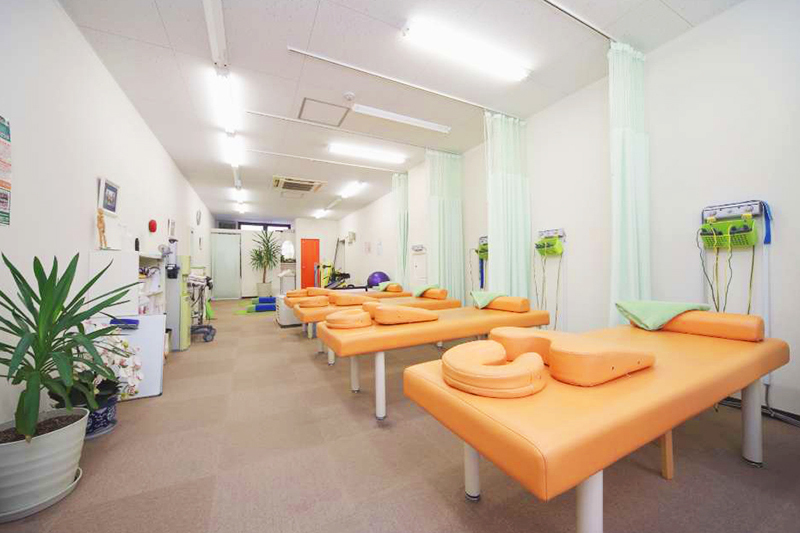
住所
〒213-0002
神奈川県川崎市高津区二子1丁目7−17 リバーサイドマンション杉崎 102
アクセス
二子新地駅 徒歩3分
駐車場:近隣にコインパーキングあり。自転車・バイクは店舗前に駐輪場がございます。
受付時間
月~土
9:00〜13:00 /15:00〜19:00
定休日
日曜・祝日