〒213-0002 神奈川県川崎市高津区二子1丁目7−17
リバーサイドマンション杉崎 102 二子新地駅 徒歩3分
| 月 | 火 | 水 | 木 | 金 | 土 | 日祝 | |
|---|---|---|---|---|---|---|---|
| 9:00〜13:00 | ● | ● | ● | ● | ● | ● | ─ |
| 15:00〜19:00 | ● | ● | ● | ● | ● | ● | ─ |
慢性腰痛の重症度を決めるのは?
公開日:2026/01/19
更新日:2026/06/03
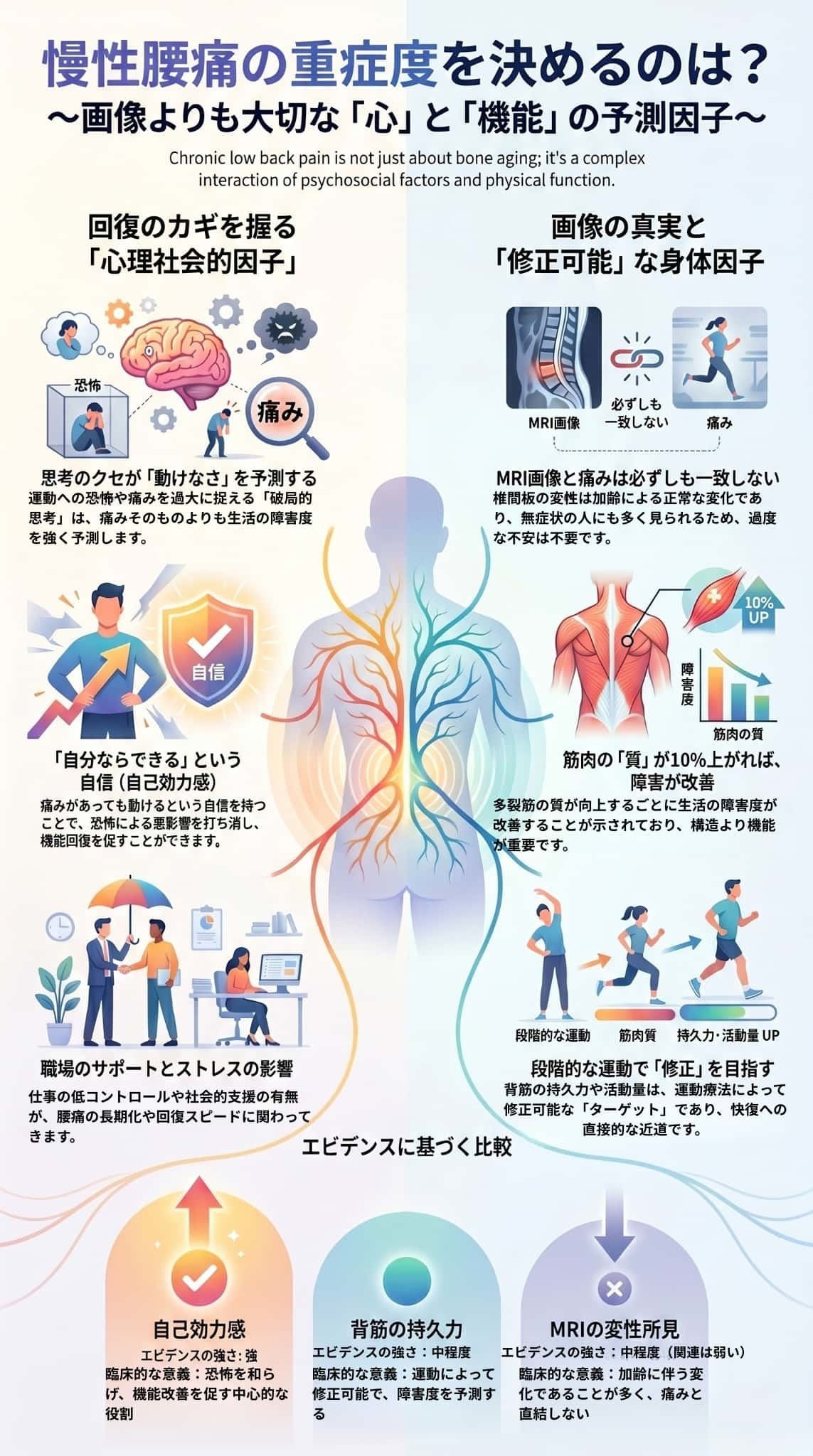
2016年以降の最新エビデンスに基づき、慢性腰痛の重症度を左右する多角的な予測因子を包括的に解説したレポートです。
腰痛の悪化や長期化は単一の原因ではなく、生体力学的・心理社会的・画像所見・生物学的・生活習慣という5つの要素が複雑に絡み合って決定されることを強調しています。
特に、運動への恐怖感や自己効力感といった心理的側面や、筋持久力などの機能的側面は、画像上の変性所見よりも予後を予測する上で重要な指標となります。
画像診断の結果に一喜一憂せず、修正可能な因子に焦点を当てた個別化治療や多職種連携が、患者の機能回復と不安解消に不可欠であることを説いています。最終的に、患者が自身の病態を正しく理解し、段階的な運動や生活改善に前向きに取り組むための実践的な指針を提示しています。
目次
慢性腰痛の重症度と予測因子に関する主要な知見は、**「慢性腰痛の重症度は単一の要因で説明できるものではなく、身体的・心理的・社会的要因が複雑に絡み合って決定される(多因子性の病態)」**という点に集約されます。
- **運動恐怖(動かすことへの恐れ)や破局的思考(痛みを過大に捉えること)**は、治療後の機能障害の悪化を予測する最も一貫したエビデンスを持つ重要な因子です。
- 一方で、**「自己効力感(自分の能力に対する自信)」**は、恐怖による悪影響を和らげ、機能回復を促す中心的な役割を果たします。
- これらの心理的・社会的要因は決して「気のせい」などではなく、身体的要因と同様に科学的に証明された回復への影響因子です。最大の強みは、認知行動療法や段階的な活動によって改善(修正)が可能である点です。
- MRIなどで見つかる構造的な変性所見(ヘルニアや椎間板の変性など)は、加齢に伴う正常な変化であることも多く、無症状の人にも頻繁に見られるため、必ずしも痛みの原因や重症度を説明するものではありません。
- 画像所見に過度な不安を抱くよりも、背筋の持久力や腰部多裂筋といった**「筋肉の質や機能」のほうが、将来の障害度をより正確に予測**します。筋肉の機能は運動療法によって改善可能なターゲットです。
- 身体活動と運動療法は慢性腰痛管理の中核を担います。ただし、過度な負荷は避け、個々の状態に合わせた段階的で規則的なアプローチが推奨されています。
- また、体重管理(肥満は炎症を介して痛みに影響する可能性が指摘されています)や、職場での重い肉体労働・長時間の運転といった「作業負荷の軽減」も、患者自身が取り組める重要な領域です。
- 炎症性バイオマーカー(CRPや特定のサイトカインなど)や遺伝的リスクスコアが重症度や慢性化に関連する可能性は示されていますが、現時点で個別の患者の予後を予測するツールとしては確立されていません。
- 遺伝的素因があるからといってそれが「運命」として固定されるわけではありません。現在の治療では、上記の「修正可能な因子(心理面・機能面・生活習慣)」に対処することが最優先とされています。
慢性腰痛は複雑ですが、多くの「修正可能因子」が存在するという希望が主要なメッセージです。画像上の変化や遺伝的要因に過度に不安を抱くのではなく、心理的な不安を軽減して自己効力感を高め、医療者と協働しながら段階的な運動や生活習慣の改善(多次元的・多職種アプローチ)に取り組むことが、長期的な改善への鍵となります。
生体力学的・解剖学的因子は、主に運動などで改善できる**「修正可能な機能的要素」と、骨や椎間板の変形など「修正が困難な構造的要素」**の2つに大別されます。
これらの因子に関する最も重要な結論は、画像検査でわかる骨格のアライメントや構造的な変性よりも、筋肉の質や持久力といった「機能的な面」を評価し改善することのほうが、慢性腰痛の将来の障害度をより正確に予測し、回復に寄与するという点です。
具体的な因子ごとの主要な知見は以下の通りです。
- 背筋持久力: 慢性腰痛の将来の障害度を予測する重要な因子です。Sorensen testなどで測定される背筋の持久力は、痛みの強さとともに障害度の有意な予測因子になることが示されています。
- 腰部多裂筋(背骨を支える筋肉)の質: 12ヶ月後の障害度を予測する独立した重要な因子です。筋肉の質が10%向上するごとに障害度が明確に改善することが分かっています。重要なのは、この筋肉の質の向上は、背骨の構造的な変性とは無関係に、直接的に障害度を改善させるという点です。
- これらの機能は運動療法などによって改善(修正)が可能である点が最大の強みです。
- 無意識に行われる予測的・代償的な姿勢調整(運動制御の変化)が慢性腰痛と関連していることには、高い確実性のエビデンスが存在します。運動パターンの評価と修正も治療の有効なターゲットになります。
- 姿勢の歪みや脊椎・骨盤のアライメント(骨格の配列)異常は、障害度とある程度の相関はあるものの、他の要因を含めた多変量解析を行うとその予測効果は消失します。つまり、アライメント異常単独では痛みの重症度や障害度を十分に説明できないため、機能的な評価(筋肉の強さなど)を優先すべきとされています。
- MRIで見つかる構造的な変性(椎間板の変性など)は、将来の症状への影響が限定的です。例えば、4つ以上の変性所見があったとしても、12ヶ月後の腰痛の強さには影響せず、下肢痛にわずかな影響を与えるに留まりました。
- また、軽度の変性所見は腰痛と関連しないことが多く、腹横筋(お腹の深層筋)の形態異常なども慢性腰痛とは関連しないという高い確実性のエビデンスがあります。
医療者から患者へ教育すべきポイントとして、**「構造の変化に対する過度な不安を和らげること」**が強調されています。
画像検査で見つかる構造的な変化は、加齢に伴う正常な変化であることが多く、無症状の人にも頻繁に見られます。
患者は「背骨が変形しているから治らない」と悲観するのではなく、画像所見よりも確かな予測因子である「実際の筋持久力や筋肉の質」を高めることに焦点を当てるべきです。
機能的能力の改善を目指して段階的な運動に取り組むことが、日常生活の障害度を減らす長期的な改善につながります。
慢性腰痛の重症度を予測する因子の中で、心理社会的因子は最も再現性が高く、臨床的に重要な予測因子です。最大のポイントは、これらが決して「気のせい」として片付けられるものではなく、身体的要因と同様に科学的に証明された強力な予測因子であり、なおかつ**「修正可能(治療・改善が可能)である」**という点です。
- これらは、保存的治療後の機能障害の悪化を予測する最も一貫したエビデンスを持つ因子です(エビデンスの強さ:強)。
- 痛みの強さの変化そのものよりも、将来の「生活の障害度」をより強く予測することが分かっています。
- 予後において中心的な役割を果たす重要な因子です(エビデンスの強さ:強)。
- 自己効力感は、恐怖などのネガティブな心理的要因が将来の痛みや障害へと繋がるのを防ぐ「媒介役」として機能します。
- 小さな成功体験や段階的な活動を通じて患者の自信(自己効力感)を高めることが、長期的な機能回復の鍵となります。
- 抑うつ症状は、痛みの強さや障害度、回復の遅れと関連しています。
- 機械学習を用いたデータ解析でも、「心理的ウェルビーイング」と「社会的機能」は、慢性腰痛患者と無症状の人を区別する最も重要な変数であることが示されています。
- 職場の環境も大きく影響します。高い作業負荷は痛みの悪化と関連しますが、逆に**「仕事の裁量権(コントロール)」や「社会的支援(周囲のサポート)」は、腰痛を保護する因子**として働きます。
慢性腰痛の重症度予測における「画像所見(MRIなど)」に関する最も重要なメッセージは、**「画像所見単独では症状を予測しにくく、臨床情報や心理社会的因子と統合して解釈する必要がある」**という点です。
- 非特異的(原因が特定しにくい)腰痛では、日常的な画像検査は推奨されていません。
- MRIで見つかる椎間板の変性などは、腰痛患者に多く見られるものの、痛みがない無症状の人にも頻繁に存在します。そのため、画像上の変性所見と実際の腰痛症状との相関は弱く、慢性腰痛における診断的価値には議論の余地があります。
- MRI上で変性所見が多数(4つ以上)あったとしても、12ヶ月後の腰痛の強さには影響せず、下肢痛に対してわずかな影響(0.99ポイントの変化)を与えるに留まります。この影響は臨床的には非常に小さく、構造の変性と実際の症状が必ずしも一致しない(乖離している)ことを示しています。
- 一般集団においては、下部腰椎の「重度かつ多発性」の変性のみが腰痛と関連し、軽度の変形や単一の画像所見(Modic変化や椎間板変性など)と痛みとの関連は弱いとされています。
- 画像でわかる骨や椎間板の構造的な変性よりも、**腰部多裂筋(腰を支える深層筋)の「質」のほうが、臨床的に関連性が高い(障害度をよく予測する)**ことが分かっています。
- 筋肉の質が10%向上するごとに12ヶ月後の障害度が明確に改善します。筋肉の質と構造的変性は独立した経路で症状に影響するため、背骨に変性があっても筋肉の機能や質を高めることで症状の改善が期待できます。
- 画像上の椎間板変性が痛みに結びつくかどうかは、個人の「遺伝的疼痛素因(痛みの感じやすさの遺伝的背景)」によっても修飾される(左右される)ことが分かっています。
- 機械学習を用いたデータ解析でも、MRIデータ単独では慢性腰痛の存在を完全に説明できないことが示されています。心理社会的因子や関節の可動域などを含めた「多次元モデル」を用いることが、患者の状態を最も効果的に区別します。
慢性腰痛の重症度予測における生物学的・遺伝的因子についての最も重要なメッセージは、**「これらは病態の理解を深める有望な研究領域であるものの、現時点では個別の患者の予後を予測する日常的なツールとしては確立されていない」**という点です。
- 腰痛患者では、健康な人と比べて古典的な炎症性バイオマーカー(CRP、IL-6、TNF-αなど)が高く、抗炎症性バイオマーカー(IL-10)が低いことが確認されています。また、これらの炎症性サイトカインの濃度が高いほど、痛みや障害の重症度と関連することが大規模調査で示されています。
- しかし、これらが「将来の痛みの経過や重症度」を正確に予測できるかどうかについては縦断的なエビデンスが不十分であり、一部のマーカー(血清IL-1βやIL-6など)では関連がないとする質の高い研究も存在します。
- 大規模なゲノム研究により、慢性腰痛と関連する遺伝子変異(SOX5遺伝子など)が特定されています。
- 固定的な遺伝的素因を表す「多遺伝子リスクスコア」と、修正可能な心理社会的リスクを評価する「STarT Back Tool」を組み合わせることで、2年後の労働障害の予測精度が向上することが示されており、遺伝的リスクが最も高いグループは労働障害日数が有意に多くなりました。
- ただし、現在の遺伝的知見が説明できる遺伝性の割合はわずか7.6%にとどまっています。また、血液中の遺伝子発現パターンが痛みや障害の重症度と相関するものの、そのパターンには男女でほとんど重複がない(明確な性差がある)など、非常に複雑であることが分かっています。
- 興味深い進展として、急性腰痛の初期段階における「血漿サイトカインプロファイルや免疫細胞(特にB細胞の成熟の軌跡など)の特徴」は、患者自身の自己申告による痛みの評価のみを用いるよりも、慢性腰痛へ移行するかどうかの予測を改善することが分かっています。
医療者から患者に伝えるべき最も重要なポイントは、**「生物学的決定論(運命論)に陥らないこと」**です。
慢性腰痛の重症度予測における「生活習慣・行動因子」は、**患者自身が主体的に取り組むことができる「修正可能な領域」**として非常に重要です。臨床ガイドラインでも推奨される運動療法を中心に、体重や労働環境などが複雑に関与しています。
- 活動を維持し、運動療法を行うことは慢性腰痛管理の中核を担い、エビデンスベースの治療として確立されています。
- ただし「運動すればするほど良い」という単純なものではありません。中程度の余暇の身体活動は保護的に働きますが、過度な負荷や高強度のトレーニングは逆にリスクを増加させる可能性があります。
- そのため、急激に運動を始めるのではなく、個人の状態に合わせた**「段階的で規則的なプログラム」**が最も効果的です。適切な活動は腰痛を悪化させるのではなく、むしろ改善に役立ちます。
- 高い身体的作業負荷は、腰痛の長期的な予後不良や職場復帰の遅れと一貫して関連しています。
- 具体的には、重い肉体労働や長時間の運転などが、より重度の腰痛と関連することが示されています。症状を悪化させる場合は、作業方法の改善や作業負荷の軽減など、職場環境の調整を検討することが重要です。
- 高いBMI(過体重や肥満)は、より重度の腰痛スコアと関連することが示されています。これは、肥満が引き起こす軽度の「炎症」が痛みの感覚に悪影響を与える可能性で説明されます。
- ただし、体重だけが予後を決定するわけではなく、体重管理による影響には個人差もあるため、医療者と相談しながら慎重に取り組むことが推奨されます。
- **睡眠:**ベースラインでの睡眠不良や睡眠障害の継続は、腰痛が改善しないことと関連するデータがありますが、現時点では含まれる研究の質が低く、確固たるエビデンスには至っていません。
- **喫煙:**喫煙が非特異的腰痛のリスクであるという報告がある一方で、長期的な痛みの重症度への影響についてはデータが一致していません(社会的地位や職業的負荷など他の要因が影響している可能性が指摘されています)。
- これらは腰痛の長期予後に対する直接的な影響は不明確ですが、全体的な健康改善の一環として睡眠の最適化や禁煙を目指すことは合理的とされています。
生活習慣因子に対処する際の最大のポイントは、「活動への恐怖(動かすと痛むのではないかという不安)」を和らげ、段階的に活動レベルを上げていくことです。心理的アプローチと組み合わせて無理のない範囲で身体活動を行い、必要に応じて体重管理や職場環境の調整(作業負荷の軽減)を医療者と相談しながら進めることが、長期的な予後改善につながります。
慢性腰痛の患者教育における最も重要な実践的提言は、**「慢性腰痛が多因子性の病態であることを理解し、患者自身が主体的に改善できる『修正可能な因子』に焦点を当てること」**です。
- 最優先事項(心理社会的因子と身体活動): 運動への恐怖心や自己効力感(自信)などの心理面と、適切な身体活動の維持が、予後を改善するための最も重要なターゲットです。
- 重要事項(体重管理と職場環境の調整): 肥満への対処や、重い肉体労働などの作業負荷の軽減も、長期的な予後改善に寄与します。
- 遺伝的素因や炎症マーカーが関与していたとしても、それは決して**「運命」を意味するものではありません**。多くの修正可能因子へアプローチすることで改善が可能であるという**「希望」を患者に提供すること**が重要です。
- 心理的要因(不安や抑うつ、動きへの恐怖など)は、決して**「気のせい」ではなく、回復に影響を与える科学的に証明された因子**であることを明確に伝えます。
- これらに対処することは「弱さの表れ」ではなく、回復への重要なステップです。認知行動療法や段階的な活動を通じて小さな成功体験を積み重ね、「自己効力感(自分の能力に対する自信)」を高めることが長期的な障害を軽減します。
- MRIで見つかる構造的変化の多くは加齢に伴う一般的な変化であり、無症状の人にも見られるため、必ずしも痛みを完全に説明するものではないことを教育します。
- 画像上の変化よりも、「筋肉の質や機能的能力」のほうが将来の予後をより正確に予測するため、変形を恐れるのではなく、機能の改善に焦点を当てるべきです。
- 運動療法は非常に有効ですが、急激な変化を求めるのではなく、個別の状態に合わせた段階的で規則的なプログラムを提供することが重要です。適切な身体活動は痛みを悪化させるものではなく、むしろ改善に役立ちます。
- 患者ごとに要因の組み合わせ(身体的・心理的・社会的・遺伝的要因など)は異なるため、医師、理学療法士、心理士などが協働する多職種連携による個別化されたケアが不可欠です。
患者と医療者が協働し、過度な不安を取り除きながらこれらの修正可能な領域へ段階的に取り組むことが、長期的な成功と予後改善への鍵となります
[1]L. Mendonça, M. Monteiro-Soares, and L. F. Azevedo, “Prediction of Clinical Outcomes in Individuals With Chronic Low Back Pain: A Protocol for a Systematic Review With Meta-Analysis,” Systematic Reviews, vol. 7, no. 1, pp. 149–149, Oct. 2018, doi: 10.1186/S13643-018-0818-2.
[2]E. M. Pinto, J. Rocha-Neves, and M. Laranjeira, “The importance of inflammatory biomarkers in non-specific acute and chronic low back pain: a systematic review.,” European Spine Journal, May 2023, doi: 10.1007/s00586-023-07717-1.
[3]W. Mika, J. Moszkowicz, J. Słowik, D. Narożniak, M. Mierniczek, and A. Rodzeń, “Prognostic factors in low back pain: from identification to stratified care,” Archiv EuroMedica, vol. 15, no. 5, Oct. 2025, doi: 10.35630/2025/15/iss.5.515.
[4]C. A, W. R., O. C., C. T, H. Ca, and L. J, “Theoretical Schemas to Guide Back Pain Consortium (BACPAC) Chronic Low Back Pain Clinical Research,” Sept. 2025, doi: 10.7302/27327.
[5]A. Chau et al., “Theoretical Schemas to Guide BACPAC Chronic Low Back Pain Clinical Research.,” Pain Medicine, Dec. 2022, doi: 10.1093/pm/pnac196.
[6]E. Otero-Ketterer, C. Peñacoba-Puente, C. F. Pinheiro-Araujo, J. A. Valera-Calero, and R. Ortega-Santiago, “Biopsychosocial Factors for Chronicity in Individuals with Non-Specific Low Back Pain: An Umbrella Review,” International Journal of Environmental Research and Public Health, vol. 19, no. 16, pp. 10145–10145, Aug. 2022, doi: 10.3390/ijerph191610145.
[7]S. G. Hassan, K. Nesovic, J. Babineau, A. D. Furlan, D. Kumbhare, and L. C. Carlesso, “Identifying chronic low back pain phenotypic domains and characteristics accounting for individual variation: a systematic review.,” Pain, vol. Publish Ahead of Print, Apr. 2023, doi: 10.1097/j.pain.0000000000002911.
[8]J. Boissoneault, J. M. Mundt, M. E. Robinson, and S. Z. George, “Predicting Low Back Pain Outcomes: Suggestions for Future Directions,” Journal of Orthopaedic & Sports Physical Therapy, vol. 47, no. 9, pp. 588–592, Aug. 2017, doi: 10.2519/JOSPT.2017.0607.
[9]N. AUTHOR_ID, N. AUTHOR_ID, and A. M. Elabd, “Prediction of Back Disability Using Clinical, Functional, and Biomechanical Variables in Adults with Chronic Nonspecific Low Back Pain,” Stomatology, vol. 13, no. 13, pp. 3980–3980, July 2024, doi: 10.3390/jcm13133980.
[10]“Spinal degeneration and lumbar multifidus muscle quality may independently affect clinical outcomes in patients conservatively managed for low back or leg pain,” Dental science reports, vol. 14, no. 1, Apr. 2024, doi: 10.1038/s41598-024-60570-0.
[11]R. K. Jensen, P. Kent, T. S. Jensen, and P. Kjaer, “The association between subgroups of MRI findings identified with latent class analysis and low back pain in 40-year-old Danes.,” BMC Musculoskeletal Disorders, vol. 19, no. 1, pp. 62–62, Feb. 2018, doi: 10.1186/S12891-018-1978-X.
[12]J. J. Wong et al., “Association Between Depressive Symptoms or Depression and Health Outcomes for Low Back Pain: a Systematic Review and Meta-analysis.,” Journal of General Internal Medicine, pp. 1–14, Aug. 2021, doi: 10.1007/S11606-021-07079-8.
[13]A. Alhowimel, A. Alhowimel, M. Alotaibi, M. Alotaibi, K. Radford, and N. S. Coulson, “Psychosocial factors associated with change in pain and disability outcomes in chronic low back pain patients treated by physiotherapist: A systematic review.,” Sage Open Medicine, vol. 6, pp. 2050312118757387–2050312118757387, Feb. 2018, doi: 10.1177/2050312118757387.
[14]A. S. Alhowimel et al., “Psychosocial Predictors of Pain and Disability Outcomes in People with Chronic Low Back Pain Treated Conservatively by Guideline-Based Intervention: A Systematic Review”, doi: 10.2147/jmdh.s343494.
[15]G. Buruck, A. Tomaschek, J. Wendsche, E. Ochsmann, and D. Dörfel, “Psychosocial areas of worklife and chronic low back pain: a systematic review and meta-analysis,” BMC Musculoskeletal Disorders, vol. 20, no. 1, pp. 480–480, Oct. 2019, doi: 10.1186/S12891-019-2826-3.
[16]S. Vickery et al., “Integrating multidimensional data analytics for precision diagnosis of chronic low back pain,” medRxiv, vol. 15, Oct. 2024, doi: 10.1038/s41598-025-93106-1.
[17]I. Løchting et al., “The impact of psychological factors on condition-specific, generic and individualized patient reported outcomes in low back pain,” Health and Quality of Life Outcomes, vol. 15, no. 1, p. 40, Feb. 2017, doi: 10.1186/S12955-017-0593-0.
[18]D. C. Felício et al., “Risk factors for non-specific low back pain in older people: a systematic review with meta-analysis.,” Archives of Orthopaedic and Trauma Surgery, pp. 1–10, May 2021, doi: 10.1007/S00402-021-03959-0.
[19]Elgaeva et al., “Bidirectional Mendelian Randomization Study of Personality Traits Reveals a Positive Feedback Loop Between Neuroticism and Back Pain.,” The journal of pain, 2023, doi: 10.1016/j.jpain.2023.05.012.
[20]P. Suri, M. Kazemi-Naini, and F. Williams, “The Association Between Individual Lumbar Intervertebral Disc Degeneration Features and Low Back Pain is Modified by Genetic Propensity to Pain,” The Journal of Pain, Apr. 2024, doi: 10.1016/j.jpain.2024.01.209.
[21]R. S. Perera, “Role of lumbar disc degeneration and genetic variation in chronic low back pain,” Ceylon Journal of Medical Science, vol. 55, no. 1, p. 3, Aug. 2018, doi: 10.4038/CJMS.V55I1.4931.
[22]“Nonspecific Low Back Pain,” The New England Journal of Medicine, vol. 386, no. 18, pp. 1732–1740, May 2022, doi: 10.1056/nejmcp2032396.
[23]P. K. Morris, K. Ali, M. Merritt, J. Pelletier, and L. G. Macedo, “A systematic review of the role of inflammatory biomarkers in acute, subacute and chronic non-specific low back pain.,” BMC Musculoskeletal Disorders, vol. 21, no. 1, pp. 1–12, Mar. 2020, doi: 10.1186/S12891-020-3154-3.
[24]V. T. Enrico et al., “Plasma Pro‐ and Anti‐Inflammatory Cytokines in an Observational Chronic Low Back Pain Cohort,” JOR spine, vol. 8, no. 3, Sept. 2025, doi: 10.1002/jsp2.70095.
[25]M. D. Vigeland et al., “Gene Expression Correlates with Disability and Pain Intensity in Patients with Chronic Low Back Pain and Modic Changes in a Sex-Specific Manner,” International Journal of Molecular Sciences, vol. 26, no. 2, pp. 800–800, Jan. 2025, doi: 10.3390/ijms26020800.
[26]R. Compte, M. K. Naeini, E. Heikkala, T. McSweeney, J. Karppinen, and F. M. K. Williams, “Does combining the STarT Back Tool with a polygenic risk score for chronic low back pain improve prediction of work disability over two years?,” Sept. 2025, doi: 10.1101/2025.09.09.25335394.
[27]P. Suri et al., “Genome-wide meta-analysis of 158,000 individuals of European ancestry identifies three loci associated with chronic back pain.,” PLOS Genetics, vol. 14, no. 9, pp. 1–23, Sept. 2018, doi: 10.1371/JOURNAL.PGEN.1007601.
[28]M. C. Brown et al., “Patterns and trajectories of peripheral inflammatory cytokines, immune tolerance, and lymphocyte differentiation predict transition from acute to chronic low back pain in a sex- and age-specific manner,” Pain, Oct. 2025, doi: 10.1097/j.pain.0000000000003811.
[29]Y. Z. Lim et al., “Association Between Inflammatory Biomarkers and Nonspecific Low Back Pain: A Systematic Review.,” The Clinical Journal of Pain, vol. 36, no. 5, pp. 379–389, Jan. 2020, doi: 10.1097/AJP.0000000000000810.
[30]P. Suri et al., “Genome-wide Meta-analysis of 158,000 Individuals of European Ancestry Identifies Three Loci Associated with Chronic Back Pain,” bioRxiv, p. 244483, Jan. 2018, doi: 10.1101/244483.
[31]K. Verkerk, P. A. J. Luijsterburg, H. S. Miedema, A. Pool-Goudzwaard, and B. W. Koes, “Prognostic Factors for Recovery in Chronic Nonspecific Low Back Pain: A Systematic Review,” Physical Therapy, vol. 92, no. 9, pp. 1093–1108, Sept. 2012, doi: 10.2522/PTJ.20110388.
[32]S. S. Sribastav et al., “Risk Factors Associated with Pain Severity in Patients with Non-specific Low Back Pain in Southern China.,” Asian Spine Journal, vol. 12, no. 3, pp. 533–543, June 2018, doi: 10.4184/ASJ.2018.12.3.533.
[33]I. M. da C. Fernandes, R. Z. Pinto, P. H. Ferreira, and F. S. Lira, “Low back pain, obesity, and inflammatory markers: exercise as potential treatment,” Journal of exercise rehabilitation, vol. 14, no. 2, pp. 168–174, Apr. 2018, doi: 10.12965/JER.1836070.035.
[34]Silva, Hayden, Mendes, Verhagen, Pinto, and Silva, “Sleep as a prognostic factor in low back pain: a systematic review of prospective cohort studies and secondary analyses of randomized controlled trials.,” Sleep, 2024, doi: 10.1093/sleep/zsae023.
[35]D. N. K, G. E. J, V. A. M, T. S. S, and H. A. C, “Prognostic Factors for Disability and Pain Outcomes in Patients with Axial Low Back Pain Undergoing a Multidisciplinary Spine Treatment Program,” vol. 6, no. 1, Jan. 2020, doi: 10.23937/2572-4215.1510019.
[36]F. Russo et al., “Prognostic factors for return to work in patients affected by chronic low back pain: a systematic review,” Musculoskeletal Surgery, June 2024, doi: 10.1007/s12306-024-00828-y.
[37]B. N. Green et al., “A scoping review of biopsychosocial risk factors and co-morbidities for common spinal disorders,” PLOS ONE, vol. 13, no. 6, p. 0197987, June 2018, doi: 10.1371/JOURNAL.PONE.0197987.
[38]J. Yang, W. L. A. Lo, F. Zheng, X. Cheng, Q. Yu, and C. Wang, “Evaluation of Cognitive Behavioral Therapy on Improving Pain, Fear Avoidance, and Self-Efficacy in Patients with Chronic Low Back Pain: A Systematic Review and Meta-Analysis,” Pain Research & Management, vol. 2022, pp. 1–15, Mar. 2022, doi: 10.1155/2022/4276175.
[39]E. K. Ho et al., “Psychological interventions for chronic, non-specific low back pain: systematic review with network meta-analysis,” BMJ, vol. 376, pp. e067718–e067718, Mar. 2022, doi: 10.1136/bmj-2021-067718.
[40]A. C. Traeger et al., “Estimating the Risk of Chronic Pain: Development and Validation of a Prognostic Model (PICKUP) for Patients with Acute Low Back Pain,” PLOS Medicine, vol. 13, no. 5, pp. 1–21, May 2016, doi: 10.1371/JOURNAL.PMED.1002019.
[41]E. L. Karran et al., “Can screening instruments accurately determine poor outcome risk in adults with recent onset low back pain? A systematic review and meta-analysis.,” BMC Medicine, vol. 15, no. 1, pp. 13–13, Jan. 2017, doi: 10.1186/S12916-016-0774-4.
ごあいさつ
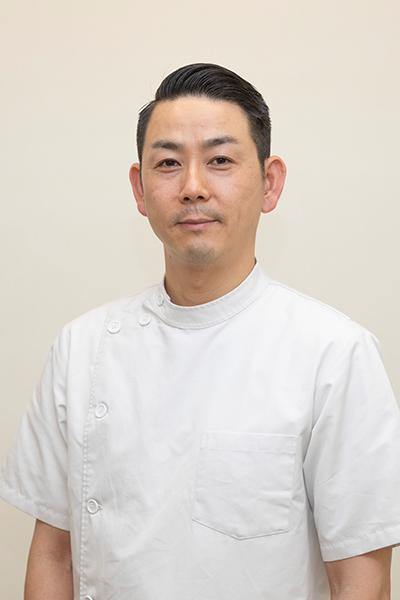
長引いた痛みを一人で治すのは困難なことが多いです。
困ったときは自身で判断せずに適切な処置を受けるために専門家に相談しましょう。
もし、お近くにお住まいで、困っているならば、一度ひまわり接骨院までお問い合わせください。腰痛・坐骨神経痛の専門家の新幡が、ご相談に乗ります。
気軽にご相談ください。

新着情報・お知らせ
平常通り営業致します。
4・5・6は祝日の為、お休みになります。
お気軽にお問合せください

お電話でのお問合せ・相談予約
<受付時間>
月~土
9:00〜13:00 /15:00〜19:00
※日曜・祝日は除く
フォームは24時間受付中です。お気軽にご連絡ください。
- トップページ
ひまわり接骨院
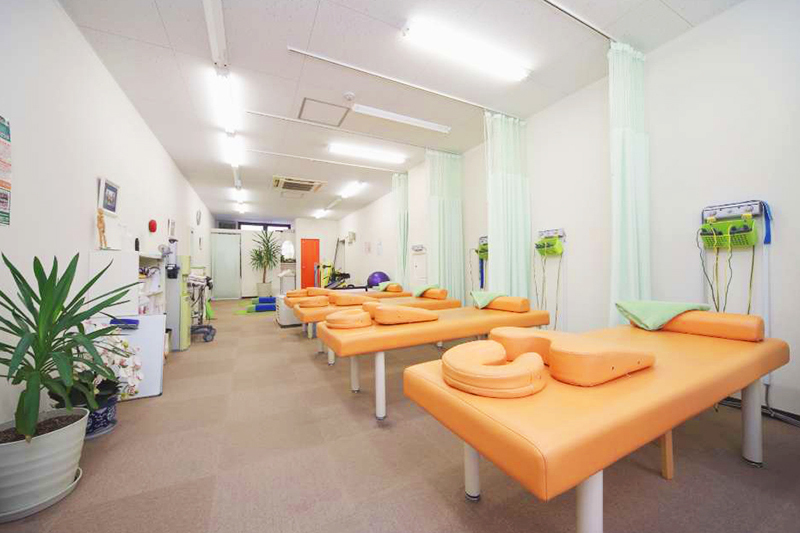
住所
〒213-0002
神奈川県川崎市高津区二子1丁目7−17 リバーサイドマンション杉崎 102
アクセス
二子新地駅 徒歩3分
駐車場:近隣にコインパーキングあり。自転車・バイクは店舗前に駐輪場がございます。
受付時間
月~土
9:00〜13:00 /15:00〜19:00
定休日
日曜・祝日