〒213-0002 神奈川県川崎市高津区二子1丁目7−17
リバーサイドマンション杉崎 102 二子新地駅 徒歩3分
| 月 | 火 | 水 | 木 | 金 | 土 | 日祝 | |
|---|---|---|---|---|---|---|---|
| 9:00〜13:00 | ● | ● | ● | ● | ● | ● | ─ |
| 15:00〜19:00 | ● | ● | ● | ● | ● | ● | ─ |
腰部脊柱管狭窄症の重症度を決めるのは?
公開日:2026/06/06
更新日:2026/00/00
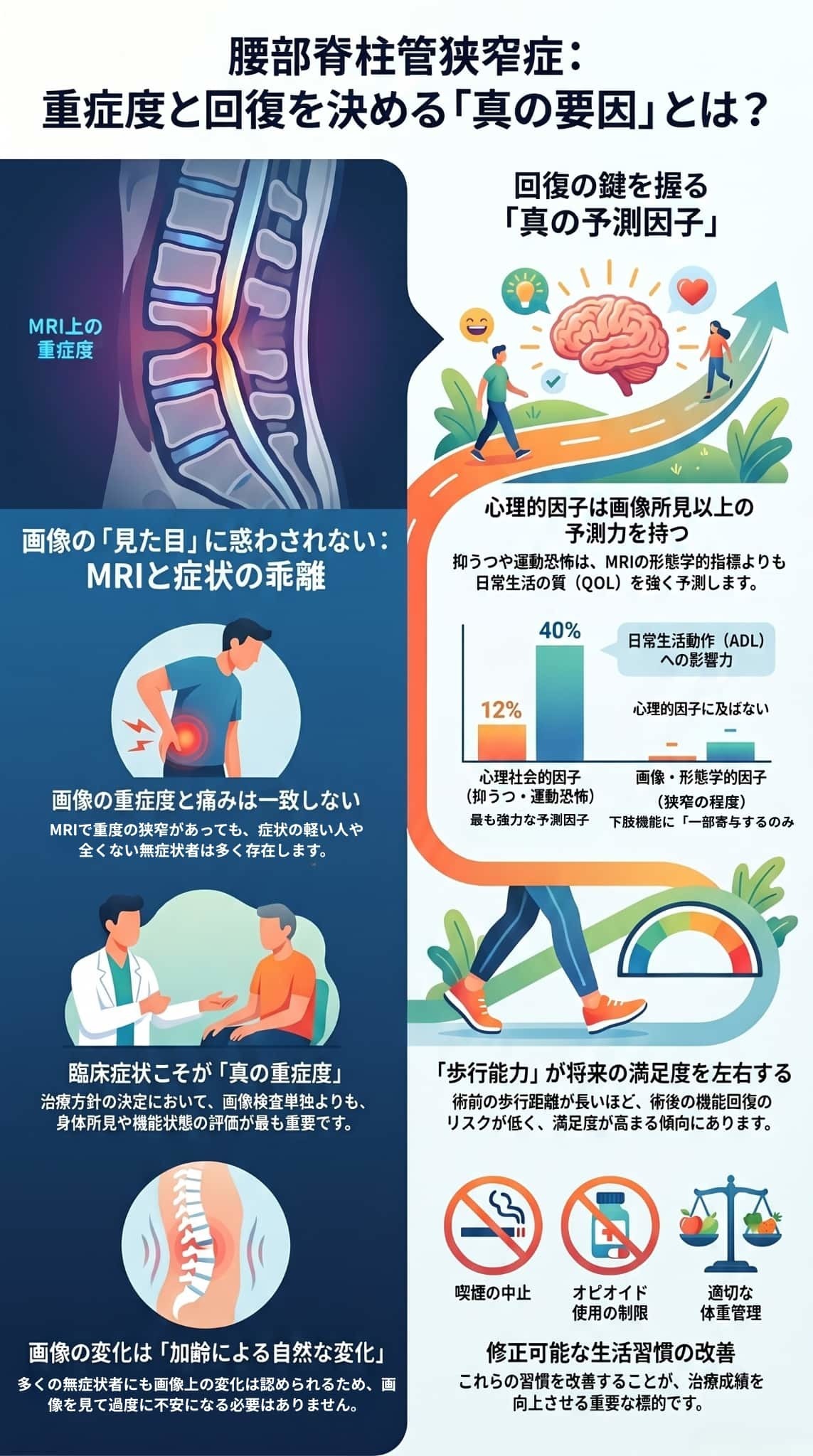
このレポートは、腰部脊柱管狭窄症(LSS)の重症度を予測する因子と、その知見を患者教育へ応用する方法について包括的に解説したものです。
特筆すべき点は、画像診断による形態学的変化よりも、抑うつや運動恐怖といった心理社会的因子の方が、患者の日常生活や術後成績に対して高い予測力を持つという事実です。
歩行能力などの生体力学的因子や喫煙・肥満といった生活習慣も重要な指標として挙げられており、これらは介入可能な標的として強調されています。
一方で、MRIの画像所見と実際の臨床症状には乖離があるため、画像のみに依存しない包括的な評価の必要性が説かれています。
最終的には、機械学習を用いた予測モデルの活用や多職種連携を通じて、患者が自身の状態を正しく理解し、治療方針の決定に主体的に参加する共同意思決定の重要性を提示しています。
目次
腰部脊柱管狭窄症(LSS)の重症度および治療成績(予後)を予測する因子に関する主要な知見は、以下の5つのカテゴリーに分類されます。最も重要な発見は、画像所見(形態学的因子)よりも、患者の心理社会的因子の方がはるかに強力な予測力を持つということです。
- 抑うつと運動恐怖:日常生活動作(ADL)の遂行能力や社会参加を妨げる最も強力な予測因子です。術前に運動恐怖(痛みの悪化を恐れて活動を避けること)や抑うつ・不安が強い患者は、術後の機能障害や痛みが強く残る傾向があります。
- 自己効力感と治療への信頼:「自分は課題をこなせる」という自己効力感が高い患者や、治療に対する信頼性が高い患者は、手術成功の可能性が高くなる(保護因子となる)ことが示されています。
- 画像所見と症状の乖離:MRIなどによる脊柱管の狭窄の重症度と、患者が実際に感じる痛みや機能障害の間には、一貫した相関関係がありません。重度の狭窄があるからといって必ずしも重度の症状が出るとは限らず、軽度の狭窄でも強い症状を訴える患者がいます。
- 画像診断の限界:画像検査単独では症状や予後を十分に予測できず、硬膜嚢断面積などのMRIパラメータと痛みの重症度には臨床的に意味のある関連は認められていません。ただし、発達性狭窄(生まれつき脊柱管が狭い)などは、中長期的な臨床的悪化のリスク因子となります。
- 歩行能力:術前の「最大歩行距離」や自己評価による歩行能力は、術後成績の一貫した予測因子です。術前によく歩ける患者ほど、術後の満足度が高く、歩行能力不良に陥るリスクが低くなります。
- 身体機能評価の限界:歩行能力とは対照的に、体幹筋力、筋持久力、腰椎可動域、下肢筋力といった身体的な指標は、術後成績の予測因子としては限定的な価値しかありません。
- オピオイド(医療用麻薬)の使用と喫煙:術前のオピオイド使用や喫煙習慣は、機能障害や痛みの改善率を低下させる強力な予測因子です。これらは修正可能な因子であり、術前の減薬や禁煙が推奨されます。
- 症状持続期間と痛みの性質:症状が3ヶ月以上続くなど長期化している場合や、下肢痛よりも腰痛が強い場合、全身に広範囲の痛みがある場合は、治療成績が悪化しやすい傾向があります。
- 肥満(BMI):肥満の患者は術前の状態こそ悪いものの、適切な選択の下で手術を行えば、正常体重の患者と同等の改善が得られることが分かっています。
- 腰椎の変性や狭窄には、複数の遺伝的変異(SNPなど)や、生まれつきの脊柱管の形状(発達性狭窄)、腰仙椎移行椎(LSTV)などの生物学的な構造異常が関連しており、これらが症状の発現リスクを高める要因となります。
腰部脊柱管狭窄症の重症度や予後は単一の要因で決まるのではなく、これら複数の要因が複雑に絡み合っています。患者の治療成績を向上させるためには、画像所見だけに頼るのではなく、歩行能力の維持、抑うつや運動恐怖に対する心理的サポート、禁煙やオピオイド減量といった「修正可能な因子」に包括的に介入することが極めて重要だとされています。
腰部脊柱管狭窄症(LSS)の重症度や治療成績を予測する上で、心理社会的因子はMRIなどの画像所見(形態学的因子)を上回る強力な予測力を持っています。
- 術前に抑うつや不安のスコアが高い患者は、機能障害(ODIスコア)が大きく、痛みが強く、生活の質(QOL)が低い傾向があります。
- 抑うつは日常生活動作(ADL)の遂行能力や社会参加を妨げる強力な予測因子であり、これらに対する説明分散は12%から40%に及びます。
- ただし、術前に抑うつ状態であっても、手術後に機能が有意に改善し、非抑うつ患者と同等のレベルまで回復する可能性があることも示されています。
- ある研究では、術前の運動恐怖が術後機能障害の最強の予測因子であることが示されています。
- 抑うつと同様に、ADL遂行能力や社会参加を妨げる大きな要因となります。そのため、「運動は安全であり回復に不可欠である」というメッセージを伝え、段階的に活動を再開させることが重要とされています。
- 疼痛破局化スコアが高い患者は、痛みや機能障害のスコアが悪化しやすく、長期的な手術成功の可能性が低くなる傾向が報告されています。
- 身体機能への自己効力感が高い患者ほど、術後の活動再開に積極的になり、手術成功の可能性が高くなります。
- 興味深いことに、疼痛管理への自己効力感が低い(自分では痛みを管理できないと感じている)患者の方が、手術による痛み緩和への期待が高いためか、手術成功の基準を満たしやすいという報告もあります。
- 治療への信頼性が高い患者ほど、長期的にも手術が成功する可能性が高くなります。
- 一方で、過度に楽観的な期待は治療後の失望につながる可能性があるため、改善の可能性と限界の両方をバランスよく理解し、現実的な期待値を設定することが重要とされています。
画像上の重度な狭窄が必ずしも重度な症状を意味するわけではない一方で、これらの心理社会的因子は治療成績に多大な影響を与えます。
そのため、治療にあたっては早期に心理的なスクリーニングを行い、多職種(整形外科医、理学療法士、心理士など)が連携して、不安や抑うつの軽減、運動恐怖の克服、自己効力感の向上に向けた包括的なサポート(認知行動的アプローチなど)を行うことが推奨されています。
腰部脊柱管狭窄症(LSS)の重症度や予後を予測する画像・解剖学的因子に関して、最も重要な臨床的知見は、**「MRIなどによる放射線学的な狭窄の重症度と、患者が実際に感じる痛みや機能障害の間に、一貫した相関関係が認められない」**という画像と症状の乖離です。
硬膜嚢断面積などの狭窄の程度を示す指標は、術前の歩行距離や機能障害(ODI)、QOLなどの症状の重症度とはほとんど相関しません。
大多数の患者が画像上「重度の狭窄」と分類されても、必ずしも重度の症状を示すわけではありません。
しかし、DCSAが75mm²未満の「重度狭窄」の患者は、軽度狭窄の患者と比較して、手術後に臨床的に意味のある大きな改善(MCID)を示す可能性が4〜13倍高いことが分かっています。
つまり、狭窄が強いほど術前の状態が悪いとは限りませんが、「手術による改善の伸びしろ」は大きいことを予測します。
狭窄そのものの程度よりも、椎間板の変性や終板の欠損の方が症状に影響を与える場合があります。
- 終板欠損・椎間板内真空現象:椎間板変性の進行を示すこれらの所見は、狭窄そのものよりも腰痛の重症度と有意に関連することが示されています。
- 高度な椎間板変性:Pfirrmann分類でグレード4以上の高度な椎間板変性は、減圧手術後の「治療失敗(後日固定術が必要になること)」のリスク増加を予測する因子となります。
生まれつき脊柱管の径が狭い「発達性脊柱管狭窄」を持つ患者は、加齢変化が加わることでLSSを発症しやすく、中長期的な臨床的悪化の強力なリスク因子となります。
特に、DCSAが55mm²未満にまで狭小化している場合は、症状発現後5年以内の臨床的悪化を高精度で予測します。
腰仙椎移行椎(LSTV)と呼ばれる異常に形成された骨の奇形がある場合、LSSの発症リスクが有意に増加します(オッズ比3.74倍)。
LSTVは脊椎や骨盤のアライメント(配列)や椎間板変性に悪影響を与え、特に両側にこの異常がある場合はさらに強いリスクとなります。
腰部脊柱管狭窄症(LSS)の重症度および治療成績を予測する生体力学的因子において、最も重要な知見は**「術前の歩行能力が最も一貫した予測的価値を持つ」こと、そして「生体力学的因子の多くは患者自身で介入・修正が可能である」**という点です。
- 術前の「最大歩行距離」が長い患者は、術後12ヶ月時点での歩行能力不良に陥るリスクが低くなります。
- 術前の自己評価で1,000m以上の歩行が可能である患者は、術後の満足度が高くなる強力な予測因子となります。
- 歩行速度や歩幅などの歩行パターン特性は、機能障害の程度と強い相関を示す客観的指標として有用です。
- 近年、スマートシューズを用いた定量的評価が術後成績の高い予測精度を示しています。術前の10m自己ペース歩行テスト(約6分間で完了し、患者負担が少ない)から得られる歩行パラメータは、術後の機能障害(ODI)や疼痛(VAS)の改善を高精度に予測できることが報告されています。
※スマートシューズは、靴に内蔵されたセンサーを通じて、歩行やランニングの質的な客観的データを高精度に取得し、評価する技術
- 歩行能力とは対照的に、体幹の筋力や筋持久力、腰椎の伸展可動域、下肢(膝など)の筋力といった身体機能指標は、術後成績の予測因子としては限定的な価値しか持ちません。
- これらの指標を改善することは機能的タスクの遂行に寄与する可能性はありますが、術後の良好なアウトカム(痛みや機能障害の大幅な改善)を単独で予測する因子とはならないことが示されています。
- 骨盤傾斜:骨盤の傾きなどの脊椎骨盤パラメータは、一部の患者において腰痛の重症度と弱い相関を示しますが、予測的価値は限定的です。
- 脚長差(足の長さの左右差):見かけの脚長差が少ない患者ほど減圧手術後の成功率が高いことが報告されており、靴の中敷き(インソール)などで簡便に補正できる重要な介入標的となります。
- 腰を支える傍脊柱筋(特に多裂筋)への脂肪浸潤や筋量の低下は、痛みそのものというよりは、機能障害の悪化や生活の質(QOL)の低下と関連します。ただし、研究によって結果にばらつきがあり、予測因子としての一貫性は高くありません。
腰部脊柱管狭窄症(LSS)の重症度および治療成績を予測する人口統計学的・臨床的予測因子は、患者の予後を形成する重要な要素です。これらの因子の最大の特徴は、オピオイド使用や肥満など「患者自身の努力や治療で修正可能な因子」と、年齢や性別などの「修正不可能な因子」が混在している点にあり、これらを把握することが個別化された治療計画の基盤となります。
- オピオイド(医療用麻薬)の使用:術前のオピオイド使用は、機能障害や生活の質(QOL)、痛みの全アウトカムにおいて改善の確率を低下させる強力な予測因子です。
- 喫煙とアルコール使用:喫煙習慣は治療成績不良の一貫した予測因子であり、術後10年時点でもより多くの痛みや機能障害を経験しやすくなります。また、アルコール依存も術後疼痛の持続と関連します。これらは術前の禁煙・節酒によって長期的な成績改善が期待できる重要な介入標的です。
- 肥満(BMI):BMI 35以上の高度肥満患者は術前の状態が悪く、術後の歩行能力不良リスクも高くなります。しかし極めて重要な点として、肥満患者であっても、適切な選択の下で手術を行えば、術後1〜2年時点では正常体重の患者と同等の機能改善やQOL向上を達成できることが示されています。
- 併存疾患:糖尿病や低い足関節上腕血圧比(ABI)などの血管性因子は、症状発現のリスクを高めます。また、線維筋痛症を持つ患者は術後4年時点での満足度が72%も低下するなど、心血管疾患やその他の併存疾患の管理が治療成績の最適化に不可欠です。
- 痛みの部位(腰痛 vs 下肢痛):術前に「腰痛」が優位な患者は治療成績の改善オッズが低い一方で、「下肢痛(足の痛み)」が強い患者は機能障害が改善しやすいという特徴があります。
これは、下肢痛が神経根の直接的な圧迫症状であるため減圧手術が効きやすいのに対し、腰痛は多様な原因から生じるため手術の恩恵が限定的になりやすいためです。全身の広範囲に痛みがある場合も強力な予後不良因子となります。
- 症状持続期間:症状が3ヶ月以上続くなど長期化している場合、改善の確率は低下します。症状持続期間が12ヶ月長くなるごとに治療成功の確率が4%低下するため、長引く前の早期介入が重要です。
- 年齢の逆説的な影響:75歳以上の高齢者は身体的な回復(特に歩行能力)が遅れやすい傾向にあります。しかし一方で、機能障害の改善は乏しくとも、QOLや痛みの改善に対する満足度は若年者よりも高いという逆説的な結果も報告されています。これは高齢者の方が治療に対してより現実的な期待を持っているためと考えられています。
- 性差:女性患者は男性よりも機能障害(ODIスコアなど)を重度に報告する傾向があり、抑うつや痛みの慢性化スコアも高いことが分かっています。痛みに対する認識や心理的影響が、女性の生活の質に大きく影響していることが示唆されています。
- 教育レベルと保険・補償:大学教育など高等教育を受けた患者は治療成功の確率が高い傾向があります。一方で、労災補償を受けている患者や公的保険の患者は、治療成績の改善オッズが低いことが示されています。
- 就労状況:術前に何らかの仕事に就いている患者は機能改善しやすい一方で、肉体的にハードな職業(中等度労働以上)に就いている場合や障害で失業中の場合は、改善の確率が低くなります。
- 過去に腰椎の手術歴がある(再手術の)患者は、癒着(瘢痕組織)や解剖学的な変化の影響により、初回手術の患者よりも長期的な痛みや機能障害が残りやすく、治療成績不良の強力な予測因子となります。
患者の予後を改善するためには、年齢や過去の手術歴といった変えられないリスクを受け入れつつ、**「事前の減量」「禁煙・節酒」「オピオイドの減薬」「糖尿病などの持病の管理」といった修正可能な因子に対して術前から積極的にアプローチすること(術前最適化)**が非常に重要であるとされています。
腰部脊柱管狭窄症(LSS)の重症度および症状発現を予測する「遺伝的・生物学的因子」は、患者ごとに画像所見と症状に大きなばらつき(乖離)が生じる理由を説明する重要な基盤となります。
腰椎の変性には、複数の遺伝的な要素が強く関わっています。
- 遺伝子多型(SNP):ゲノム解析により、椎間板の隙間が狭くなること(椎間板腔狭小化)や、骨の変形(骨棘形成)の進行を強力に促進する特定の遺伝的変異が同定されています。中には、特定の症状から保護するように働く遺伝子も存在し、発症は複数の遺伝的経路が関与していることがわかっています。
- 家族歴:腰痛の家族歴があることは、画像上の狭窄がある人に実際に症状が現れるかどうか(症候化)と有意に関連しています。
先天的な骨の形状も、加齢変化が加わった際のLSSの発症リスクを大きく左右します。
- 発達性脊柱管狭窄(DLSS):生まれつき脊柱管(神経の通り道)が狭い患者は、中長期的な臨床的悪化の強力なリスク因子となります。特に、硬膜嚢断面積が55mm²未満にまで狭くなっている場合は、5年以内の症状悪化を高精度で予測します。
- 骨の大きさ:DLSSの患者は、健康な人と比べて椎体(背骨のブロック)の縦幅や横幅が大きく、神経が通る前後径や断面積が小さいという特徴的な形態を持っています。
- 腰仙椎移行椎(LSTV):腰椎と仙骨の境界に異常に形成された骨(奇形)がある場合、LSSの発症リスクが有意に増加します(オッズ比3.7倍)。これが両側にある場合はさらに強いリスク(オッズ比5.4倍)となり、背骨全体のバランスや椎間板の変性に悪影響を与えます。
神経の機能を直接測る電気生理学的評価(H反射検査など)は、MRIなどの画像所見よりも、患者が実際に抱える機能障害(歩行や日常動作の制限)と非常に強い相関を示すことがわかっています。
画像だけでは分からない神経の実際のダメージを客観的に測る高感度なツールとして、予後予測やモニタリングに価値があります。
遺伝的素因は単独で腰部脊柱管狭窄症を引き起こすのではなく、環境因子と複雑に絡み合って症状を引き起こします。
- 例えば、生まれつき骨の形にリスクを抱えている人でも、BMIの増加(肥満)、ウエスト周囲径の増加、重労働といった「修正可能な環境要因」が加わることで症状の発現が促進されます。
遺伝的・生物学的なリスク因子を持っているからといって、発症や悪化が避けられない「運命」というわけではありません。
治療への信頼性(治療に対する患者の納得感や信頼)が高い患者ほど、手術などの治療が長期的にも成功する可能性が高くなることが分かっています。この信頼性を高め、良好な治療成績につなげるために患者に伝えるべき重要なポイントは以下の通りです。
治療の根拠と期待される効果を明確に説明し、現実的かつ肯定的な期待値を設定することが極めて重要です。
過度に楽観的な期待を持たせてしまうと、術後にそれが満たされなかった際の失望につながりかねません。
そのため、「手術は多くの患者に症状の改善をもたらしますが、すべての症状が完全に消失するわけではありません」という現実的なメッセージを伝え、痛みが完全にゼロにならなくても、歩行や日常生活の機能改善は十分に可能であることを説明する必要があります。
一方的に治療を指示するのではなく、患者が自分の価値観や優先順位に基づいて治療を選択できるようサポートします。
例えば、「あなたの現在の状態に基づくと、手術によって症状が改善する確率は約70%です。一方で、保存療法を継続した場合の経過についても議論しましょう」というように、治療介入のメリットとデメリットの双方を提示し、対話を行うことが推奨されています。
このように、**「良い面も限界も正直に開示し、過度な期待を抱かせず現実的な目標を患者と共有すること」**が、結果として治療への真の信頼性を高め、術後の満足度や治療成績の向上につながります。
腰部脊柱管狭窄症(LSS)の重症度予測因子に関する知見に基づき、ソースでは「臨床実践」「患者教育」「今後の研究」の3つの観点から推奨事項が示されています。
- 多因子評価の実施: 画像検査単独では症状や予後を十分に予測できないため、画像所見だけでなく、心理社会的因子、生体力学的因子、人口統計学的因子を統合した「包括的評価」を行うことが不可欠です。
- 修正可能な因子への積極的介入: 自己効力感、脚長差、オピオイド使用、喫煙、体重(BMI)、併存疾患など、患者自身や医療介入で修正可能な因子を同定し、治療成績改善のための標的とします。特に術前からの歩行訓練や、オピオイドの減量・中止が重要視されています。
- 多職種連携による包括的アプローチ: 心理社会的因子の重要性を踏まえ、整形外科医だけでなく、理学療法士、心理士、看護師などによる多職種チームで対応し、外科的ケアと心理的ケアを統合することが推奨されています。
- 予測ツールの活用と限界の開示: 予測ツール(PROPOSEなど)を共同意思決定の支援に活用しつつ、その精度には限界があることや、個々の結果が予測と異なる可能性(不確実性)を患者に正直に伝えることが求められます。
- 画像所見の適切な説明と期待値管理: 「画像上の重度狭窄が必ずしも重度の症状を意味するわけではない」という画像と症状の乖離を明確に説明し、患者の過度な不安や運動恐怖(破局的思考)を防ぐことが重要です。
- 心理社会的因子のスクリーニングとサポート: 術前の抑うつ・不安、運動恐怖のモニタリングを実施し、早期に介入します。「運動は安全であり回復に不可欠である」と伝え、段階的な目標設定を通じて自己効力感を高めることが推奨されています。
- 共同意思決定(Shared Decision-Making)の促進: 治療のメリットとデメリット、予測される改善確率を提示し、患者自身の価値観や優先順位に基づいて治療を選択できるよう支援します。
- 個別化された教育と文化的配慮: リスク(重度の心理的苦痛や併存疾患など)に応じて患者を層別化し、必要に応じて強化された教育プログラムを提供します。また、患者の教育レベルや文化的背景に応じた情報提供を行うことが重要です。
現在のエビデンスのギャップを埋めるため、以下の研究が優先されるべきとされています。
- 大規模前向きコホート研究: 観察研究の限界(因果推論の限界や選択バイアス)を克服するための質の高い研究が必要です。
- 予測因子の相互作用分析: 画像所見と心理的因子、遺伝と環境など、複数因子がどのように絡み合って予後を決定するかを解明する研究が求められます。
- 保存療法(非手術治療)の研究拡充: 手術患者に偏っている現在のデータを補うため、保存療法の内容を標準化し、非手術治療で改善しやすい患者を予測する研究が急務です。
- 文化横断的研究: 欧米以外の地域(アジアやアフリカなど)でのデータ収集を進め、予測モデルの一般化可能性を評価する必要があります。
- 患者教育介入の効果評価: 個別化された教育プログラムが実際の臨床アウトカムや長期的な自己管理にどのような影響を与えるかを評価する研究が求められています。
[1]D. K. Weiner et al., “Identifying biopsychosocial factors that impact decompressive laminectomy outcomes in veterans with lumbar spinal stenosis: a prospective cohort study.,” Pain, vol. 162, no. 3, pp. 835–845, Mar. 2021, doi: 10.1097/J.PAIN.0000000000002072.
[2]F. Beyer, T. Prasse, P. Eysel, and J. Bredow, “Quality of life in lumbar spinal stenosis: Does it correlate with magnetic resonance imaging and spinopelvic parameters?,” Journal of orthopaedics, vol. 47, pp. 67–71, Jan. 2024, doi: 10.1016/j.jor.2023.11.010.
[3]V. Quack et al., “Psychological factors outmatched morphological markers in predicting limitations in activities of daily living and participation in patients with lumbar stenosis,” BMC Musculoskeletal Disorders, vol. 20, no. 1, pp. 557–557, Nov. 2019, doi: 10.1186/S12891-019-2918-0.
[4]J. H. Hong, M. Y. Lee, S. W. Jung, and S. Y. Lee, “Does spinal stenosis correlate with MRI findings and pain, psychologic factor and quality of life?,” Korean Journal of Anesthesiology, vol. 68, no. 5, pp. 481–487, Oct. 2015, doi: 10.4097/KJAE.2015.68.5.481.
[5]A. Simonini et al., “Valuable Prognostic Role of Disability, Pain, Anxiety, and Depression Scales in Instrumented Lumbar Spine Surgery for Degenerative Pathology: The SAP-LD Study,” Brain Sciences, vol. 15, no. 10, pp. 1035–1035, Sept. 2025, doi: 10.3390/brainsci15101035.
[6]N. Nechanicka, P. Barsa, and P. Harsa, “Psychosocial Factors in Patients Indicated for Lumbar Spinal Stenosis Surgery.,” Central European Neurosurgery, vol. 77, no. 5, pp. 432–440, May 2016, doi: 10.1055/S-0036-1583179.
[7]E. C. L. Verde et al., “Correlation between lumbar spinal stenosis based on morphology of the dural sac and the quality of life,” Scopus, vol. 18, no. 1, pp. 28–31, Mar. 2019, doi: 10.1590/S1808-185120191801178961.
[8]C. Pedersen, M. Ø. Andersen, L. Carreon, S. Skov, P. Doering, and S. Eiskjær, “PROPOSE. Development and Validation of a Prediction Model for Shared Decision Making for Patients with Lumbar Spinal Stenosis,” North American Spine Society Journal (nassj), Jan. 2024, doi: 10.1016/j.xnsj.2024.100309.
[9]A. Wagner et al., “Psychological predictors of quality of life and functional outcome in patients undergoing elective surgery for degenerative lumbar spine disease,” European Spine Journal, vol. 29, no. 2, pp. 349–359, Feb. 2020, doi: 10.1007/S00586-019-06106-X.
[10]J. J. Hebert et al., “Preoperative Factors Predict Postoperative Trajectories of Pain and Disability Following Surgery for Degenerative Lumbar Spinal Stenosis.,” Spine, vol. 45, no. 21, Nov. 2020, doi: 10.1097/BRS.0000000000003587.
[11]M. J. McGirt et al., “An analysis from the Quality Outcomes Database, Part 1. Disability, quality of life, and pain outcomes following lumbar spine surgery: predicting likely individual patient outcomes for shared decision-making.,” Journal of Neurosurgery, vol. 27, no. 4, pp. 357–369, Oct. 2017, doi: 10.3171/2016.11.SPINE16526.
[12]J. Aaen et al., “Clinical and MRI findings in lumbar spinal stenosis: baseline data from the NORDSTEN study,” European Spine Journal, pp. 1–8, Nov. 2021, doi: 10.1007/S00586-021-07051-4.
[13]Y. Norisyam, A. A. Salim, Z. Bahrin, M. I. Yusof, M. Paiman, and C. Nadarajan, “Lateral Lumbar Spinal Stenosis: Associations With the Oswestry Disability Index, Visual Analogue Scale, and Magnetic Resonance Imaging,” Cureus, Dec. 2023, doi: 10.7759/cureus.50475.
[14]M. Minetama et al., “MRI grading of spinal stenosis is not associated with the severity of low back pain in patients with lumbar spinal stenosis,” BMC Musculoskeletal Disorders, vol. 23, no. 1, Sept. 2022, doi: 10.1186/s12891-022-05810-y.
[15]“Prediction of postoperative disability in patients with degenerative diseases of the lumbar spine using preoperative psychological factors,” Mar. 2023, doi: 10.21203/rs.3.rs-2594911/v1.
[16]F. G. Sigmundsson, X. P. Kang, B. Jönsson, and B. Strömqvist, “Correlation between disability and MRI findings in lumbar spinal stenosis: A prospective study of 109 patients operated on by decompression,” Acta Orthopaedica, vol. 82, no. 2, pp. 204–210, Mar. 2011, doi: 10.3109/17453674.2011.566150.
[17]T. Kitano et al., “Psychological Distress Associated with Patient-Reported Outcomes in Preoperative Patients with Lumbar Spinal Stenosis.,” Asian Spine Journal, vol. 15, no. 4, pp. 533–538, Aug. 2021, doi: 10.31616/ASJ.2020.0093.
[18]E. Mazzucchi et al., “The role of psychopathological symptoms in lumbar stenosis: A prediction model of disability after lumbar decompression and fusion,” Frontiers in Psychology, vol. 14, Mar. 2023, doi: 10.3389/fpsyg.2023.1070205.
[19]D. Sobański, R. Staszkiewicz, M. K. Stachura, M. Gadzieliński, and B. Grabarek, “Presentation, Diagnosis, and Management of Lower Back Pain Associated with Spinal Stenosis: A Narrative Review,” Medical Science Monitor, vol. 29, pp. e939237-1, Jan. 2023, doi: 10.12659/MSM.939237.
[20]K. Matsudaira et al., “Predictive Factors for Subjective Improvement in Lumbar Spinal Stenosis Patients with Nonsurgical Treatment: A 3-Year Prospective Cohort Study.,” PLOS ONE, vol. 11, no. 2, Feb. 2016, doi: 10.1371/JOURNAL.PONE.0148584.
[21]F. G. Sigmundsson, X. P. Kang, B. Jönsson, and B. Strömqvist, “A prospective study of imaging- and patient-related factors in 109 patients who were operated on by decompression,” Jan. 2012.
[22]O. V. Sklyarenko, S. N. Larionov, E. Tsyslyak, A. P. Zhivotenko, V. E. Potapov, and A. V. Gorbunov, “Clinical and instrumental parallels of mri manifestations and electrophysiological changes in degenerative lumbar spinal stenosis,” Dec. 2025, doi: 10.57256/2949-0715-2025-4-4-68-75.
[23]T. Maeda et al., “Factors associated with lumbar spinal stenosis in a large-scale, population-based cohort: The Wakayama Spine Study.,” PLOS ONE, vol. 13, no. 7, July 2018, doi: 10.1371/JOURNAL.PONE.0200208.
[24]S. Hirotsu, T. Abiko, A. Tatsuda, S. Makio, T. Harada, and S. Murata, “Assessment of physical and psychological function factors and central sensitization-related symptoms associated with the Oswestry Disability Index in patients with lumbar spinal stenosis,” July 2025, doi: 10.21203/rs.3.rs-7093716/v1.
[25]J. M. Burgstaller et al., “Is There an Association Between Pain and Magnetic Resonance Imaging Parameters in Patients With Lumbar Spinal Stenosis,” Spine, vol. 41, no. 17, Mar. 2016, doi: 10.1097/BRS.0000000000001544.
[26]U. Held et al., “Prognostic function to estimate the probability of meaningful clinical improvement after surgery - Results of a prospective multicenter observational cohort study on patients with lumbar spinal stenosis.,” PLOS ONE, vol. 13, no. 11, Nov. 2018, doi: 10.1371/JOURNAL.PONE.0207126.
[27]D. P. Fields et al., “Preoperative factors and four-year decompressive laminectomy success in symptomatic lumbar spinal stenosis,” Frontiers in musculoskeletal disorders, vol. 2, Jan. 2025, doi: 10.3389/fmscd.2024.1493642.
[28]R. Peteler, P. Schmitz, M. Loher, P. Jansen, J. Grifka, and A. Benditz, “Sex-Dependent Differences in Symptom-Related Disability Due to Lumbar Spinal Stenosis,” Journal of Pain Research, vol. 14, pp. 747–755, Mar. 2021, doi: 10.2147/JPR.S294524.
[29]L. Wood et al., “Characterising patients undergoing surgery for lumbar spinal stenosis associated neurogenic claudication in the UK: what does the British Spinal Registry tell us?,” European Spine Journal, June 2025, doi: 10.1007/s00586-025-09000-x.
[30]H. Abou-Al-Shaar, O. Adogwa, and A. I. Mehta, “Lumbar Spinal Stenosis: Objective Measurement Scales and Ambulatory Status.,” Asian Spine Journal, vol. 12, no. 4, pp. 765–774, July 2018, doi: 10.31616/ASJ.2018.12.4.765.
[31]S. Gupta, T. Bansal, A. Kashyap, S. Sural, and V. Kumar, “Correlation of short form 36 health survey with other relevant clinical scores in patients with degenerative lumbar spinal stenosis,” Journal of orthopaedic diseases and traumatology, vol. 6, no. 2, pp. 132–136, May 2023, doi: 10.4103/jodp.jodp_57_22.
[32]A.-A. Marchand, M.-J. F. C. Houle, J. O’Shaughnessy, C.-É. Chatillon, and M. Descarreaux, “Physical Predictors of Favorable Postoperative Outcomes in Patients Undergoing Laminectomy or Laminotomy for Central Lumbar Spinal Stenosis: Secondary Analysis of a Randomized Controlled Trial,” Frontiers in Neurology, vol. 13, Apr. 2022, doi: 10.3389/fneur.2022.848665.
[33]Y.-T. Lin et al., “Correlation of Foraminal Parameters with Patient-Reported Outcomes in Patient with Degenerative Lumbar Foraminal Stenosis,” Stomatology, vol. 12, no. 2, pp. 479–479, Jan. 2023, doi: 10.3390/jcm12020479.
[34]C. Weber et al., “Is There an Association Between Radiological Severity of Lumbar Spinal Stenosis and Disability, Pain, or Surgical Outcome?: A Multicenter Observational Study.,” Spine, vol. 41, no. 2, Jan. 2016, doi: 10.1097/BRS.0000000000001166.
[35]S. Y.-L. Ng, J. S.-H. Wong, G. Wang, J. M. Ha, J. P. Y. Cheung, and G. K. Shea, “Mid- to long-term natural history of degenerative lumbar spinal stenosis and predictors for clinical deterioration.,” pp. 1–10, Sept. 2025, doi: 10.3171/2025.5.spine25215.
[36]A. F. Mannion et al., “Dural sac cross-sectional area and morphological grade show significant associations with patient-rated outcome of surgery for lumbar central spinal stenosis.,” European Spine Journal, vol. 26, no. 10, pp. 2552–2564, Aug. 2017, doi: 10.1007/S00586-017-5280-7.
[37]B. R. Kinzyagulov, В. Б. Лебедев, П. В. Лебедев, and А. А. Зуев, “The influence of the lumbar spinal stenosis severity and extent on clinical symptoms and functional outcomes of surgical treatment,” Hirurgiâ pozvonočnika, vol. 22, no. 1, pp. 73–78, Mar. 2025, doi: 10.14531/ss2025.1.73-78.
[38]D. Dimitris, W. Sabrina, B. Michael, and F. Mazda, “A Simple Preoperative Score Predicting Failure Following Decompression Surgery for Degenerative Lumbar Spinal Stenosis.,” Aug. 2023, doi: 10.5167/uzh-235382.
[39]J. Qian, K. Liang, X. Luo, and C. Ying, “MRI parameters predict central lumbar spinal stenosis combined with redundant nerve roots: a prospective MRI study,” Frontiers in Neurology, vol. 15, May 2024, doi: 10.3389/fneur.2024.1385770.
[40]S. I. Lee et al., “Identifying predictors for postoperative clinical outcome in lumbar spinal stenosis patients using smart-shoe technology.,” Journal of Neuroengineering and Rehabilitation, vol. 14, no. 1, pp. 77–77, July 2017, doi: 10.1186/S12984-017-0288-0.
[41]J. M. Getzmann et al., “The Effect of Paraspinal Fatty Muscle Infiltration and Cumulative Lumbar Spine Degeneration on the Outcome of Patients With Lumbar Spinal Canal Stenosis: Analysis of the Lumbar Stenosis Outcome Study (LSOS) Data,” Spine, vol. 48, pp. 97–106, Sept. 2022, doi: 10.1097/BRS.0000000000004477.
[42]S. McIlroy, S. McIlroy, F. Jadhakhan, D. Bell, A. Rushton, and A. Rushton, “Prediction of walking ability following posterior decompression for lumbar spinal stenosis.,” European Spine Journal, vol. 30, no. 11, pp. 3307–3318, Aug. 2021, doi: 10.1007/S00586-021-06938-6.
[43]F. G. Sigmundsson, B. Jönsson, and B. Strömqvist, “Determinants of patient satisfaction after surgery for central spinal stenosis without concomitant spondylolisthesis: a register study of 5100 patients,” European Spine Journal, vol. 26, no. 2, pp. 473–480, Feb. 2017, doi: 10.1007/S00586-016-4495-3.
[44]R. T. Paulsen, J. B. Bouknaitir, S. Fruensgaard, L. Y. Carreon, and M. Ø. Andersen, “Prognostic Factors for Satisfaction After Decompression Surgery for Lumbar Spinal Stenosis.,” Neurosurgery, vol. 82, no. 5, pp. 645–651, May 2018, doi: 10.1093/NEUROS/NYX298.
[45]M. Houle, J.-D. Bonneau, A.-A. Marchand, and M. Descarreaux, “Physical and Psychological Factors Associated With Walking Capacity in Patients With Lumbar Spinal Stenosis With Neurogenic Claudication: A Systematic Scoping Review.,” Frontiers in Neurology, vol. 12, p. 720662, Sept. 2021, doi: 10.3389/FNEUR.2021.720662.
[46]G. A. Elsayed et al., “Association between payer status and patient-reported outcomes in adult patients with lumbar spinal stenosis treated with decompression surgery.,” Journal of Neurosurgery, vol. 30, no. 2, pp. 198–210, Feb. 2019, doi: 10.3171/2018.7.SPINE18294.
[47]M. Dobran et al., “Clinical and psychological outcome after surgery for lumbar spinal stenosis: A prospective observational study with analysis of prognostic factors.,” Neurologia I Neurochirurgia Polska, vol. 52, no. 1, pp. 70–74, Jan. 2018, doi: 10.1016/J.PJNNS.2017.12.002.
[48]L. M. Luna, C. C. Zetina, H. V. Sámano, K. A. I. Stone, and E. S. Chiang, “Factors associated with persistence of pain in lumbar stenosis surgery,” Coluna\/columna, vol. 17, no. 2, pp. 110–116, June 2018, doi: 10.1590/S1808-185120181702190993.
[49]H. Myllykangas et al., “Obese people benefit from lumbar spinal stenosis surgery as much as people of normal weight.,” Journal of Orthopaedic Surgery and Research, vol. 16, no. 1, p. 550, Sept. 2021, doi: 10.1186/S13018-021-02692-Z.
[50]R. J. Achttien, A. Powell, K. Zoulas, J. B. Staal, J. B. Staal, and A. Rushton, “Prognostic factors for outcome following lumbar spine fusion surgery: a systematic review and narrative synthesis,” European Spine Journal, pp. 1–46, Oct. 2021, doi: 10.1007/S00586-021-07018-5.
[51]I. Tuomainen et al., “Preoperative Predictors of Better Long-term Functional Ability and Decreased Pain Following LSS Surgery: A Prospective Observational Study with a 10-year Follow-up Period.,” Spine, vol. 45, no. 11, pp. 776–783, June 2020, doi: 10.1097/BRS.0000000000003374.
[52]T. Petersen, C. B. Juhl, and G. Fournier, “Patients With Persistent Low Back Pain and Nerve Root Involvement: To Operate, or Not to Operate, That Is the Question.,” Spine, vol. 45, no. 7, pp. 483–490, Apr. 2020, doi: 10.1097/BRS.0000000000003304.
[53]H. A. Kim, S. G. Heo, J. W. Park, and Y. O. Jung, “Novel Genetic Variants Associated with Lumbar Spondylosis in Koreans : A Genome-Wide Association Study.,” Journal of Korean Neurosurgical Society, vol. 61, no. 1, pp. 66–74, Jan. 2018, doi: 10.3340/JKNS.2016.0910.002.
[54]J. Abbas, N. Peled, I. Hershkovitz, and K. Hamoud, “Is Lumbosacral Transitional Vertebra Associated with Degenerative Lumbar Spinal Stenosis,” BioMed Research International, vol. 2019, pp. 3871819–3871819, June 2019, doi: 10.1155/2019/3871819.
[55]H. Si, Y. Wu, Y. Zeng, C. E. U. HERNÁNDEZ, E. Kimmel, and D. Altheide, “Transcriptome-wide association study reveals candidate causal genes for lumbar spinal stenosis,” Bone and Joint Research, vol. 12, no. 6, pp. 387–396, June 2023, doi: 10.1302/2046-3758.126.bjr-2022-0160.r1.
[56]J. Abbas, J. Abbas, N. Peled, I. Hershkovitz, K. Hamoud, and K. Hamoud, “The Role of Vertebral Morphometry in the Pathogenesis of Degenerative Lumbar Spinal Stenosis.,” BioMed Research International, vol. 2021, p. 7093745, Sept. 2021, doi: 10.1155/2021/7093745.
[57]E. H. Morales-Rangel et al., “Parameters of nuclear magnetic resonance in patients with congenital narrowing of the lumbar spinal canal,” Coluna\/columna, vol. 15, no. 4, pp. 287–289, Dec. 2016, doi: 10.1590/S1808-185120161504167174.
[58]M. Doualla-Bija, M. A. Takang, E. Mankaa, J. Moutchia, P. Ongolo-Zogo, and H. Luma-Namme, “Characteristics and determinants of clinical symptoms in radiographic lumbar spinal stenosis in a tertiary health care centre in sub-Saharan Africa.,” BMC Musculoskeletal Disorders, vol. 18, no. 1, pp. 494–494, Nov. 2017, doi: 10.1186/S12891-017-1844-2.
[59]K. F. Spratt, T. S. Keller, M. Szpalski, K. Vandeputte, and R. Gunzburg, “A predictive model for outcome after conservative decompression surgery for lumbar spinal stenosis,” European Spine Journal, vol. 13, no. 1, pp. 14–21, Feb. 2004, doi: 10.1007/S00586-003-0583-2.
[60]A. Siccoli, M. P. de Wispelaere, M. L. Schröder, V. E. Staartjes, and V. E. Staartjes, “Machine learning-based preoperative predictive analytics for lumbar spinal stenosis.,” Neurosurgical Focus, vol. 46, no. 5, May 2019, doi: 10.3171/2019.2.FOCUS18723.
[61]S. D. Rundell et al., “The Lumbar Stenosis Prognostic Subgroups for Personalizing Care and Treatment (PROSPECTS) study: protocol for an inception cohort study,” BMC Musculoskeletal Disorders, vol. 23, no. 1, July 2022, doi: 10.1186/s12891-022-05598-x.
[62]N. Dietz et al., “Variability in the utility of predictive models in predicting patient-reported outcomes following spine surgery for degenerative conditions: a systematic review.,” Neurosurgical Focus, vol. 45, no. 5, Nov. 2018, doi: 10.3171/2018.8.FOCUS18331.
[63]X. Liu, Y. Wu, P. Ma, H. Xu, M. Qiu, and L. Kang, “Long-Term Prognosis of Surgical and Non-Surgical Treatment for Lumbar Spinal Stenosis: A Retrospective Cohort Study,” Journal of Pain Research, vol. 18, pp. 7311–7326, Dec. 2025, doi: 10.2147/jpr.s550063.
[64]H. A. Brøgger, T. Maribo, R. Christensen, and B. Schiøttz-Christensen, “Comparative effectiveness and prognostic factors for outcome of surgical and non-surgical management of lumbar spinal stenosis in an elderly population: protocol for an observational study,” BMJ Open, vol. 8, Dec. 2018, doi: 10.1136/bmjopen-2018-024949.
ごあいさつ
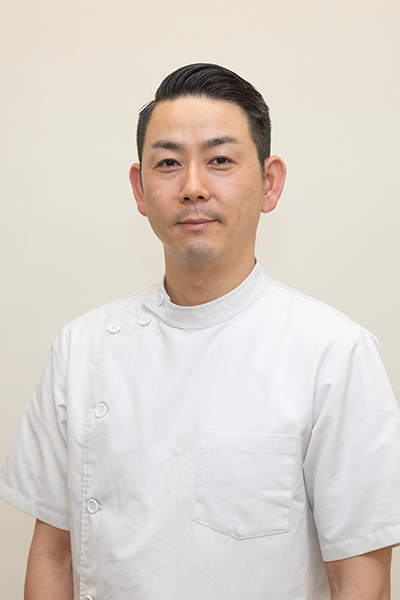
長引いた痛みを一人で治すのは困難なことが多いです。
困ったときは自身で判断せずに適切な処置を受けるために専門家に相談しましょう。
もし、お近くにお住まいで、困っているならば、一度ひまわり接骨院までお問い合わせください。腰痛・坐骨神経痛の専門家の新幡が、ご相談に乗ります。
気軽にご相談ください。

新着情報・お知らせ
平常通り営業致します。
日・祝休みです。
タイトル「腰痛は戦うのをやめると、痛みは消え始める」
Amazonの「Kindle Unlimited」にご登録の方は、【無料(0円)】で今すぐお読みいただけます!
↓↓
こちらから

タイトル「不安から逃げるのをやめると、腰痛は消え始める」」
Amazonの「Kindle Unlimited」にご登録の方は、【無料(0円)】で今すぐお読みいただけます!
↓↓
こちらから

お気軽にお問合せください

お電話でのお問合せ・相談予約
<受付時間>
月~土
9:00〜13:00 /15:00〜19:00
※日曜・祝日は除く
フォームは24時間受付中です。お気軽にご連絡ください。
ひまわり接骨院
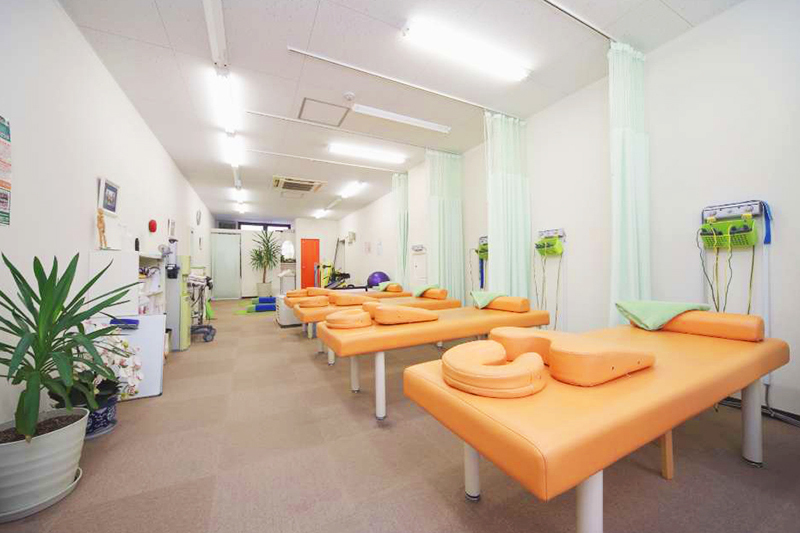
住所
〒213-0002
神奈川県川崎市高津区二子1丁目7−17 リバーサイドマンション杉崎 102
アクセス
二子新地駅 徒歩3分
駐車場:近隣にコインパーキングあり。自転車・バイクは店舗前に駐輪場がございます。
受付時間
月~土
9:00〜13:00 /15:00〜19:00
定休日
日曜・祝日