〒213-0002 神奈川県川崎市高津区二子1丁目7−17
リバーサイドマンション杉崎 102 二子新地駅 徒歩3分
| 月 | 火 | 水 | 木 | 金 | 土 | 日祝 | |
|---|---|---|---|---|---|---|---|
| 9:00〜13:00 | ● | ● | ● | ● | ● | ● | ─ |
| 15:00〜19:00 | ● | ● | ● | ● | ● | ● | ─ |
腸内細菌叢と腰痛・椎間板の意外な繋がり
公開日:2026/07/23
更新日:2026/00/00
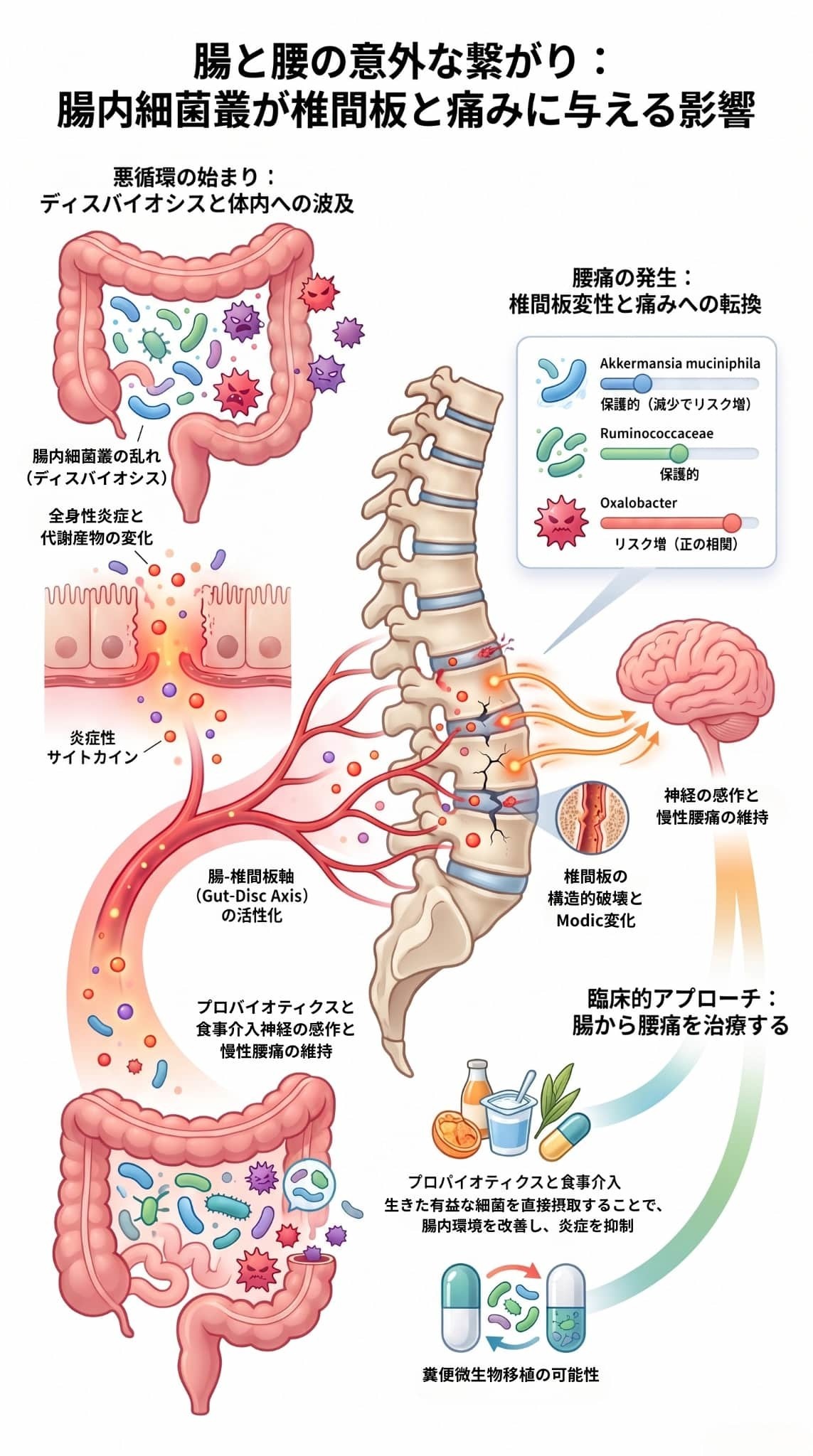
腸内細菌叢と腰痛の因果関係およびその生物学的メカニズムを包括的に解説しています。
最新のエビデンスにより、腸内の細菌バランスが崩れるディスバイオシスが、炎症性サイトカインや代謝産物を介して椎間板変性や慢性的な痛みを引き起こす可能性が示されました。
特に「腸ー椎間板軸」という概念が提唱されており、腸内環境の悪化が脊椎の健康に直接影響を与える経路が明らかにされています。
臨床面では、プロバイオティクスや食事介入、さらには糞便微生物移植が腰痛の新たな治療戦略として期待されています。
一方で、結果には研究間の不一致も残っており、個別化された介入やさらなる学際的研究の必要性が強調されています。
総じて、腸内環境の調節が腰痛の予防と治療における革新的なアプローチになる可能性を提示しています。
目次
腸内細菌叢と腰痛の関係性における主要な知見は、因果関係の遺伝学的エビデンス、特定の病態における細菌叢の変化、および**「腸-椎間板軸」を介した生物学的メカニズム**の観点から整理されます。
- 保護的に働く細菌群: **Akkermansia muciniphila(アッカーマンシア・ムシニフィラ)の存在量と椎間板変性リスクの間には因果的な逆相関(保護的な関連)**が特定されており、便中の同菌のレベル減少は椎間板変性の重症度増加と相関しています。また、Ruminococcaceae(ルミノコッカス科)、ブチリシコッカス(Butyricicoccus)、ラクノスピラ科(Lachnospiraceae)、オルセネラ(Olsenella)なども腰痛に対して保護的な因果関係(リスク低下)が示されています。
- リスクを高める細菌群: ティザレラ3(Tyzzerella 3)は腰痛のリスク因子**として特定されています。
- BMIの媒介: 多変量解析において、BMIを追加すると多くの細菌群の曝露-アウトカム効果が有意に減弱・無効化する傾向があり、腸内細菌叢と腰痛の関連の一部がBMIによって媒介されている可能性が示されています。
観察研究や症例対照研究において、腰痛患者における腸内細菌叢の破綻(ディスバイオシス)が具体的に報告されています。
- 多様性の低下: 慢性疼痛患者や、椎間板変性に強く関連するModic(モディック)変化患者では、腸内細菌叢のα多様性(種の豊富さや均等さ)が有意に減少していることが確認されています。
- 特徴的な細菌の変動: 慢性腰痛患者では、対照群と比較して52種の細菌種で存在量に有意差があり、特にクロストリジオイデス・ディフィシル(Clostridium difficile)が豊富に存在することが観察されています。また、Modic変化患者においてはunclassified_Parabacteroidesやバクテロイデス・ユニフォルミス(Bacteroides uniformis)が主要な識別細菌として特定されています。
※unclassified_Parabacteroides:パラバクテロイデス属(Parabacteroides)に属していることは分かるが、詳細な種(しゅ)までは分類(特定)されていないグループ
腸内細菌叢が腰痛に影響を与える経路として、**「腸-椎間板軸(Gut-Disc Axis)」**などの双方向性コミュニケーションシステムが提唱されています。主な生物学的メカニズムは以下の3つの経路に大別されます。
- 細菌の直接移行: ディスバイオシスにより腸管透過性が変化し、細菌が腸上皮バリアを越えて椎間板に移行する可能性が指摘されています。
- 免疫調節と全身性炎症: ディスバイオシスは、TNF-α、IL-1β、IL-6などの炎症性サイトカインを増加させ、全身性炎症反応や末梢・中枢感作(疼痛に対する感度の増幅)を引き起こします。
- 代謝産物の作用: 腸内細菌が産生する短鎖脂肪酸(SCFA)、胆汁酸、トリプトファン誘導体などの代謝産物が、神経炎症や侵害受容シグナル伝達を調節し、血流を介して椎間板の外部・内部の微小環境に拡散・影響を与えます。
- プロバイオティクス: Modic変化を伴う慢性腰痛患者を対象に、ビフィドバクテリウム・アドレセンティス(Bifidobacterium adolescentis)を投与する二重盲検無作為化プラセボ対照試験が実施されています。また、アッカーマンシア・ムシニフィラ(Akkermansia muciniphila)やその由来の細胞外小胞(Akk-EVs)が椎間板変性を保護する効果も動物モデルで実証されています。
- その他のアプローチ: 糞便微生物移植(FMT)抗炎症食・特定の栄養素(オメガ-3脂肪酸など)を用いた食事介入、ライフスタイル介入(電気鍼など)が、腸内細菌叢を調整し疼痛を緩和する新規治療法として注目されています。
腸内細菌叢と腰痛の関係性に着目されるようになった背景には、腰痛という疾患の深刻さ、ゲノム解析技術の飛躍的な進歩、そして腸と全身の器官を結ぶ双方向性のネットワーク(軸)の解明といった、複数の要因が重なり合っています。
腰痛は世界的に最も一般的な筋骨格系疾患の一つであり、その病態生理は非常に複雑で多因子的です。生涯のある時点で人口の約3分の2が罹患するとされており、慢性腰痛は日常生活に支障をきたす主要な障害要因となっています。
特に高齢化社会において、腰痛の主要原因である椎間板変性などの脊椎変性疾患は、極めて重大な社会経済的問題となっています。しかし、従来の治療法では効果が限定的な患者も多く、新たな治療標的の開拓が強く求められていました。
近年、配列ベースの検出法(メタゲノミクス)の進歩・発展により、腸内細菌叢が宿主の健康維持や疾患の調節において極めて重要な役割を果たしていることが急速に明らかになってきました。
その中で、腸内細菌叢のバランスが崩れる**「ディスバイオシス(不均衡)」**が、リウマチ性疾患、神経障害性疼痛、神経変性疾患といった様々な疾患の病態生理に寄与していることが示され、筋骨格系疾患や疼痛との関連性が注目されるようになりました。
腸内細菌叢のディスバイオシスが全身性炎症や筋骨格系疾患に関与するというエビデンスが蓄積されるにつれ、腸と骨を結ぶ「腸-骨軸」や「腸-骨-脳軸」といった概念に加え、**「腸-椎間板軸(Gut-Disc Axis)」**という概念が新たに提唱されました。
腰痛の主要原因である椎間板変性や、それに強く関連する椎体終板病変(Modic変化)に対して、腸内細菌のバリア透過性の変化による直接移行、全身性の免疫・炎症調節、あるいは代謝産物の拡散といった経路を通じて、腸内細菌叢が関与している可能性が強く示唆されるようになったことが、研究を加速させる大きな背景となっています。
従来の対症療法や侵襲的な治療とは異なり、**食事、プレバイオティクス、プロバイオティクス、糞便微生物移植(FMT)**などを用いて腸内細菌叢にアプローチする手法が、副作用が少なく個別化しやすい「腰痛の新規治療・予防戦略」として、理論的かつ臨床的な可能性を秘めていると期待されたためです。
腸内細菌叢と腰痛の関連性を示す疫学的エビデンスは、**遺伝的な因果関係を検証する「メンデルランダム化(MR)研究」**と、**患者の臨床データを比較する「観察研究・症例対照研究」**の2つのアプローチから蓄積されています。
■椎間板変性における因果関係:
- **Akkermansia muciniphila(アッカーマンシア・ムシニフィラ)の存在量と椎間板変性(IDD)リスクとの間に因果的な逆相関(保護的な関連)**が特定されています。便中の同菌レベルの減少は、椎間板変性の重症度増加と直接相関しています。
- 椎間板変性を対象とした別のMR研究では、10の細菌形質が因果関係を持つことが特定されています。また、椎間板変性の発生と強く関連する6つの分類群が特定されており、そのうちコマモナスB属(ComamonasB)、ハロモナス科(Halomonadaceae)、UBA6960科は、血液代謝産物を介してその関連が媒介されていることが示されています。
■腰痛に対して保護的に働く(リスクを下げる)細菌群:
- Ruminococcaceae(ルミノコッカス科):腰痛と負の因果関係(保護的)を示しています(ある研究では OR 0.923, 95% CI 0.849–0.997, p=0.033;別の研究では OR 0.771, 95% CI 0.652–0.913, FDR補正p=0.045)。属レベルでは Ruminococcaceae UCG011(OR 0.859, p=0.0003)も保護因子として同定されています。
- Butyricicoccus(ブチリシコッカス)(OR 0.920, p=0.002)および Lachnospiraceae(ラハノスピラ科)(OR 0.948, p=0.022)も腰痛と負の関連(保護的)を示しています。
- Olsenella(オルセネラ属)(OR 0.893, p=0.0004)も腰痛の保護因子として特定されています。
■腰痛のリスクを高める細菌群:
- Oxalobacter(オキサロバクター属):複数のMR研究において、腰痛リスクの増加と一貫して相関しています(OR 1.143、OR 1.151、および IVW解析による FDR p=0.044)。
- Tyzzerella 3(ティザレラ 3):腰痛のリスク因子として特定されています(OR 1.145, 95% CI 1.059–1.238, p=0.0007)。
- 慢性局所疼痛を対象としたMR研究では、Class Bacteroidia(バクテロイデス綱)、Order Bacteroidales(バクテロイデス目)、Phylum Bacteroidetes(バクテロイデーテス門)が腰痛と因果関係を持つことが示されています。
■BMI(体格指数)による媒介効果:
- 多変量MR解析において、BMIを追加すると17の腸内細菌群の曝露-アウトカム効果が有意に減弱し無効になる傾向がありました。これは、腸内細菌叢が腰痛に及ぼす影響の一部が、BMI(肥満など)を介して媒介されている可能性を示唆しています。
■双方向性の因果関係:
- 双方向MR研究により、「腸内細菌叢の変化が処方オピオイド使用や多部位慢性疼痛のリスクを増加させる」という因果の方向性が示唆される一方、その逆(「疼痛そのものが腸内細菌叢を直接変化させる」)という明確な証拠は見つかっていません。
実際の患者を対象とした臨床比較研究により、腰痛の有無や病態の違いに伴う具体的な細菌叢の破綻(ディスバイオシス)が報告されています。
■慢性腰痛(CLBP)患者における特徴:
- 慢性腰痛患者73名(腰痛群40名、対照群33名)を対象とした研究では、52種の細菌種で平均相対存在量に有意な差(36種が腰痛群で豊富、16種が対照群で豊富)が認められました。特に、腰痛群ではClostridium difficile(クロストリジウム・ディフィシル)の存在量が有意に多いことが確認されています。
■Modic変化(椎体終板病変)を伴う腰痛患者:
- Modic変化患者31名と健常対照者25名の比較において、Modic変化患者では腸内細菌のα多様性(Chao1、Shannon、Simpson指数すべて)が有意に減少しており、特に重症なType 1 Modic変化で最も顕著でした。
- 主要な識別タクサ(バイオマーカー候補)として、Bacteroides uniformis(バクテロイデス・ユニフォルミス)(AUC=0.889)**が極めて高い精度で特定されています。
■骨髄病変・脂肪置換を伴う慢性腰痛:
- 脂肪置換を伴う慢性腰痛患者は血清中の分岐鎖アミノ酸(BCAA)レベルの低下を特徴としており、これがBCAA分解経路を調整する腸内細菌叢と相関しています。
- 具体的には、Ruminococcus gnavus(ルミノコッカス・グナバス)、Roseburia hominis(ロゼブリア・ホミニス)、Lachnospiraceae bacterium 8 1 57FAA(ラクノスピラ科の一種)が、BCAA生合成と骨髄間葉系幹細胞代謝(脂肪形成誘導など)の関連を促進する主要な種として特定されています。
■過体重・肥満の個人における腰痛:
- 過体重・肥満者36名を対象とした横断研究では、腰痛を持つ個人においてAdlercreutzia(アドレクルーツィア)の存在量が有意に高く、また(一般的な慢性疼痛とは逆に)α多様性(Chao1指数)が有意に高いという特異的な結果が報告されています。
■慢性疼痛・慢性広範性疼痛全般におけるディスバイオシス:
- システマティックレビューとメタアナリシス(慢性疼痛患者対象)では、α多様性の有意な減少が示されており、Lachnospiraceae科(ラクノスピラ科)、Faecalibacterium属(フィーカリバクテリウム)、Roseburia属(ロゼブリア属)、Faecalibacterium prausnitzii(フィーカリバクテリウム・プラウスニッツィ)、Odoribacter splanchnicus(オドリバクター・スプランクニクス)の相対存在量の減少と、*Eggerthella spp.*の増加が認められています。
- 慢性広範性筋骨格痛患者113名のコホートでもα多様性が有意に低く、Coprococcus comes(コプロコッカス・コメス)が有意に枯渇していました。
■研究間の一貫性の欠如:
- 例えば**Lactobacillaceae(乳酸菌科)**は、あるMR研究では腰痛と正の関連(リスク増)を示した一方、別の研究では保護的な因果関係(OR 0.875, FDR補正p=0.045)を示すなど、一貫性のない結果が報告されています。
■環境要因と交絡因子の調整不足:
- 腸内細菌叢は食事、抗生物質などの薬剤、生活習慣に大きく左右されますが、多くの観察研究において食事などの環境的交絡因子が十分に考慮されていないことが指摘されています。
■サンプルサイズと方法論の標準化:
- 既存の臨床観察研究やFMT(糞便微生物移植)等のヒト試験は、しばしば小規模かつ不均一なコホートに基づいているため予備的な段階に留まっており、16S rRNA配列決定法の機能評価における解像度の限界も存在します。
腸内細菌叢が腰痛に影響を与える生物学的メカニズムは、腸管と中枢神経系を双方向的に結ぶ**「腸脳脊髄軸(腸-脊髄軸)」** や、腸と椎間板を結ぶ**「腸-椎間板軸」** の破綻を介した、複数の相互作用ネットワークによって構成されています。
具体的には、以下の4つの主要な経路を通じて、椎間板の変性や疼痛の増幅が引き起こされます。
腸内細菌叢の不均衡(ディスバイオシス)が、腰痛の主要原因である椎間板変性を誘発する経路として、主に以下の3つのメカニズムが提唱されています:
- 細菌の直接移行: ディスバイオシスに伴って腸管透過性が変化し、細菌が腸上皮バリアを越えて直接椎間板に移行する可能性が示唆されています。
- 粘膜・全身免疫系の調節: 腸管の局所的な免疫系、および全身の免疫応答を調節することで、椎間板の健康に影響を及ぼします。
- 代謝産物の拡散: 腸上皮における栄養吸収と代謝産物の形成が調節され、それらが血流を介して椎間板へ拡散・浸透します。
- 全身性炎症とサイトカインの増加: ディスバイオシスは、炎症性サイトカイン(TNF-α、IL-1β、IL-6)のレベルを増加させ、一方で抗炎症因子(IL-4、TGF-β、IL-10)を減少させます。例えば、神経損傷時の炎症性TNF-αの発現は、腸内細菌叢を枯渇させることで減少することが示されています。
- TLR4/MyD88経路の活性化: ディスバイオシスは、TLR4/MyD88シグナル伝達経路を活性化し(TLR4, MyD88, p65, IkBaなどの発現増)、炎症性環境を形成して脊髄の損傷や痛みを悪化させます。
- T細胞バランスの制御: 腸内細菌は、炎症を促進するT細胞(Th1やTh17)と、炎症を抑制する制御性T細胞(Treg)のバランス調整において重要な役割を果たします。経口抗生物質投与により腸内細菌を変化させると、IFN-γ産生Th1細胞が減少し、Foxp3+制御性T細胞(Treg)が増加して、神経障害性疼痛が減弱することが確認されています。
- 乳酸菌の介入効果: マウスモデルにおいてLactobacillus paracasei S16を投与すると、Th1/Th2の割合やTh17/Treg比が減少し、腰椎椎間板ヘルニアに伴う炎症応答が緩和されることが実証されています。
※Lactobacillus paracasei S16:学術研究において抗炎症作用や腸内環境の調整効果が報告されている特定の乳酸菌株
- 内受容シグナル伝達: 腸の感覚情報は、迷走神経の求心性経路や脊髄経路を介して中枢(脊髄や脳幹を経由し、大脳皮質辺縁系回路など)に伝達されます。
- 神経細胞への影響: 腸内細菌叢が産生する短鎖脂肪酸(SCFA)やインドールなどの代謝産物は、腸管神経系の腸クロム親和性細胞(EC細胞)に影響を与え、シグナルを脳へと伝えます。
- 脳・神経ネットワークの変容: メンデルランダム化(MR)を用いた媒介分析により、特定の腸内細菌(Genus Eubacterium brachy)が坐骨神経痛に与える因果効果のうち、27.07%が脳の特定のネットワーク(右半球の顕著性/腹側注意ネットワークと被殻との接続性)を介して媒介されていることが明らかにされています。
■末梢および中枢感作(痛みの増幅):
- ディスバイオシス下では、短鎖脂肪酸(SCFA)産生菌が減少し、炎症促進性の細菌群が過剰増殖します。これに伴い、SCFA(プロピオン酸、酪酸、酢酸)、胆汁酸、トリプトファン代謝産物(セロトニン、キヌレン酸、キノリン酸など)の産生バランスが崩れます。
- これらの代謝産物が宿主の受容体と相互作用することで、侵害受容ニューロンの興奮性が変化し、免疫細胞からのサイトカイン放出が刺激されます(末梢感作)。
- さらに、これが血液脳関門(BBB)の透過性を増加させ、**中枢(脊髄など)のミクログリアを活性化して神経炎症を増幅(中枢感作)**させます。活性化されたミクログリアは、グルタミン酸作動性活動(興奮性)を強め、GABA作動性シグナル伝達(抑制性)を弱めることで、神経伝達のバランスを破壊し、痛みを固定化させます。
- 分岐鎖アミノ酸(BCAA)の代謝と骨髄病変:
- 脂肪置換を伴う慢性腰痛患者では、血清中のBCAAレベルが低下しています。
- 腸内細菌の Ruminococcus gnavus、Roseburia hominis、Lachnospiraceae bacterium 8 1 57FAA は、BCAA分解・生合成経路を調節しており、BCAAがSIRT4経路を活性化して骨髄間葉系幹細胞の脂肪形成(骨髄病変における脂肪置換)を誘導することを促進しています。
■局所代謝経路の変化:
- 椎間板変性モデルを用いた研究では、チロシン代謝やアミノ糖・ヌクレオチド糖代謝、安息香酸分解といった複数の代謝経路が顕著に変容しており、特にDL-チロシンやN-アセチルムラミン酸といった代謝産物が、特定の病原性細菌群(HelicobacterやVibrioなど)の動態と強く相関していることが報告されています。
**腸内細菌叢の乱れ(ディスバイオシス)**は、腸と全身の様々な組織を繋ぐ「腸-椎間板軸(Gut-Disc Axis)」などの伝達シグナルの破綻を引き起こし、椎間板変性やこれに伴う慢性疼痛を誘発・増悪させる直接的な要因と考えられています。
その具体的な影響や機序は以下の通りです。
腸内細菌叢の乱れ(ディスバイオシス)は、椎間板の外部および内部の微小環境を物理的・化学的に変容させ、椎間板変性を引き起こします。
■「腸-椎間板軸」を介した3つの病因経路: ディスバイオシスは以下の3つの経路を通じて椎間板の健康を破綻させます。
- 細菌の直接的な移行: 腸管の透過性が変化(リーキーガット化)することで、腸内細菌が上皮バリアを越えて直接椎間板組織へ移行する可能性が示唆されています。
- 免疫系の活性化: 粘膜および全身の免疫系を調節し、炎症反応を引き起こします。
- 代謝産物の拡散: 腸上皮での栄養吸収や代謝産物の形成プロセスを攪乱し、生成された代謝物が血流を介して椎間板へと拡散します。
■椎間板内・外部環境の変容と病原性細菌: 正常な椎間板組織には本来 Firmicutes(ファーミキューテス/フィルミクテス)や Actinobacteria (アクチノバクテリア)が豊富に存在していますが、腸内細菌叢の乱れ(ディスバイオシス)によってこれらのバランスが崩れ、変性またはヘルニアを起こした椎間板では病原性細菌が多く検出されるようになります。ウサギモデルを用いた研究では、椎間板変性によって腸内細菌叢のβ多様性や優勢な属の構成が著しく変化することが確認されています。
■代謝プロファイルの異常: 椎間板変性の進行に伴い、腸内および糞便中の代謝経路に大きな変動が生じます。特にチロシン代謝、アミノ糖・ヌクレオチド糖代謝、安息香酸分解、ABCトランスポーター、アスコルビン酸やパントテン酸代謝などが強く影響を受けます。その中で、代謝物である DL-チロシン や N-アセチルムラミン酸 のレベルが、Helicobacter (ヘリコバクター・ピロリ)や Vibrio (ビブリオ属)といった特定の病原性細菌の動態と密接に関連していることが報告されています。
■アッカーマンシア・ムシニフィラ(Akkermansia muciniphila)の枯渇: 疫学的(メンデルランダム化)研究や臨床コホートにおいて、アッカーマンシア・ムシニフィラ(Akk)の減少と椎間板変性の重症化に因果的な逆相関(保護的な関係)細胞外小胞(Akk-EVs)、およびそのエフェクタータンパク質である B2UKX5 は、自然老化や物理的損傷による椎間板変性を保護する作用があり、これらが減少することで変性が加速します。
ディスバイオシスは、腰痛や慢性疼痛に関連する特定の局所病態とも深く結びついています。
■Modic変化(椎体終板病変)との関連: 椎間板性腰痛の重要な病因であるModic変化患者では、腸内細菌叢のα多様性(Chao1, Shannon, Simpson指数)が有意に減少しており、特に重症度の高いType 1 Modic変化においてこの多様性の低下が顕著にみられます。
- 識別バイオマーカー: Modic変化患者を健常群と区別する特徴的な細菌(タクサ)として、unclassified_Parabacteroides(AUC=0.895)や Bacteroides uniformis(バクテロイデス・ユニフォルミス)(AUC=0.889)が高い精度で特定されています。
※※unclassified_Parabacteroides:パラバクテロイデス属(Parabacteroides)に属していることは分かるが、詳細な種(しゅ)までは分類(特定)されていないグループ
- 代謝の偏り: 患者の腸内では「クオラムセンシング」や「グリセロ脂質代謝」などの代謝経路が過剰に濃縮されており、これらが炎症反応(高CRP値)や重度の椎間板変性(高Pfirrmannグレード)と強く相関しています。
■骨髄病変(終板の脂肪置換)を伴う慢性腰痛: 脂肪置換を伴う慢性腰痛患者では、血清中の**分岐鎖アミノ酸(BCAA)**レベルが低下しています。これはBCAA分解経路を調整する能力を持つ特定の腸内細菌叢と相関しています。
- 鍵となる細菌として、Ruminococcus gnavus、Roseburia hominis、Lachnospiraceae bacterium 8 1 57FAA が特定されており、これらがBCAAの生合成と骨髄間葉系幹細胞代謝を制御しています。
- BCAAの不足や分解経路の変化は、SIRT4経路を介して骨髄間葉系幹細胞の異常な脂肪形成(脂肪置換)を促進し、慢性的な腰痛に寄与します。
腸内細菌叢の乱れ(ディスバイオシス)は、腰の局所的病変を進めるだけでなく、**神経系を過敏にして痛みを持続・増幅させる「感作」**に大きく関与します。
- 慢性腰痛患者における細菌叢のアンバランス: 臨床観察研究において、慢性腰痛患者の腸内からは健常群と比較して悪玉菌である Clostridium difficile(クロストリジウム・ディフィシル)が有意に多く検出されます。腰痛患者と対照群の間では、52種もの細菌種の平均相対存在量に有意な差が見出されています。
- 代謝産物の変化と末梢感作: ディスバイオシス下では、酪酸やプロピオン酸、酢酸といった短鎖脂肪酸(SCFA)を産生する有益な細菌群が減少し、炎症を促進する細菌群が過剰増殖します。これにより代謝産物の組成が崩れ、これらが末梢の侵害受容ニューロン(痛みを感じる神経)の受容体と相互作用してその興奮性を高めます(末梢感作)。また、免疫細胞を刺激して TNF-α、IL-1β、IL-6 などの炎症性サイトカインを放出させ、局所的な炎症環境を維持します。
- 血液脳関門の突破と中枢感作(ミクログリアの活性化): 崩れた代謝産物や放出されたサイトカインは血液脳関門(BBB)の透過性を高め、脳や脊髄などの中枢神経系に到達します。これにより中枢の免疫細胞であるミクログリアが活性化され、神経炎症が増幅されます。 活性化されたミクログリアは、グルタミン酸作動性活動(痛みを伝える興奮性シグナル)を強め、GABA作動性シグナル伝達(痛みを抑える抑制性シグナル)を弱めることで、中枢感作(痛みの固定化・慢性化)を誘導・維持してしまいます。
- 慢性疼痛・広範性疼痛全般に共通する乱れ: 慢性疼痛や慢性広範性筋骨格痛の患者では、全般的に腸内細菌叢のα多様性が低下しており、抗炎症作用を持つ Lachnospiraceae科、Faecalibacterium属、Roseburia属、Faecalibacterium prausnitzii、Coprococcus comes などの有益な細菌が有意に枯渇し、逆に Eggerthella spp. などの炎症を惹起しやすい細菌が増加していることが確認されています。
このように、腸内細菌叢の乱れ(ディスバイオシス)は、椎間板の物理的な変性を進めるだけでなく、特定の神経経路や代謝産物を介して全身の痛みの閾値を下げ、腰痛を慢性化・複雑化させる強力な推進力となっています。
腰痛において腸内細菌叢を標的とした介入を行うことは、従来の対症療法や侵襲的治療(手術など)とは異なり、炎症の抑制、代謝恒常性の回復、そして神経可塑性の調節を通じて、腰痛を根本的に予防・治療する新たなアプローチとして極めて重要な臨床的意義を持っています。
現在、腸内細菌叢のバランスを整えて腰痛やそれに関連する痛みを和らげるために、主に以下の3つのアプローチが研究されています。
- ビフィズス菌(Bifidobacterium): 椎間板変性患者においてビフィズス菌の減少が報告されていることを受け、Modic変化(I型またはII型)を伴う慢性腰痛患者を対象とした多施設共同の二重盲検無作為化プラセボ対照試験が進行中です。この試験では、Bifidobacterium adolescentis (ビフィドバクテリウム・アドレセンティス)を3ヶ月間投与し、腰痛による機能障害質問票(Roland-Morris Disability Questionnaire)を用いて、治療後最長12ヶ月間にわたる改善効果を厳格に評価しています。
- アッカーマンシア菌(Akkermansia muciniphila): 椎間板変性の重症度と負の相関があるこの細菌、あるいはその**細胞外小胞(Akk-EVs)**をマウスに投与した実験では、自然老化や物理的損傷による椎間板変性を保護する効果が実証されています。
- 乳酸菌(Lactobacillus): 動物モデル(腰椎椎間板ヘルニア)において、Lactobacillus paracasei S16 の投与が炎症性T細胞の割合(Th1/Th2比、Th17/Treg比)を減少させ、ヘルニアに伴う炎症を効果的に緩和することが報告されています。
- ヒトにおける臨床試験: 線維筋痛症患者45名を対象とした無作為化比較試験において、FMT治療を受けたグループは、**痛みの数値(NRSスコア)が有意に減少(総有効率90.9%)**したほか、不安・抑うつ、睡眠の質も劇的に改善しました。また、治療6ヶ月後には鎮痛に関わる神経伝達物質(セロトニン、GABA)が有意に増加し、痛みを強めるグルタミン酸が減少しました。
- 動物モデルでの知見: 神経障害性疼痛ラットモデルに対するFMTは、痛覚過敏を改善させるだけでなく、血中脊髄関門(BSCB)の完全性を回復させ、全身のサイトカインバランスを再調整(IL-6やTNF-αを減少、IL-10を増加)させることが確認されています。
- 栄養素の活用: マグネシウム、セレン、オメガ-3脂肪酸、抗酸化化合物などは、痛みと炎症の経路に直接影響を与える潜在的な可能性を有しています。
- ライフスタイルとの統合: 運動やプロバイオティクス摂取に加え、電気鍼治療などが、腸内細菌叢の多様性を変化させるとともに、痛みのスコアを有意に改善させることが示されています。
特定の腸内細菌やその代謝産物は、腰痛の診断、予後(見通し)、および治療効果を判定するための客観的なバイオマーカーとして応用できる可能性があります。
- 椎間板変性の進行度評価: Akkermansia muciniphila 由来の細胞外小胞(Akk-EVs)やそのエフェクタータンパク質 B2UKX5 の循環レベルは、椎間板変性の重症度と負の相関があるため、診断や治療反応性を評価する優れたバイオマーカーになり得ます。
- Modic変化の精密診断: Modic変化患者を健常者と区別する上で、unclassified_Parabacteroides(AUC=0.895)および Bacteroides uniformis(AUC=0.889)という特定の細菌種が極めて高い識別精度を示しており、非侵襲的な診断指標としての活用が期待されています。
これらの介入には大きな可能性が秘められている一方で、日常の臨床現場に普及させるには以下のような課題を克服する必要があります。
- エビデンスの不均一性と一貫性の欠如: これまでのヒトを対象とした介入研究や観察研究は、しばしば小規模で予備的なコホートに基づいています。例えば、乳酸菌(Lactobacillaceae)の効果についても、研究によってリスクを上げるという報告と、保護的(リスクを下げる)という報告の双方が存在し、一貫性がありません。
- 多くの未調整交絡因子(特に食事): 腸内細菌叢は個人の食事、薬物療法(抗生物質など)、ライフスタイルによって容易に変化しますが、既存の多くの臨床試験において、これらの環境的な交絡因子が十分に考慮・調整されていません。
- 方法論の標準化不足: 16S rRNA配列決定法には、機能評価や解像度(種の特定)の面で技術的な限界があり、解析手法の標準化や再現性の確保が急務とされています。
- ガイドラインの未確立: 個人の細菌プロファイルに基づいて慎重に栄養・治療アプローチを統合するための標準的な治療ガイドラインは、現時点では存在していません。
腸内細菌叢を標的とした介入は、腰痛や慢性疼痛の病態生理に「腸」という全く新しい治療窓口を開くものです。今後は、食事などの交絡因子を厳格に管理した、マルチオミクス統合による大規模な縦断的コホート研究を実施し、一人ひとりの細菌叢に適した「個別化介入戦略」を確立していくことが、真の臨床実用化に向けた優先事項とされています。
腸内細菌叢と腰痛の関係性に関する最新研究レビューが導き出している科学的結論は、新たな病態生理の理解と治療戦略のロードマップを示すものであり、大きく以下の3つの要点に集約されます。
- 「腸脳脊髄軸」および「腸-椎間板軸」の確立: 腸内細菌叢のディスバイオシス(不均衡)が、椎間板変性や慢性腰痛の発症・維持に直接的または間接的に寄与していることが示され、腸管の健康と脊椎の健康が密接に関連していることが科学的に明らかになりました。
- 因果関係の存在: メンデルランダム化(MR)研究により、特定の腸内細菌群と腰痛の間に遺伝的な因果関係が存在する可能性が示されています。また、実際の臨床観察研究でも、慢性腰痛患者における腸内細菌叢の多様性の減少と特定の細菌種の存在量の変化が一貫して報告されています。
- 統合的な相互作用メカニズム: 腸内細菌叢が腰痛に与える影響は単一の経路ではなく、**炎症性メディエーター、神経シグナル伝達、代謝産物(短鎖脂肪酸やアミノ酸など)、免疫応答という複数の経路が相互に関連し合う「統合的メカニズム」**を形成して、椎間板変性と慢性疼痛を修飾していると結論づけられています。
- 新規治療戦略としてのポテンシャル: プロバイオティクス、糞便微生物移植(FMT)、食事介入といった腸内細菌叢を標的とした介入が、腰痛の新たな治療選択肢となる可能性が示されています。これらは炎症の抑制、代謝恒常性の回復、神経可塑性の調節を通じて、従来の治療法では効果が限定的であった患者の腰痛の予防と治療に貢献することが期待されています。
- 客観的バイオマーカーとしての応用性: 特定の細菌種(Modic変化を識別する細菌など)やその代謝産物(アッカーマンシア・ムシニフィラ由来の細胞外小胞やエフェクタータンパク質B2UKX5など)は、腰痛や椎間板変性の診断、予後予測、あるいは治療反応性を評価する非侵襲的なバイオマーカーとして臨床応用できる可能性が結論づけられています。
- エビデンスの不均一性と課題: 特定の細菌種の役割について研究間で一貫性のない(または矛盾する)結果が存在すること、多くの試験が小規模であること、食事や薬物療法などの環境的な交絡因子への考慮が不十分であること、そして16S rRNA配列決定法をはじめとする解析方法論の標準化や再現性の確保が課題となっています。
- 今後のロードマップ: 因果関係を病原性として完全に確立し、基礎研究の知見を実際の患者治療に結びつけるためには、微生物学、神経免疫学、疼痛研究を横断する**「学際的アプローチ」**が求められます。今後は、マルチオミクス統合、厳格に管理された大規模な縦断的コホート研究、そして個人の細菌プロファイルに応じた「個別化介入」の開発が不可欠な優先事項であると結論されています。
[1]J. Hui et al., “Insight into the Causal Relationship between Gut Microbiota and Back Pain: A Two Sample Bidirectional Mendelian Randomization Study,” Nov. 2023, doi: 10.1002/ggn2.202300192.
[2]B. Lan, Y. Liang, Z. Zhou, and J. Liu, “Gut microbiome dysbiosis implicates the gut-bone axis in Modic changes: a metagenomic case–control study,” Frontiers in Microbiology, vol. 16, Dec. 2025, doi: 10.3389/fmicb.2025.1702357.
[3]Fang et al., “Causal associations between gut microbiota with intervertebral disk degeneration, low back pain, and sciatica: a Mendelian randomization study.,” European spine journal : official publication of the European Spine Society, the European Spinal Deformity Society, and the European Section of the Cervical Spine Research Society, 2024, doi: 10.1007/s00586-024-08131-x.
[4]Y. Cai et al., “Multiple reports on the causal relationship between various chronic pain and gut microbiota: a two-sample Mendelian randomization study,” Frontiers in Neuroscience, Apr. 2024, doi: 10.3389/fnins.2024.1369996.
[5]H. Ratna, M. Jeyaraman, S. Yadav, N. Jeyaraman, and A. kumar Nallakumarasamy, “Is Dysbiotic Gut the Cause of Low Back Pain?,” Cureus, vol. 15, July 2023, doi: 10.7759/cureus.42496.
[6]L. Goudman et al., “Gut dysbiosis in patients with chronic pain: a systematic review and meta-analysis,” Frontiers in Immunology, vol. 15, Jan. 2024, doi: 10.3389/fimmu.2024.1342833.
[7]S. Chen, H. Han, X. Sun, G. Zhou, Q. Zhou, and Z. Li, “Causal effects of specific gut microbiota on musculoskeletal diseases: a bidirectional two-sample Mendelian randomization study.,” Frontiers in Microbiology, vol. 14, pp. 1238800–1238800, Aug. 2023, doi: 10.3389/fmicb.2023.1238800.
[8]Y. Tang, W. Kong, S. Zhang, and T. Zhu, “Genetically supported causality between gut microbiota, gut metabolites and low back pain: a two-sample Mendelian randomization study,” Frontiers in Microbiology, vol. 14, Apr. 2023, doi: 10.3389/fmicb.2023.1157451.
[9]A. Das, “Gut-disc axis: A cause of intervertebral disc degeneration and low back pain?,” European Spine Journal, vol. 31, no. 4, pp. 917–925, Mar. 2022, doi: 10.1007/s00586-022-07152-8.
[10]S.-Z. Hong et al., “Genetically predicted causal effects of gut microbiota on spinal pain: a two-sample Mendelian randomization analysis,” Frontiers in Microbiology, Mar. 2024, doi: 10.3389/fmicb.2024.1357303.
[11]T. Morimoto et al., “Gut-spine axis: a possible correlation between gut microbiota and spinal degenerative diseases,” Frontiers in Microbiology, Oct. 2023, doi: 10.3389/fmicb.2023.1290858.
[12]Guan et al., “Akkermansia muciniphila attenuates intervertebral disc degeneration via extracellular vesicle-mediated delivery of the effector protein B2UKX5.,” Bone research, 2026, doi: 10.1038/s41413-026-00541-5.
[13]M. Jeyaraman, A. kumar Nallakumarasamy, and V. K. Jain, “Gut Microbiome - Should we treat the gut and not the bones?,” Journal of clinical orthopaedics and trauma, vol. 39, pp. 102149–102149, Mar. 2023, doi: 10.1016/j.jcot.2023.102149.
[14]S. Nian et al., “Bifidobacterium treatment for chronic low back pain in patients with Modic changes: study protocol for a multicenter, randomized, placebo-controlled trial,” Trials, vol. 26, no. 1, Sept. 2025, doi: 10.1186/s13063-025-09084-2.
[15]A. M. Tieppo, J. S. Tieppo, and L. A. Rivetti, “Analysis of Intestinal Bacterial Microbiota in Individuals with and without Chronic Low Back Pain,” Current Issues in Molecular Biology, vol. 46, no. 7, pp. 7339–7352, July 2024, doi: 10.3390/cimb46070435.
[16]Q.-A. Xiao et al., “The causality between gut microbiome and chronic regional pain: a Mendelian randomization analysis,” Frontiers in Microbiology, Feb. 2024, doi: 10.3389/fmicb.2024.1329521.
[17]W. Li et al., “Disease-associated gut microbiome and metabolome changes in chronic low back pain patients with bone marrow lesions,” bioRxiv, July 2023, doi: 10.1101/2023.07.26.550629.
[18]M. D. Nitert, A. Mousa, H. L. Barrett, H. L. Barrett, N. Naderpoor, and B. de Courten, “Altered Gut Microbiota Composition Is Associated With Back Pain in Overweight and Obese Individuals,” Frontiers in Endocrinology, vol. 11, p. 605, Sept. 2020, doi: 10.3389/FENDO.2020.00605.
[19]D. Zheng, Z. Wu, L. Li, S. Cheng, and J. P. Chang, “Genetic analysis of the causal relationship between gut microbiota and intervertebral disc degeneration: a two-sample Mendelian randomized study.,” European Spine Journal, Dec. 2023, doi: 10.1007/s00586-023-08059-8.
[20]Y. Zheng et al., “Causal Relationship Between Gut Microbiota, Blood Metabolites, and Intervertebral Disc Degeneration: A Two‐Step, Two‐Sample Bidirectional Mendelian Randomization Study,” JOR spine, vol. 8, no. 2, May 2025, doi: 10.1002/jsp2.70078.
[21]L. Lin et al., “Gut microbiota alterations may increase the risk of prescription opioid use, but not vice versa: A two-sample bi-directional Mendelian randomization study,” Frontiers in Microbiology, vol. 13, Nov. 2022, doi: 10.3389/fmicb.2022.994170.
[22]M. B. Freidin et al., “An association between chronic widespread pain and the gut microbiome.,” Rheumatology, vol. 60, no. 8, pp. 3727–3737, Nov. 2020, doi: 10.1093/RHEUMATOLOGY/KEAA847.
[23]Shi, Zhou, Ma, Wang, Deng, and Ma, “Genetically predicted the causal relationship between gut-brain axis and chronic pain: a Mendelian randomization study.,” Human genomics, 2025, doi: 10.1186/s40246-025-00876-w.
[24]K. Wang et al., “A new target for treating intervertebral disk degeneration: gut microbes,” Frontiers in Microbiology, vol. 15, Nov. 2024, doi: 10.3389/fmicb.2024.1452774.
[25]S. Y. Jung, “A new perspective on chronic pain: molecular biological mechanisms and neuroimmune interactions,” Journal of Korean Institute for Functional Medicine (Online), vol. 8, no. 1, pp. 6–19, May 2025, doi: 10.32581/jkifm.2025.8.1.6.
[26]Z. Gong et al., “The role of gut microbiota in neuropathic pain: insights into immune mechanisms,” Journal of Headache and Pain, vol. 27, no. 1, pp. 28–28, Dec. 2025, doi: 10.1186/s10194-025-02260-4.
[27]Z. Wang, H. Wu, Y. Chen, H. Chen, X. Wang, and W. Yuan, “Lactobacillus paracasei S16 Alleviates Lumbar Disc Herniation by Modulating Inflammation Response and Gut Microbiota.,” Frontiers in Nutrition, vol. 8, p. 701644, Aug. 2021, doi: 10.3389/FNUT.2021.701644.
[28]I. Ahmed et al., “Oral and Gut Health, (Neuro) Inflammation, and Central Sensitization in Chronic Pain: A Narrative Review of Mechanisms, Treatment Opportunities, and Research Agenda,” International Journal of Molecular Sciences, vol. 27, Dec. 2025, doi: 10.3390/ijms27010114.
[29]S. Cheng, J. Yu, M. Cui, H. Su, and Y. Cao, “Changes in the composition of the fecal metabolome and gut microbiota contribute to intervertebral disk degeneration in a rabbit model,” Journal of Orthopaedic Surgery and Research, vol. 19, Jan. 2024, doi: 10.1186/s13018-023-04486-x.
[30]S. Ni et al., “A new paradigm of bidirectional regulation of the gut-spinal cord axis.,” Neural Regeneration Research, Nov. 2025, doi: 10.4103/nrr.nrr-d-25-01016.
[31]Z. Rong et al., “Gut Microbiota Disorders Promote Inflammation and Aggravate Spinal Cord Injury Through the TLR4/MyD88 Signaling Pathway.,” Frontiers in Nutrition, vol. 8, pp. 702659–702659, Sept. 2021, doi: 10.3389/FNUT.2021.702659.
[32]J. Lee, G. Lee, G. Ko, and S. Lee, “Nerve injury-induced gut dysbiosis contributes to spinal cord TNF-α expression and nociceptive sensitization,” Brain Behavior and Immunity, vol. 110, pp. 155–161, Mar. 2023, doi: 10.1016/j.bbi.2023.03.005.
[33]O. Akpınar, “The gut-brain axis: interactions between microbiota and nervous systems,” vol. 10, no. 3, pp. 783–783, Aug. 2018, doi: 10.37212/JCNOS.610103.
[34]W. Ding et al., “Gut Microbiota Influences Neuropathic Pain Through Modulating Proinflammatory and Anti-inflammatory T Cells.,” Anesthesia & Analgesia, vol. 132, no. 4, pp. 1146–1155, Apr. 2021, doi: 10.1213/ANE.0000000000005155.
[35]J. Dong et al., “Gut–Spinal Cord Axis in Spinal Cord Injury: Bidirectional Inflammatory Mechanisms and Microbiota-Targeted Therapeutic Strategies,” Journal of Inflammation Research, vol. Volume 18, pp. 12549–12573, Sept. 2025, doi: 10.2147/jir.s543912.
[36]S.-Q. Li, T.-H. Chen, Y. Zhou, and X. Li, “Palmitic acid and trans-4-hydroxy-3-methoxycinnamate, the active ingredients of Yaobishu formula, reduce inflammation and pain by regulating gut microbiota and metabolic changes after lumbar disc herniation to activate autophagy and the Wnt/β-catenin pathway,” Biochimica Et Biophysica Acta: Molecular Basis Of Disease, vol. 1870, no. 2, pp. 166972–166972, Feb. 2024, doi: 10.1016/j.bbadis.2023.166972.
[37]M. Kano and S. Fukudo, “Gut–brain interactions,” Jan. 2023, doi: 10.1016/b978-0-12-820480-1.00036-x.
[38]B. Lin, Y. Wang, P. Zhang, Y. Yuan, Y. Zhang, and G. Chen, “Gut microbiota regulates neuropathic pain: potential mechanisms and therapeutic strategy.,” Journal of Headache and Pain, vol. 21, no. 1, pp. 1–16, Aug. 2020, doi: 10.1186/S10194-020-01170-X.
[39]A. C. Johnson, T. Louwies, T. Yuan, A. Orock, and B. G.-V. Meerveld, “Gut and brain interactions,” pp. 17–30, Jan. 2020, doi: 10.1016/B978-0-12-813037-7.00002-9.
[40]Y. Sun, J. Duan, E. Liu, L. Yang, L. Chen, and S. Yang, “Unveiling the Gut-Disc Axis: How Microbiome Dysbiosis Accelerates Intervertebral Disc Degeneration,” Journal of Inflammation Research, vol. 17, pp. 8271–8280, Nov. 2024, doi: 10.2147/jir.s487936.
[41]P. Leong and L. Shi, “Gut Microbiota in Adults with Chronic Widespread Pain: A Systematic Review,” Diseases, vol. 13, no. 9, pp. 299–299, Sept. 2025, doi: 10.3390/diseases13090299.
[42]P. J. Kennedy, J. F. Cryan, T. G. Dinan, and G. Clarke, “Irritable bowel syndrome: A microbiome-gut-brain axis disorder?,” World Journal of Gastroenterology, vol. 20, no. 39, pp. 14105–14125, Oct. 2014, doi: 10.3748/WJG.V20.I39.14105.
[43]“Mechanisms, Phenotypes, and Translational Applications of the Gut-Brain Axis in Neurological Function Regulation,” Jan. 2026, doi: 10.54254/2753-8818/2026.pj31355.
[44]Shtrozberg, Bazzichi, Sarzi-Puttini, Aloush, and Ablin, “Is the gut microbiome of importance in fibromyalgia? A critical review of emerging evidence.,” Clinical and experimental rheumatology, 2025, doi: 10.55563/clinexprheumatol/pmajsv.
[45]Fang et al., “Fecal Microbiota Transplantation Improves Clinical Symptoms of Fibromyalgia: An Open-Label, Randomized, Nonplacebo-Controlled Study.,” The journal of pain, 2024, doi: 10.1016/j.jpain.2024.104535.
[46]Keeler, Oguguo, Goodwin, and Goertz, “The Role of Nutrition in Low Back Pain: A Narrative Review and Clinical Implications.,” American journal of lifestyle medicine, 2025, doi: 10.1177/15598276251375398.
[47]L. Marchese, D. Contartese, G. Giavaresi, L. D. Sarno, and F. Salamanna, “The Complex Interplay between the Gut Microbiome and Osteoarthritis: A Systematic Review on Potential Correlations and Therapeutic Approaches,” International Journal of Molecular Sciences, Dec. 2023, doi: 10.3390/ijms25010143.
[48]A. Dunalska, K. Saramak, and N. Szejko, “The Role of Gut Microbiome in the Pathogenesis of Multiple Sclerosis and Related Disorders,” Cells, vol. 12, no. 13, pp. 1760–1760, June 2023, doi: 10.3390/cells12131760.
[49]M. Rani, A. Akhilesh, D. Chouhan, A. Uniyal, and V. Tiwari, “Fecal Microbiota Transplantation-Mediated Rebalancing of the Gut–Brain Axis Alleviates Cisplatin-Induced Neuropathic Pain,” ACS Chemical Neuroscience, Sept. 2024, doi: 10.1021/acschemneuro.4c00267.
[50]M. Gonzalez-Alvarez, E. A. Sánchez-Romero, S. Turroni, J. Fernández-Carnero, and J. H. Villafañe, “Correlation between the Altered Gut Microbiome and Lifestyle Interventions in Chronic Widespread Pain Patients: A Systematic Review,” Medicina-lithuania, vol. 59, no. 2, pp. 256–256, Jan. 2023, doi: 10.3390/medicina59020256.
[51]P. Gulrandhe, S. Acharya, S. Shukla, and M. Patel, “Neuropsychiatric and Neurological Diseases in Relation to the Microbiota-Gut-Brain Axis: From Research to Clinical Care,” Cureus, Sept. 2023, doi: 10.7759/cureus.44819.
[52]R. Li, C. G. Boer, L. Oei, L. Oei, and C. Medina-Gomez, “The Gut Microbiome: a New Frontier in Musculoskeletal Research,” Current Osteoporosis Reports, vol. 19, no. 3, pp. 347–357, Apr. 2021, doi: 10.1007/S11914-021-00675-X.
[53]M. Mao et al., “Bibliometric and visual analysis of research on the links between the gut microbiota and pain from 2002 to 2021,” Frontiers in Medicine, vol. 9, Nov. 2022, doi: 10.3389/fmed.2022.975376.
[54]R. Guo, L.-H. Chen, C. Xing, and T. Liu, “Pain regulation by gut microbiota: molecular mechanisms and therapeutic potential.,” BJA: British Journal of Anaesthesia, vol. 123, no. 5, pp. 637–654, Nov. 2019, doi: 10.1016/J.BJA.2019.07.026.
[55]X. Chen et al., “The association between low virulence organisms in different locations and intervertebral disc structural failure: A meta‐analysis and systematic review,” JOR spine, vol. 6, no. 2, Feb. 2023, doi: 10.1002/jsp2.1244.
[56]T. Jogia and M. J. Ruitenberg, “Traumatic Spinal Cord Injury and the Gut Microbiota: Current Insights and Future Challenges.,” Frontiers in Immunology, vol. 11, p. 704, May 2020, doi: 10.3389/FIMMU.2020.00704.
ごあいさつ
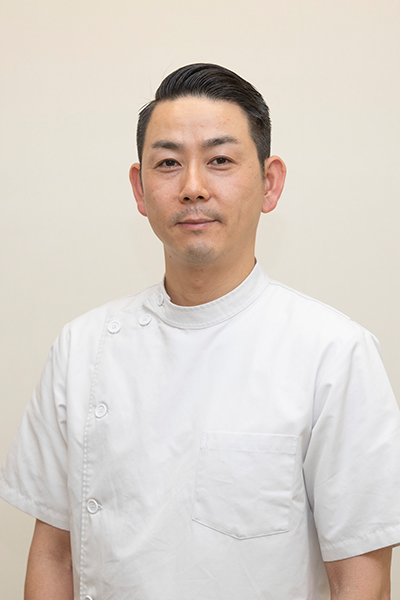
長引いた痛みを一人で治すのは困難なことが多いです。
困ったときは自身で判断せずに適切な処置を受けるために専門家に相談しましょう。
もし、お近くにお住まいで、困っているならば、一度ひまわり接骨院までお問い合わせください。腰痛・坐骨神経痛の専門家の新幡が、ご相談に乗ります。
気軽にご相談ください。

新着情報・お知らせ
平常通り営業致します。
日・祝休みです。
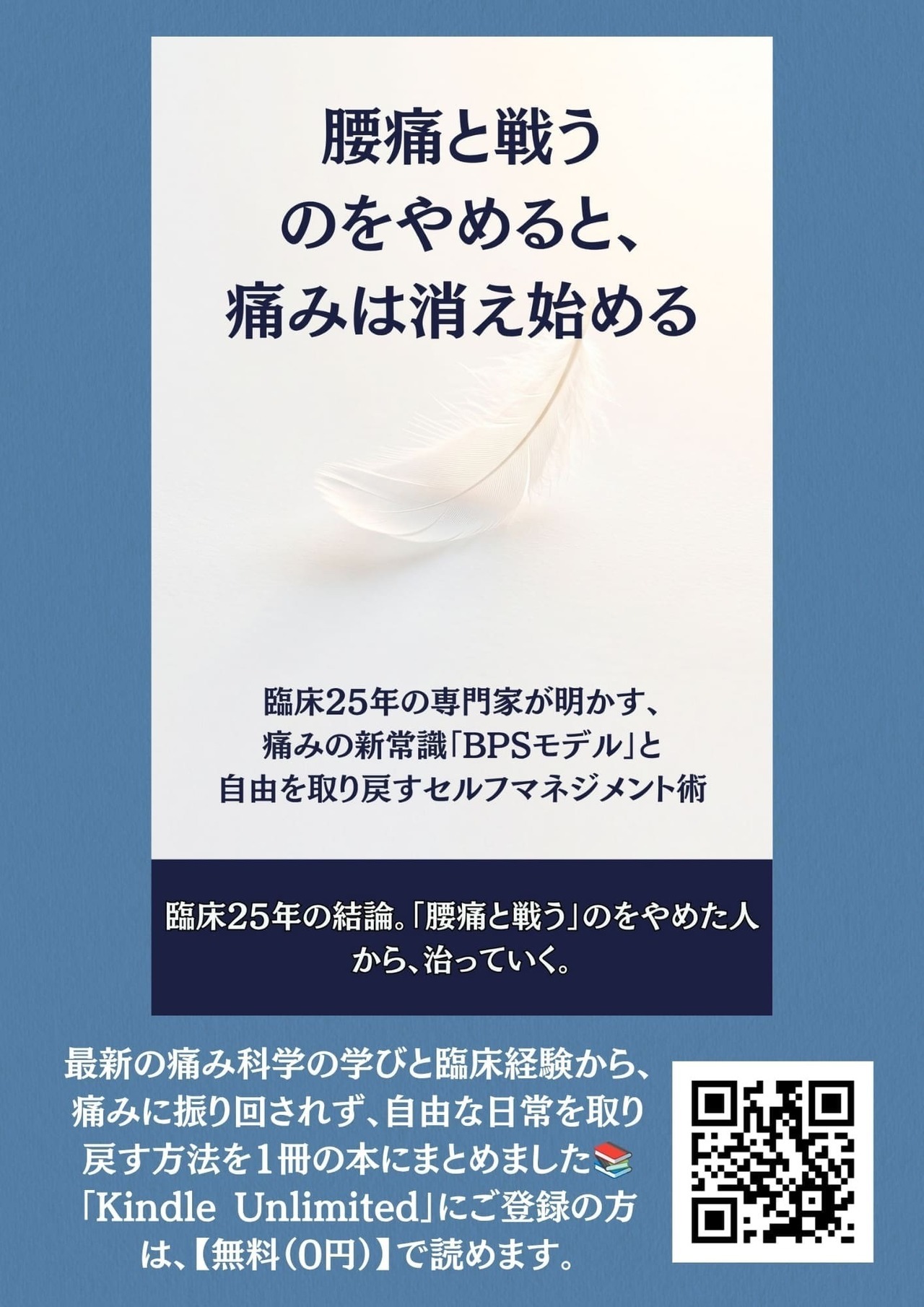
タイトル「腰痛は戦うのをやめると、痛みは消え始める」
Amazonの「Kindle Unlimited」にご登録の方は、【無料(0円)】で今すぐお読みいただけます!
↓↓
こちらから
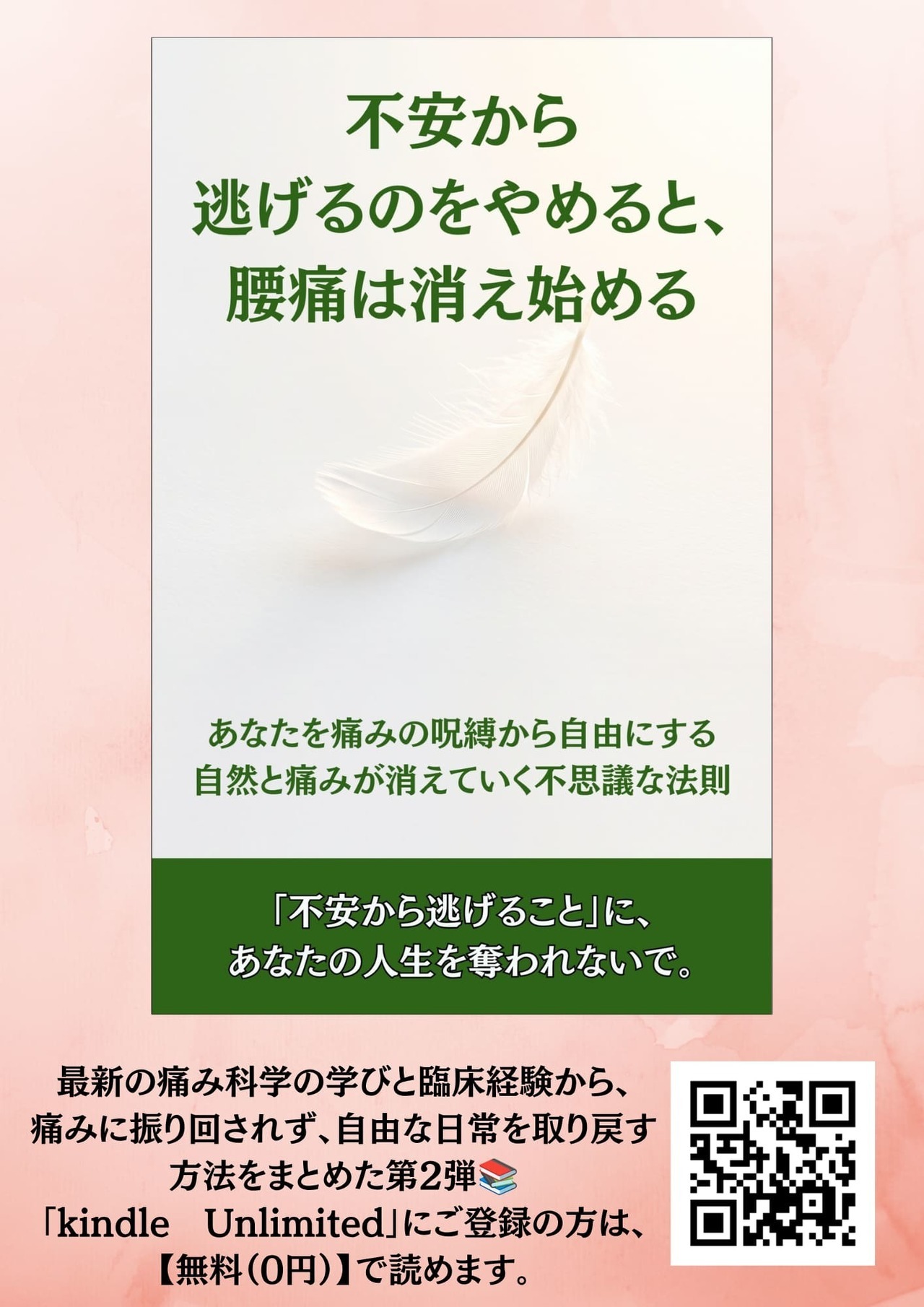
タイトル「不安から逃げるのをやめると、腰痛は消え始める」」
Amazonの「Kindle Unlimited」にご登録の方は、【無料(0円)】で今すぐお読みいただけます!
↓↓
こちらから
お気軽にお問合せください

お電話でのお問合せ・相談予約
<受付時間>
月~土
9:00〜13:00 /15:00〜19:00
※日曜・祝日は除く
フォームは24時間受付中です。お気軽にご連絡ください。
ひまわり接骨院
住所
〒213-0002
神奈川県川崎市高津区二子1丁目7−17 リバーサイドマンション杉崎 102
アクセス
二子新地駅 徒歩3分
駐車場:近隣にコインパーキングあり。自転車・バイクは店舗前に駐輪場がございます。
受付時間
月~土
9:00〜13:00 /15:00〜19:00
定休日
日曜・祝日