〒213-0002 神奈川県川崎市高津区二子1丁目7−17
リバーサイドマンション杉崎 102 二子新地駅 徒歩3分
| 月 | 火 | 水 | 木 | 金 | 土 | 日祝 | |
|---|---|---|---|---|---|---|---|
| 9:00〜13:00 | ● | ● | ● | ● | ● | ● | ─ |
| 15:00〜19:00 | ● | ● | ● | ● | ● | ● | ─ |
慢性腰痛を改善する「抗炎症」ライフスタイル:低悪性度炎症を抑える治療ガイド
公開日:2026/07/22
更新日:2026/00/00
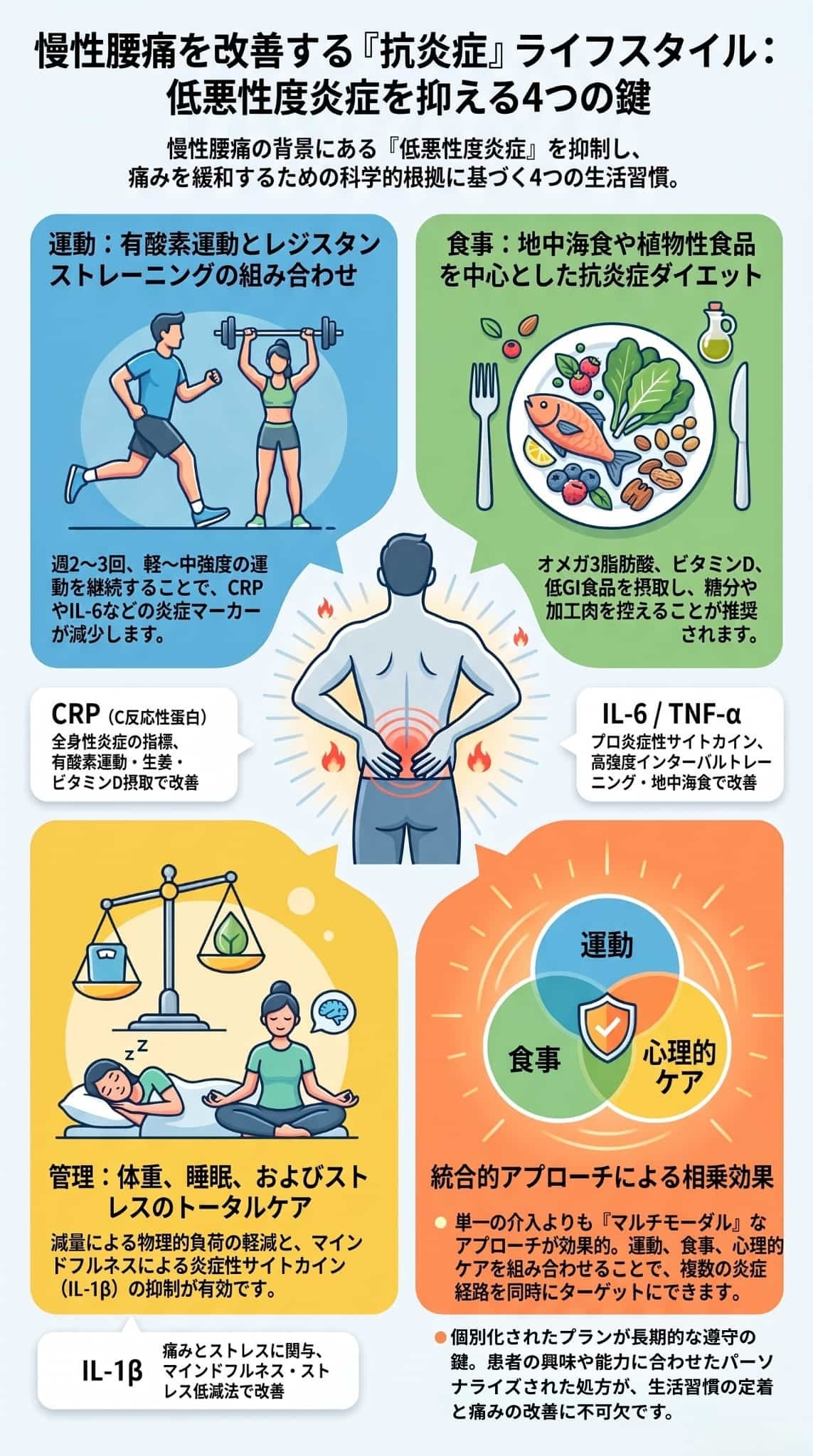
この資料は、慢性腰痛と低炎症状態の相関関係に焦点を当て、生活習慣の改善を通じた非薬物的な治療アプローチを解説しています。
主な介入分野として、運動療法、抗炎症作用のある食事、体重管理、睡眠とストレスの軽減の4点を挙げ、それらが炎症マーカーを抑制し痛みを和らげる仕組みを検証しています。
特に、地中海食や定期的な有酸素運動が、肥満に伴う代謝性炎症を抑え、身体機能を向上させる有効な手段であると述べています。
一方で、患者の継続性や個別の状況に合わせた多角的でパーソナライズされた指導の重要性についても指摘しています。結論として、複数の生活習慣を統合的に改善することが、痛みの緩和と生活の質の向上に最も寄与すると強調しています。
目次
慢性腰痛(LBP)は世界的な障害の主要原因であり、その病態生理において低悪性度全身性炎症(全身の軽微な慢性炎症)が中心的な役割を果たしています。
特に肥満に伴う持続的な全身性炎症(メタフレーション:代謝的に誘発される炎症)は、椎間板変性を引き起こす主要因子と考えられており、脂肪組織から分泌されるプロ炎症性サイトカインが、腰痛患者の痛み過敏性と密接に関連するCRP(C反応性タンパク)を刺激することがわかっています。
- 炎症マーカーの減少: 有酸素運動や抵抗運動(筋力トレーニング)を定期的に行うことで、CRP、IL-6、TNF-αなどの炎症性バイオマーカーが有意に減少し、痛みと身体機能が改善します。
- 効果的な頻度と強度: 慢性疼痛に対しては、軽度から中強度の運動を、週2〜3回、少なくとも4週間以上継続することが最大の効果をもたらします。
- 多面的なプログラムの推奨: 有酸素運動、筋力強化、柔軟性、バランス訓練を組み合わせた「マルチモーダル(多面的)な運動プログラム」が推奨されます。特に、ウォーキング、サイクリング、水泳などの有酸素耐久運動やストレッチは有効性が確認されています。
- 改善のメカニズム: 運動による腹部脂肪の減少は、全身の慢性炎症マーカーを直接的に抑制し、痛みを緩和します。また、骨格筋から放出されるマイオカインの調整などを通じて、中枢神経レベルでの痛みやストレスへの適応力が高まります。
■抗炎症食事パターン: 地中海食やプラントベース(植物性食品中心)の食事、低炭水化物食は、全身性および中枢性の炎症を抑え、痛みの過敏性を低下させる効果が示されています。
■積極的に取り入れるべき栄養素:
- オメガ3系脂肪酸や一価不飽和脂肪酸: 食事の質を高め、これらの脂質を摂ることで、痛みの重症度や日常生活への支障が軽減されます。週4回程度の魚の摂取や、エクストラバージンオリーブオイルの日常的な使用が推奨されています。
- ビタミンDとショウガ: ビタミンDサプリメントはプロ炎症性サイトカインを抑制し、抗炎症性サイトカインを促進します。また、ショウガやビタミンD3の摂取は、CRP値を大幅に低下させることが実証されています。
- 低GI炭水化物と食物繊維: 低GI値の炭水化物(1日3サービング)や、果物・野菜(1日5サービング)、全粒穀物、豆類を摂ることで腸内細菌叢の健康が促進され、腰痛軽減に寄与します。
■避けるべき食事要素: 高い食事炎症指数(DII)を示す食品(赤身肉や加工肉、過剰な糖分や脂肪、甘いお菓子など)は、全身の炎症レベルを高め、慢性腰痛のリスクを増加させるため制限すべきです。
- 保存的治療との相乗効果: 減量を一般的な疼痛管理と組み合わせることで、それぞれを単独で行うよりも、痛みや機能障害をより効果的に改善できます。
- 適切な生活習慣による健康的な減量は、炎症レベルを低下させ、QOL(生活の質)と身体機能を著しく向上させます。
睡眠障害やストレスは、生物学的・行動学的経路を通じて全身の炎症と疼痛に悪影響を及ぼします。
- 不眠の悪影響: 不眠症や睡眠不足は、神経炎症性サイトカインを増加させ、痛みの閾値や耐性を低下させて痛みの過敏性を悪化させます。
- マインドフルネスストレス低減法(MBSR): 慢性腰痛患者におけるマインドフルネスプログラムは、ストレスホルモン(コルチゾール)の上昇を抑え、プロ炎症性サイトカイン(IL-1β)を減少させます。これにより、自覚する痛みが和らぎ、睡眠の質や身体機能が向上します。
最も強力な効果を発揮するのは、どれか一つの習慣を単独で行うのではなく、「運動、食事、体重管理、睡眠、ストレス管理」を同時に組み合わせた、個別化された統合的(マルチモーダル)アプローチです。これらを同時に実施することで、複数の炎症経路に同時に作用し、単一の介入を上回る相乗効果(シナジー効果)が期待できます。
低悪性度炎症と慢性腰痛(LBP)の関連性、およびそれを標的とした生活習慣の改善に注目が集まっている背景には、主に以下の4つの要因があります。
慢性腰痛は、日常生活の機能、労働能力、そして生活の質(QOL)を著しく低下させる極めて一般的かつ複雑な疾患です。
世界的に見ても**「障害を抱えて生きる年数(YLD:Years Lived with Disability)」の主要な原因**となっており、医療システムにとっても非常に大きな負担となっています。
このため、より効果的で持続可能な管理アプローチの確立が急務となっています。
長年の研究から、肥満と腰痛の間に強い正の相関関係があることは知られていました。
従来、この関連性は主に「体重増加による脊椎への物理的な負荷(機械的ストレス)」として説明されてきましたが、近年のエビデンスにより、肥満に伴う「全身性の低悪性度慢性炎症」が腰痛の発生や悪化に極めて重要な役割を果たしていることが明らかになりました。
- 脂肪組織と痛み受容: 肥満者の脂肪組織からは、プロ炎症性サイトカイン(炎症を促進する物質)が分泌されます。これが急性炎症マーカーである**CRP(C反応性タンパク)**を感作し、筋骨格系の痛み感受性を高める(過敏にする)ことがわかっています。
- メタフレーションの概念: この代謝によって誘発される持続的な免疫プロセスは**「メタフレーション(代謝性炎症:metaflammation)」**と呼ばれ、全身の恒常性を乱し、慢性疼痛を開始および持続させる性質を持っています。
- 椎間板変性への影響: この慢性的な低悪性度炎症は、腰痛の根底にある椎間板変性を進行させる重要な寄与因子としても仮説が立てられています。
慢性疼痛に対する従来の薬物治療や手術などの侵襲的な治療技術には、副作用や合併症のリスクが常に伴います。 こうした背景から、副作用のリスクがなく、安価で安全な選択肢として、体内の炎症メディエーターを直接コントロールできる**「非薬物療法」や「抗炎症作用を持つ生活習慣の改善(食事、運動、睡眠など)」**に対して、近年急速に関心と期待が高まっています。
このように、単に「骨や筋肉が物理的に傷んでいる」という捉え方から、**「全身の代謝性炎症が痛みを引き起こし、持続させている」**という生物学的な理解への進歩が、低悪性度炎症と腰痛の関連性に着目し、ライフスタイル医学を取り入れる強い動機となっています。
低悪性度全身性炎症による慢性腰痛(LBP)の管理において、身体活動と運動は薬物療法のような副作用を伴わない安全かつ効果的な非薬物療法(ライフスタイル医学)として、極めて重視されています 。
運動介入が炎症を抑え、腰痛を改善する具体的なアプローチや推奨事項は以下の通りです。
■炎症性マーカーの抑制: 慢性腰痛患者を対象とした研究において、運動を含む非薬物療法により、プロ炎症性(炎症を促進する)マーカーであるTNF-α、IL-1β、IL-8、インターフェロンγ、IL-6などの減少が報告されています。
■運動強度と炎症反応の関係:
- 比較的強度の低い運動(50〜85% VO₂peakの有酸素運動を12週間など)では、運動単体での明確な炎症マーカー減少が見られない場合もあります。
- 一方で、より強度の高い有酸素運動(70〜80% VO₂peak、1回60分を週2回、12ヶ月継続)や、85% VO₂peakの高強度インターバルトレーニング(HIIT)では、抗炎症性サイトカイン(IL-10など)の上昇や、循環器・脂肪組織におけるプロ炎症性マーカーの有意な減少といった明確な抗炎症プロファイルが確認されています。
運動は、慢性腰痛の痛みを和らげ、身体を動かす能力(機能障害)を回復させる強力な手段です。
- 痛みの軽減に効果的な運動: 慢性的な非特異的腰痛に対して、**「認知療法と機能的運動プログラムの組み合わせ」「腰部安定化運動(体幹深層筋のトレーニングなど)」「抵抗運動(筋力トレーニング)」**が、痛みの強度を減らす上で最も高い効果を示しています。
- 身体機能障害の改善に効果的な運動: 機能的運動プログラム、有酸素運動、およびガイドラインに基づく標準的な運動ケアが最も効果的です。
- 推奨される日常的な活動: ウォーキング、サイクリング、水泳などの有酸素耐久運動やストレッチは、急性・亜急性・慢性のいずれの腰痛に対しても有効性が高く推奨されます。
- 内臓脂肪(腹部脂肪)の減少: 運動により腹部脂肪が減少することで、慢性疼痛を持続させる原因となる全身性の炎症マーカーを直接的に引き下げることができます。
- 組織の虚血改善: 有酸素運動と抵抗運動を組み合わせた「マルチモーダル運動」が最も優れた抗炎症効果を発揮します。これは、運動が脂肪組織の低酸素状態(虚血)を改善し、血流を増加させるためです。
- 神経免疫系の変化: 運動は中枢神経にも作用し、骨格筋から放出されるマイオカインの調整、マイクログリア(中枢神経系の免疫細胞)の活性調整、サイトカインシグナル伝達の変調などを引き起こします。これにより、末梢(身体)の代謝活動と、痛みやストレスに対する脳(中枢)の適応メカニズムが結びつき、痛みの知覚が減少します。
効果的かつ安全に身体活動を取り入れるための具体的な推奨事項は以下の通りです。
- 最適な強度と頻度: 慢性疼痛に対しては、**「軽度から中強度の運動プログラムを、週に2〜3回、最低でも4週間以上継続する」**ことで最大のベネフィットが得られます。
- 徐々に開始する: 低負荷の活動は、例えば1日5分間といった短い時間から段階的に開始することが推奨されます。
- 複合的なプログラムの採用: 有酸素運動、筋力強化、柔軟性(ストレッチ)、バランス訓練を組み合わせたマルチモーダル運動は、臨床状態に合わせて個別に調整しやすく、高い効果を発揮します。
- 急性期でも活動を維持する: 急性の痛みが現れている期間であっても、完全に安静にするのではなく、最小限の身体活動レベルを維持することが推奨されます。
運動療法を臨床や日常生活に落とし込む際の最大の障壁は、**「継続の難しさ(アドヒアランスの低さ)」**にあります。
- 個別のカスタマイズ: 指導された運動をそのまま忠実に続けられる人は多くありません。脱落を防ぎ継続を促すためには、個人の興味、身体能力、生活上のニーズに合わせて運動プログラムを個別化(カスタマイズ)することが不可欠です。
- 患者のエンパワーメント: 患者自身が主体的にライフスタイルを変えていけるよう支援(エンパワー)し、認知・行動・身体の多方面からサポートする包括的なアプローチが長期的な成果をもたらします。
低悪性度炎症が関与する慢性腰痛(LBP)の管理において、食事療法と栄養戦略は、炎症反応を直接変調させて痛みを軽減するための非常に重要なアプローチです。食事成分は体内の炎症マーカー(CRPやIL-6など)にダイレクトに影響を与えるため、適切な栄養習慣を築くことが腰痛改善の強力な武器となります。
体内の炎症を抑えるために、以下のような食事パターンが有効であると実証されています。
■地中海食とプラントベース(植物性食品中心)の食事:
- 植物性食品中心の食事は、慢性の筋骨格系疼痛に対して鎮痛効果を持つ可能性が示されています。
- 全体食(ホールフード)を用いた食事介入により、慢性疼痛患者の痛みが臨床的に客観的なレベル(視覚アナログスケールで2ポイントまたは33%の減少)で改善したことが報告されています。
- 地中海食への遵守度(アドヒアランス)が高いほど、感じる痛みが少ないという相関関係があります。
- プラントベースの食事は腸内細菌叢(腸内マイクロバイオーム)を健康に導き、結果として全身性および中枢性の炎症を抑制するため、腸内環境を整えることは腰痛緩和の重要な栄養目標となります。
■低炭水化物食(ローカーボ):
- 低炭水化物食は、慢性筋骨格系疼痛患者において血清炎症性バイオマーカーを低下させ、痛みの感受性を減少させることが示されています。
■毎日の食事構成の基本:
- 低GI(グリセミック指数)の炭水化物を毎日3サービング、果物と野菜を毎日5サービング摂取することが推奨されます。
- 全粒穀物から得られる食物繊維も優れた抗炎症効果を発揮します。
■健康的な脂質の摂取: Long chain(長鎖オメガ3系)脂肪酸や一価不飽和脂肪酸などの抗炎症性脂質を豊富に含む食品を摂ることで、痛みの緩和が期待できます。
- **魚(週4サービング)**の摂取が慢性疼痛管理として推奨されます。
- 一価不飽和脂肪酸が豊富なエキストラバージンオリーブオイルを毎日消費することが推奨されています。
■ポリフェノールの活用: ポリフェノールは体内で抗炎症・抗酸化作用を発揮します。前述のエキストラバージンオリーブオイルのほか、適量の赤ワイン(毎日125 ml)も慢性疼痛ピラミッドにおいて推奨に含まれています。
■ビタミンD:
- ビタミンDサプリメントは、**痛みを誘発するプロ炎症性サイトカインを抑制(ダウンレギュレート)し、逆に炎症を軽減する抗炎症性サイトカインを増加(アップレギュレート)**させる働きがあります。
■ショウガ(ジンジャー)とビタミンD3:
- ランダム化比較試験において、ショウガとビタミンD3の補給はどちらも対照群に比べてCRP(C反応性タンパク)を大幅に減少させました。特にショウガはビタミンD3と比較しても非常に高いCRP減少効果を示しています。
■その他の必要栄養素: 患者の臨床状態に応じて、ビタミンB12、オメガ3(n-3)脂肪酸、食物繊維などの適切な処方が有効です。
- 食事炎症指数(DII): DIIスコアが高い(炎症を促進しやすい)食事をとっている人は、全身性炎症レベルが高く、慢性腰痛や線維筋痛症にかかるリスクが有意に高いことが示されています。
- 糖分と脂肪の過剰摂取: これらは痛みの重症度を高める一因となります。
- 制限すべき食品: 赤身肉や加工肉の摂取は週1回に抑え、甘いお菓子(スイーツ)はたまに楽しむ程度に制限することが推奨されます。
低悪性度炎症が関与する慢性腰痛(LBP)を根本から改善するためには、運動や食事だけでなく、**「体重管理」「睡眠」「ストレス軽減」**という3つの要素を整えることが非常に重要です。これらは、生物学的・行動学的に互いに深く結びつき、痛みを増幅させる悪循環を作っています。
肥満や高いBMI(体格指数)は、慢性疼痛患者の身体的な機能低下や生活の質(QOL)の低下に直結します。
- 物理的負荷と神経炎症の二重構造: 肥満が腰痛を悪化させるメカニズムは、単に体重増加による「脊椎への物理的な負荷(生体力学的負荷)」だけではありません。脂肪組織から分泌されるプロ炎症性サイトカインによる**「全身性の低悪性度慢性炎症(メタフレーション)」や「低悪性度神経炎症」、さらには「腸内細菌叢(マイクロバイオーム)の変化」**など、生物学的なシステム全体が慢性疼痛を発生・持続させています。
- 保存的治療との組み合わせの推奨: ライフスタイル介入による減量(1.0〜11.5 kg程度の減少)は全身の炎症状態を低下させます。特に、「体重減少(減量)プログラム」を従来の「保存的疼痛管理」と組み合わせることで、どちらか一方を単独で行うよりも、腰痛とそれに伴う機能障害をより効果的に改善できることが示されています。
- 外科的手術によるエビデンス: 肥満外科手術(減量手術)により劇的な減量(平均約13 kgのBMI低下)を遂げた患者において、腰痛スコアが劇的に改善した(NPSスコアでマイナス3.49、VASスコアでマイナス3.75)というデータがあります。術後の大幅な減量は、脊椎にかかる物理的ストレスを減らすことで、腰痛症状を大幅に緩和し、脊椎の健康を直接的に改善します。
睡眠障害と慢性的な痛み、そして全身の炎症レベルには、双方向の強力な関連性があります。
- 痛みの閾値の低下: 不眠症や睡眠不足は、脳や神経が痛みを感じる境界線である**「疼痛閾値(痛みのしきい値)」と「疼痛耐性(痛みに耐えられる限界)」を低下させ、痛みを感じやすくしてしまいます**。
- 神経炎症性サイトカインの増加: 睡眠の質の悪さは、慢性腰痛の発生や痛みの感作(過敏化)を悪化させる原因と考えられている**「神経炎症性サイトカイン」を増加(アップレギュレート)させる**可能性があります。
- 不眠ストレスによる慢性炎症: 睡眠奪取(眠れないこと)が身体のストレスとなり、それが免疫反応の障害やフリーラジカル(活性酸素)の産生を招くことで、結果として慢性的な全身性の低悪性度炎症を引き起こすと考えられています。
- 改善のアプローチ: 慢性腰痛患者にマインドフルネスプログラムを導入したところ、睡眠の質が有意に向上(p = 0.05)したことが確認されています。
不安や管理できないストレス、うつ症状などのメンタルヘルスの問題は、痛みの閾値を下げ、身体能力の低下や機能障害の度合いをさらに深刻化させます。
- ストレスホルモンと炎症物質の抑制: 慢性腰痛患者を対象とした「マインドフルネスストレス低減法(MBSR)プログラム」の研究では、このアプローチがストレスホルモンであるコルチゾールの上昇を食い止め、痛みの原因となるプロ炎症性サイトカイン(IL-1β:インターロイキン-1β)を低下させる(p = 0.05)ことが実証されています。
- 自覚する痛みと身体機能の改善: さらにマインドフルネスの実践は、患者自身が感じる**「主観的な痛み」を劇的に減少させ(p < 0.0001)、日常生活における「物理的な身体機能」を向上させる(p = 0.002)**という、非常に優れた臨床効果を発揮しました。
これら「体重管理」「睡眠」「ストレス」は、それぞれが独立した問題ではありません。
- 肥満が代謝性炎症(メタフレーション)と脊椎への負荷を誘発し、
- 睡眠障害が炎症を高めて痛みの過敏性を引き起こし、
- 慢性的なストレスが炎症シグナルと痛みの知覚を永続させます。
低悪性度全身性炎症による慢性腰痛(LBP)の管理において、生活習慣介入(ライフスタイル医学)が持つ**総合的考察(エビデンスの統合)と臨床的意義(パラダイムシフトと課題)**について、最新の知見に基づき整理します。
これまでの運動、食事、睡眠、ストレス管理といったアプローチを個別に考えるのではなく、それらを総合的に捉えることで、以下のような重要なメカニズムの収束と相乗効果が見えてきます。
- 共通する炎症経路への多角的なアプローチ(収束性) 異なる生活習慣介入が、実は体内の共通する炎症経路を標的にしています。
- 運動と食事の組み合わせ: 例えば、抵抗運動(筋力トレーニング)と食事指導を組み合わせることで、内臓脂肪や皮下脂肪の減少を介してCCL-2(単球走化性タンパク質-1)やレプチンなどの炎症性バイオマーカーが有意に減少します。
- 心身の相乗効果: マインドフルネス(MBSR)はストレスホルモン(コルチゾール)の上昇を抑制し、プロ炎症性サイトカインであるIL-1βを直接減少させますが、これは同時に主観的な痛みの緩和、身体機能の向上、そして睡眠の質の改善にも直結しています。睡眠不足が神経炎症や全身性炎症を悪化させることを防ぐ意味でも、この経路の収束は極めて重要です。
- 運動と食事の組み合わせ: 例えば、抵抗運動(筋力トレーニング)と食事指導を組み合わせることで、内臓脂肪や皮下脂肪の減少を介してCCL-2(単球走化性タンパク質-1)やレプチンなどの炎症性バイオマーカーが有意に減少します。
- 多職種連携による相乗効果(シナジー) 単一の生活習慣を変えるだけでは、効果に限界がある場合があります。
- 多角的な介入の強み: 理学療法(運動)、栄養指導(食事)、生化学的モニタリング、および薬物療法を組み合わせた**「多職種連携(マルチディシプリナリー)による包括的アプローチ」**は、CRP(C反応性タンパク)やIL-6といった主要な炎症マーカーを劇的に減少させ、患者のQOLと痛みを大幅に改善することが示されています。
- 中長期的な効果: 運動を体重管理食に併用するアプローチは、16週間以上の長期にわたる介入において、プロ炎症性サイトカイン(TNF-α)を有意に減少させることが分かっています。
- 多角的な介入の強み: 理学療法(運動)、栄養指導(食事)、生化学的モニタリング、および薬物療法を組み合わせた**「多職種連携(マルチディシプリナリー)による包括的アプローチ」**は、CRP(C反応性タンパク)やIL-6といった主要な炎症マーカーを劇的に減少させ、患者のQOLと痛みを大幅に改善することが示されています。
- エビデンスの不均一性と課題 一方で、すべての臨床試験で一貫した結果が出ているわけではありません。
- コーチング単体の限界: 肥満または過体重の腰痛患者に対し、電話による簡易的なライフスタイルコーチングやアドバイスのみを提供した臨床試験では、6ヶ月時点で痛みの強度や生活習慣自体に有意な変化をもたらさなかったという報告もあります。
- 客観的評価の不足: 慢性疼痛管理においては、治療効果を評価するための「十分に検証された客観的な生物学的マーカー(バイオマーカー)」の不足が、依然として臨床上の課題となっています。
- コーチング単体の限界: 肥満または過体重の腰痛患者に対し、電話による簡易的なライフスタイルコーチングやアドバイスのみを提供した臨床試験では、6ヶ月時点で痛みの強度や生活習慣自体に有意な変化をもたらさなかったという報告もあります。
低悪性度炎症と腰痛の関係性にライフスタイル医学を導入することには、従来の痛みの治療を覆す重要な臨床的意義があります。
- 「組織・病因ベース」から「個別化ライフスタイル」へのパラダイムシフト 従来の「骨や関節の物理的な変形、損傷部位」のみを標的とする治療モデルから、患者個人の生物学的・行動学的特性に合わせた「精密疼痛医療(Precision Pain Medicine)」への移行を意味します。 全身の炎症(メタフレーションなど)を標的とした**「個別化されたマルチモーダル・ライフスタイル処方」**こそが、最もエビデンスに基づく慢性疼痛管理のアプローチとして台頭しています。
- 「行動変容(Behavior Change)」のファーストライン(第一選択)化 患者が自ら生活習慣を変えられるよう促す**「健康行動変容コンピテンシー」**は、単なる補助的なアプローチではありません。
- 従来の理学療法と併せて、あるいはそれとは独立して、**慢性疼痛管理の「第一選択(ファーストライン)の治療」**として位置づけられるべきであると提唱されています。
- 患者自身の主体性を引き出す(エンパワーメントする)ことで、運動や食事プログラムの長期的な離脱(ドロップアウト)を防ぎ、治療へのアドヒアランス(遵守)を高めることが可能になります。
- 社会経済的・医療的負担の軽減 慢性腰痛は世界的な障害の主要原因であり、巨額の医療費や労働損失を生んでいます。
- 生活習慣の改善を一次治療に組み込むことは、慢性腰痛の痛みや機能障害を直接改善するだけでなく、心血管疾患や糖尿病などの他の非感染性疾患(NCDs)の予防・管理にも同時に寄与するため、医療システム全体の大幅な社会経済的負担軽減につながります。
このアプローチをさらに標準化するためには、以下の領域での研究が必要です。
- 長期的な効果の検証: 多くの研究が「数週間から数ヶ月」の短中期的評価にとどまっており、生活習慣改善による効果が「数年単位」でどのように維持されるかは未解明な部分があります。
- 運動・食事の最適な「用量(Dose-Response)」: どの程度の強度や頻度の運動、あるいはどのような栄養素の組み合わせが、個々の患者の炎症プロファイル(バイオマーカー)に最も効果的かを個別化する「バイオマーカー主導型」の精密処方プロトコルの確立が求められています。
- 従来治療との関係性: 生活習慣が健康な患者は、従来の理学療法や整形外科的治療に対してより良好な反応を示すのか、あるいは健康な生活習慣によって従来の治療自体を不要にできるのか、といった相互作用の解明も期待されています。
低悪性度炎症に着目したアプローチは、単に「腰の痛みを抑える」ことにとどまりません。それは、**「生体内の炎症環境(メタフレーションなど)そのものを、安全でコストのかからない行動(運動・食事・睡眠・ストレス管理)によって根本から作り変える」**という、極めて合理的で持続可能な医療の形(パラダイムシフト)を示しています。
低悪性度炎症による慢性腰痛(LBP)を改善するための科学的な結論は、以下の4つの核心的なメッセージに集約されます。
- **運動、食事、体重管理、睡眠、ストレス軽減のすべてに同時並行で取り組む「統合的(マルチモーダル)アプローチ」**こそが、体内の重なり合う複数の炎症経路を同時に遮断し、単独介入を大きく上回る優れた相乗効果(シナジー)を生み出します。
- 体内の慢性的な炎症環境そのものを変えるために、実証された安全な非薬物療法として「生活習慣の改善」を治療の基礎(ベース)に据え、個別にカスタマイズされたライフスタイル処方を行うことが最も有望なアプローチです。
- 従来の理学療法と並んで、あるいはそれに先立つ**「慢性疼痛管理の第一選択(ファーストライン)の介入」**として臨床に組み込むべきです。これは腰痛そのものを大幅に軽減するだけでなく、社会的な経済的損失の回復や、その他の非感染性疾患(NCDs)の予防にも同時に大きく寄与します。
食事制限や運動、睡眠の改善などを長続きさせることが臨床上最も困難な障壁です。
- これを克服するためには、一画一的な方法を押し付けるのではなく、「患者個人の関心、能力、生活上のニーズに徹底的に合わせてプログラムを個別化(カスタマイズ)すること」、そして何よりも患者自身を**「エンパワーメント(主体的に行動をコントロールできるように支援)」**することが、長期的な成功と症状改善を維持するための最終的な結論です。
[1]O. Gubska, M. O. Ovdii, and O. O. Kurets, “Relationship between nutrition and chronic low back pain. Review,” Ukraïnsʹskij terapevtičeskij žurnal, no. 4, pp. 62–67, Dec. 2024, doi: 10.30978/utj2024-4-62.
[2]I. M. da C. Fernandes, R. Z. Pinto, P. H. Ferreira, and F. S. Lira, “Low back pain, obesity, and inflammatory markers: exercise as potential treatment,” Journal of exercise rehabilitation, vol. 14, no. 2, pp. 168–174, Apr. 2018, doi: 10.12965/JER.1836070.035.
[3]D. M. Roffey et al., “Obesity and Low Back Pain: Is There a Weight of Evidence to Support a Positive Relationship?,” Current obesity reports, vol. 2, no. 3, pp. 241–250, July 2013, doi: 10.1007/S13679-013-0058-7.
[4]Zadro et al., “Is Vitamin D Supplementation Effective for Low Back Pain? A Systematic Review and Meta-Analysis.,” Pain physician, 2018, [Online]. Available: https://pubmed.ncbi.nlm.nih.gov/29565945
[5]L. P. Valencia, Y. He, and P.-M. Wippert, “The changes of blood-based inflammatory biomarkers after non-pharmacologic interventions for chronic low back pain: a systematic review,” BMC Musculoskeletal Disorders, vol. 25, Mar. 2024, doi: 10.1186/s12891-024-07289-1.
[6]Ruiz-Fernández et al., “Molecular Relationships among Obesity, Inflammation and Intervertebral Disc Degeneration: Are Adipokines the Common Link?,” International journal of molecular sciences, 2019, doi: 10.3390/ijms20082030.
[7]L.-I. Arranz, M. Rafecas, and C. Alegre, “Effects of obesity on function and quality of life in chronic pain conditions.,” Current Rheumatology Reports, vol. 16, no. 1, pp. 390–390, Jan. 2014, doi: 10.1007/S11926-013-0390-7.
[8]H. D. la Corte-Rodriguez, J. M. Román-Belmonte, C. Resino-Luís, J. Madrid-Gonzalez, and E. C. Rodríguez-Merchán, “The Role of Physical Exercise in Chronic Musculoskeletal Pain: Best Medicine—A Narrative Review,” vol. 12, Jan. 2024, doi: 10.3390/healthcare12020242.
[9]G. Vrousgos, “Lifestyle Factors that Can Induce an Independent and Persistent Low-GradeSystemic Inflammatory Response: A Wholistic Approach,” The Open Biomarkers Journal, vol. 7, no. 1, June 2015.
[10]P. Herrero, P. Val, D. Lapuente-Hernández, J. N. Cuenca-Zaldívar, S. Calvo, and E. M. Gómez-Trullén, “Effects of Lifestyle Interventions on the Improvement of Chronic Non-Specific Low Back Pain: A Systematic Review and Network Meta-Analysis,” Feb. 2024, doi: 10.3390/healthcare12050505.
[11]Gajic, Kovac, Lubinsky, and Knezevic, “Exercise-Induced Hypoalgesia: Cellular and Molecular Mechanisms Linking Pain Modulation and Stress Regulation-A Narrative Review.,” Cells, 2026, doi: 10.3390/cells15100858.
[12]B. Sara, Y. Zeinab, F. C. Scott, B. J. S, and S.-A. Amin, “The addition of exercise to a weight loss diet on inflammatory markers: a systematic review and Meta-analysis of controlled clinical trials,” Nov. 2021, doi: 10.6084/m9.figshare.16999926.
[13]C. A. Paley and M. I. Johnson, “Physical Activity to Reduce Systemic Inflammation Associated With Chronic Pain and Obesity: A Narrative Review.,” The Clinical Journal of Pain, vol. 32, no. 4, pp. 365–370, Apr. 2016, doi: 10.1097/AJP.0000000000000258.
[14]G. Teferi, “Regular Physical Exercise for Prevention and Treatment of Low Back Pain: A Systematic Review,” American Journal of Sports Science and Medicine, vol. 8, no. 3, p. 73, Sept. 2020, doi: 10.11648/J.AJSS.20200803.15.
[15]A. S. Kaushik, L. J. Strath, and R. E. Sorge, “Dietary Interventions for Treatment of Chronic Pain: Oxidative Stress and Inflammation.,” vol. 9, no. 2, pp. 487–498, Oct. 2020, doi: 10.1007/S40122-020-00200-5.
[16]R. Field, F. Pourkazemi, J. Turton, and K. Rooney, “Dietary Interventions Are Beneficial for Patients with Chronic Pain: A Systematic Review with Meta-Analysis.,” Pain Medicine, vol. 22, no. 3, pp. 694–714, Mar. 2021, doi: 10.1093/PM/PNAA378.
[17]Ö. Elma et al., “Do Nutritional Factors Interact with Chronic Musculoskeletal Pain? A Systematic Review.,” Journal of Clinical Medicine, vol. 9, no. 3, p. 702, Mar. 2020, doi: 10.3390/JCM9030702.
[18]M. Rondanelli et al., “Food pyramid for subjects with chronic pain: foods and dietary constituents as anti-inflammatory and antioxidant agents.,” Nutrition Research Reviews, vol. 31, no. 1, pp. 131–151, Apr. 2018, doi: 10.1017/S0954422417000270.
[19]M. Pietrzyk, N. Nawrocka, A. Hojda, and F. Bednarek, “Synergistic role of anti-inflammatory diet and physical activity in modulating chronic pain syndromes–a narrative review”, [Online]. Available: https://apcz.umk.pl/QS/article/view/69177
[20]C. M. Keeler, E. Oguguo, C. R. Goodwin, and C. Goertz, “The Role of Nutrition in Low Back Pain: A Narrative Review and Clinical Implications,” American Journal of Lifestyle Medicine, Sept. 2025, doi: 10.1177/15598276251375398.
[21]K. E. Brain et al., “Diet and Chronic Non-Cancer Pain: The State of the Art and Future Directions.,” Journal of Clinical Medicine, vol. 10, no. 21, p. 5203, Nov. 2021, doi: 10.3390/JCM10215203.
[22]M. Hashemi, M. Ghasemi, M. Taheri, and P. Dadkhah, “Comparing the effect of ginger and vitamin D3 supplement on inflammatory factors and pain severity in adults with low back pain,” vol. 16, no. 2, Apr. 2019, doi: 10.29333/EJGM/94055.
[23]I. X. Lou, E. Gil-García, R. Cáceres-Matos, K. Ali, and E. Molina, “Nutritional aspects in chronic non-cancer pain: A systematic review,” Frontiers in Nutrition, vol. 9, Aug. 2022, doi: 10.3389/fnut.2022.931090.
[24]E. Mudd et al., “Healthy Lifestyle Care vs Guideline-Based Care for Low Back Pain,” JAMA network open, vol. 8, no. 1, pp. e2453807–e2453807, Jan. 2025, doi: 10.1001/jamanetworkopen.2024.53807.
[25]Z. Altug, “Lifestyle Medicine for Chronic Lower Back Pain: An Evidence-Based Approach:,” American Journal of Lifestyle Medicine, vol. 15, no. 4, pp. 425–433, July 2021, doi: 10.1177/1559827620971547.
[26]M. Alotaibi and R. H. Alanazi, “Integrated Multidisciplinary Approaches to Managing Chronic Inflammation: The Combined Impact of Biochemical, Nutritional, Pharmacological, and Physiotherapy Interventions,” Sept. 2024, doi: 10.5281/zenodo.13771959.
[27]Ö. Elma, K. E. Brain, and H. Dong, “The Importance of Nutrition as a Lifestyle Factor in Chronic Pain Management: A Narrative Review,” Stomatology, vol. 11, no. 19, pp. 5950–5950, Oct. 2022, doi: 10.3390/jcm11195950.
[28]J. Chang, X. Wang, G. Lin, and D. Samartzis, “… in sleep quality/quantity or baseline sleep parameters related to changes in clinical outcomes in patients with nonspecific chronic low back pain?: a systematic review”, [Online]. Available: https://journals.lww.com/clinicalpain/fulltext/2022/04000/are_changes_in_sleep_quality_quantity_or_baseline.8.aspx
[29]E. Dean, E. Dean, and A. Söderlund, “What is the role of lifestyle behaviour change associated with non-communicable disease risk in managing musculoskeletal health conditions with special reference to chronic pain?,” BMC Musculoskeletal Disorders, vol. 16, no. 1, pp. 87–87, Apr. 2015, doi: 10.1186/S12891-015-0545-Y.
[30]Y. Hassan, V. Head, D. Jacob, M. O. Bachmann, S. Diu, and J. Ford, “Lifestyle interventions for weight loss in adults with severe obesity: a systematic review,” Clinical obesity, vol. 6, no. 6, pp. 395–403, Dec. 2016, doi: 10.1111/COB.12161.
[31]D. W. da S. Pamplona, S. C. V. Freires, L. R. da C. Leite, A. Sousa, A. L. R. Faillace, and F. A. R. Neto, “Relação entre estilo de vida e incidência de dor lombar em profissionais da saúde: uma revisão sistemática,” Brazilian Journal of Health Review, vol. 8, no. 1, pp. e76797–e76797, Jan. 2025, doi: 10.34119/bjhrv8n1-176.
[32]G. G. Diez, E. Anitua, N. P. Castellanos, C. Vázquez, P. Galindo-Villardón, and M. H. Alkhraisat, “The effect of mindfulness on the inflammatory, psychological and biomechanical domains of adult patients with low back pain: A randomized controlled clinical trial,” PLOS ONE, vol. 17, no. 11, pp. e0276734–e0276734, Nov. 2022, doi: 10.1371/journal.pone.0276734.
[33]A. Malfliet et al., “Obesity Hurts: The Why and How of Integrating Weight Reduction With Chronic Pain Management,” Physical Therapy, vol. 101, no. 11, Nov. 2021, doi: 10.1093/PTJ/PZAB198.
[34]“Lifestyle and Chronic Pain,” Mar. 2022, doi: 10.3390/books978-3-0365-3577-7.
[35]Aboushaala et al., “The effects of metabolic and bariatric surgery on spinal alignment, radiological, and clinical outcomes in morbidly obese patients with LBP: a systematic review and meta-analysis.,” The spine journal : official journal of the North American Spine Society, 2026, doi: 10.1016/j.spinee.2025.10.014.
[36]Koremans, Chen, Das, and Diwan, “Changes in Back Pain Scores after Bariatric Surgery in Obese Patients: A Systematic Review and Meta-Analysis.,” Journal of clinical medicine, 2021, doi: 10.3390/jcm10071443.
[37]J. Kawi, N. Lukkahatai, J. Inouye, D. L. Thomason, and K. E. Connelly, “Effects of Exercise on Select Biomarkers and Associated Outcomes in Chronic Pain Conditions: Systematic Review.,” Biological Research For Nursing, vol. 18, no. 2, pp. 147–159, Mar. 2016, doi: 10.1177/1099800415599252.
[38]L. M. P. Lopes et al., “Resistance Training Associated with Dietetic Advice Reduces Inflammatory Biomarkers in the Elderly.,” BioMed Research International, vol. 2020, p. 7351716, Sept. 2020, doi: 10.1155/2020/7351716.
[39]P. K. Ampiah, P. Hendrick, and E. G. Macias, “Comparative effectiveness of cognitive behavioural therapy combined with exercise versus exercise in the management of non-specific chronic low back pain: A systematic review with meta-analysis,” vol. 9, p. 4, May 2018, doi: 10.5348/100041D05PA2018RA.
[40]J. J. W. Huijbers et al., “The (cost-)effectiveness of combined lifestyle interventions for people with persistent low-back pain who are overweight or obese: A systematic review.,” Musculoskeletal science and practice, vol. 65, pp. 102770–102770, May 2023, doi: 10.1016/j.msksp.2023.102770.
[41]M. Cuevas-Cervera, J. J. Pérez-Montilla, A. Gonzalez-Muñoz, M. Garcia-Rios, and S. Navarro-Ledesma, “The Effectiveness of Intermittent Fasting, Time Restricted Feeding, Caloric Restriction, a Ketogenic Diet and the Mediterranean Diet as Part of the Treatment Plan to Improve Health and Chronic Musculoskeletal Pain: A Systematic Review,” International Journal of Environmental Research and Public Health, vol. 19, no. 11, pp. 6698–6698, May 2022, doi: 10.3390/ijerph19116698.
[42]A. C. de C. Williams et al., “Effectiveness of a healthy lifestyle intervention for chronic low back pain: a randomised controlled trial.,” Pain, vol. 159, no. 6, pp. 1137–1146, June 2018, doi: 10.1097/J.PAIN.0000000000001198.
[43]J. Nijs et al., “Personalized Multimodal Lifestyle Intervention as the Best-Evidenced Treatment for Chronic Pain: State-of-the-Art Clinical Perspective,” Journal of Clinical Medicine, Jan. 2024, doi: 10.3390/jcm13030644.
[44]R. Naylor, C. Hayes, C. Hayes, G. Egger, and G. Egger, “The Relationship Between Lifestyle, Metaflammation, and Chronic Pain: A Systematic Review,” American Journal of Lifestyle Medicine, vol. 7, no. 2, pp. 130–137, Mar. 2013, doi: 10.1177/1559827612451710.
ごあいさつ
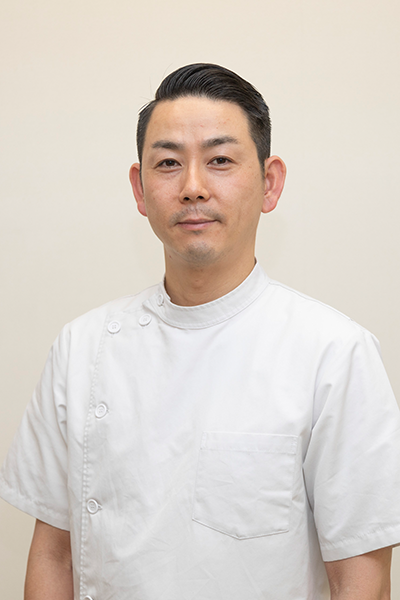
長引いた痛みを一人で治すのは困難なことが多いです。
困ったときは自身で判断せずに適切な処置を受けるために専門家に相談しましょう。
もし、お近くにお住まいで、困っているならば、一度ひまわり接骨院までお問い合わせください。腰痛・坐骨神経痛の専門家の新幡が、ご相談に乗ります。
気軽にご相談ください。

新着情報・お知らせ
平常通り営業致します。
日・祝休みです。
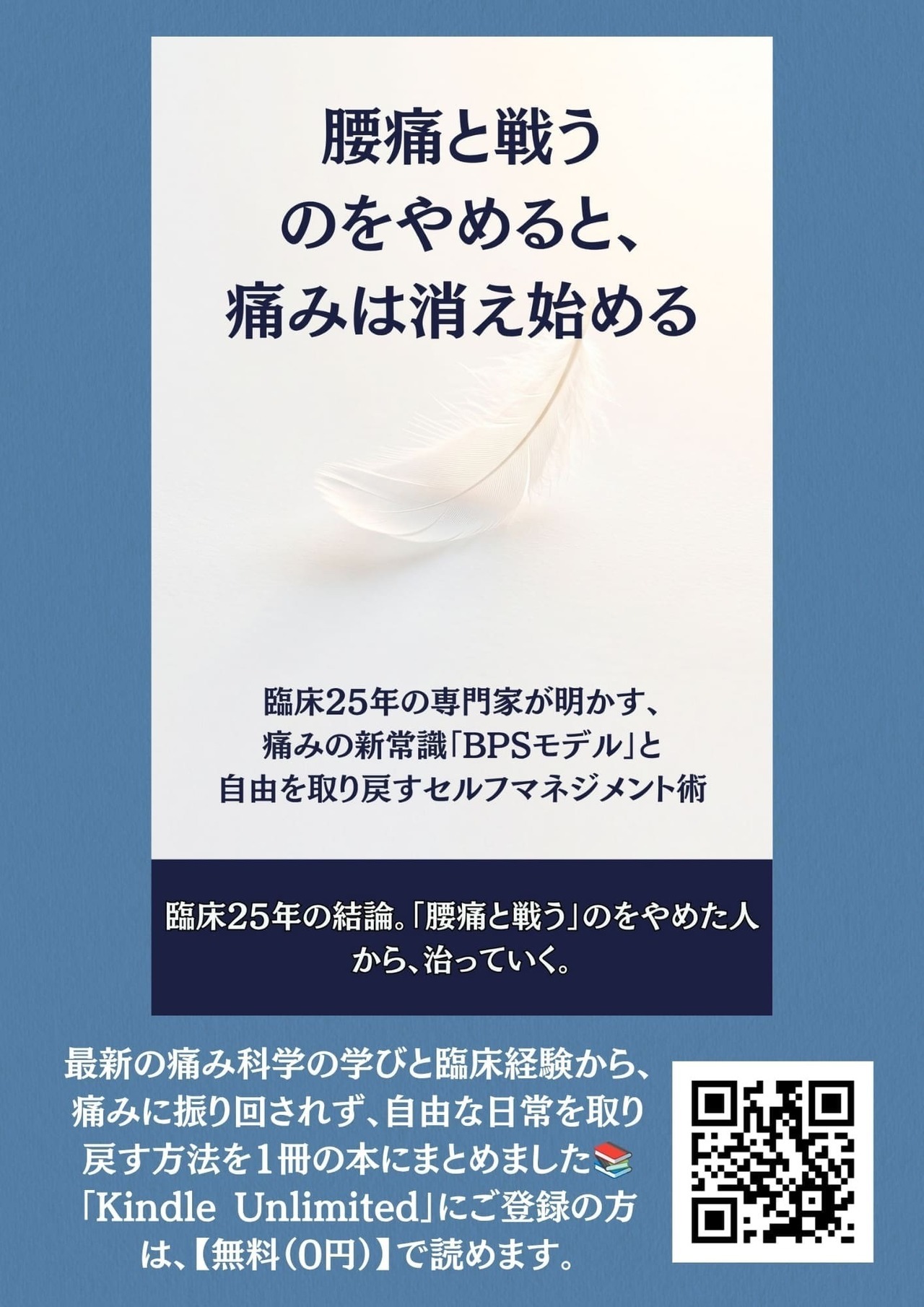
タイトル「腰痛は戦うのをやめると、痛みは消え始める」
Amazonの「Kindle Unlimited」にご登録の方は、【無料(0円)】で今すぐお読みいただけます!
↓↓
こちらから
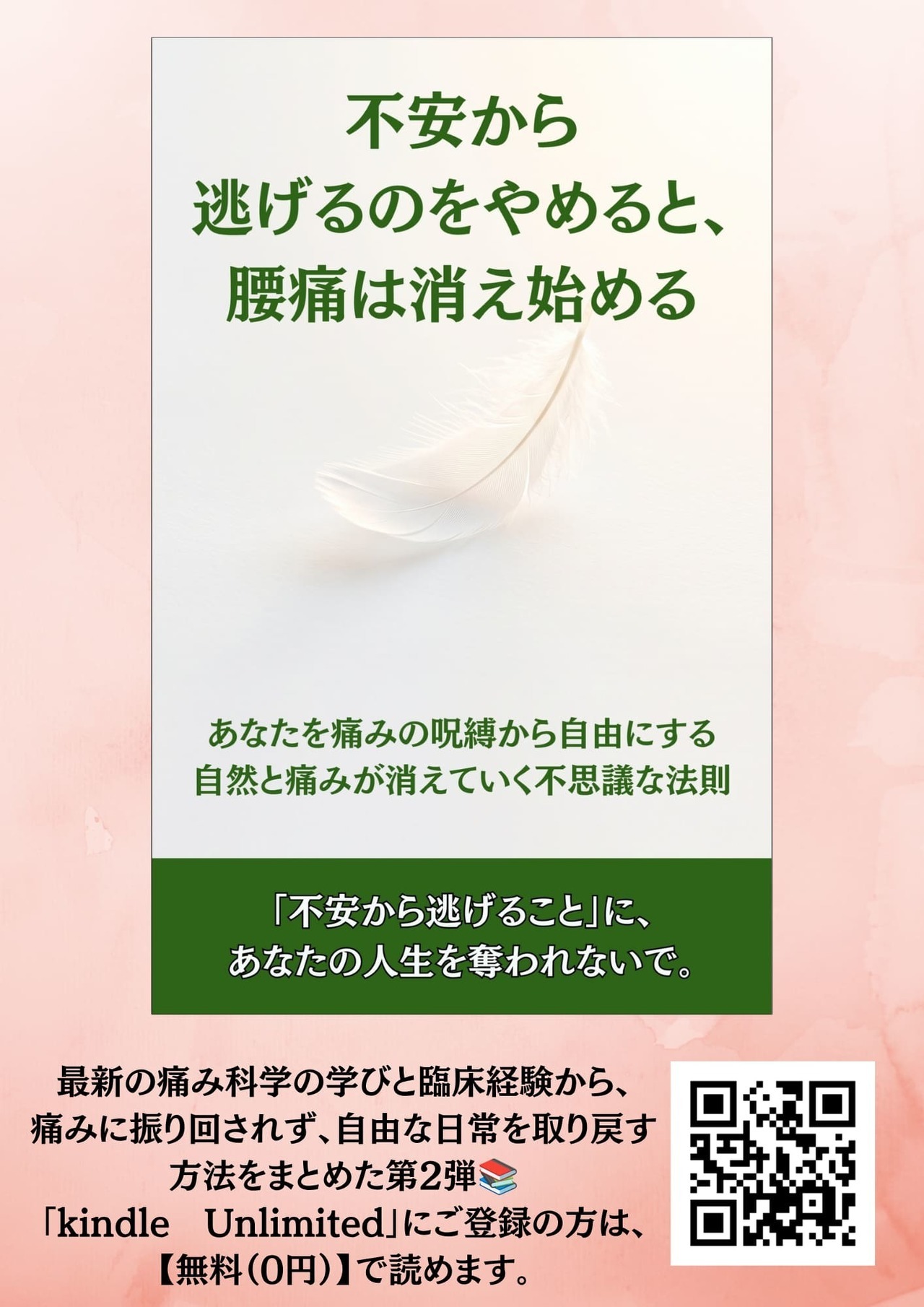
タイトル「不安から逃げるのをやめると、腰痛は消え始める」」
Amazonの「Kindle Unlimited」にご登録の方は、【無料(0円)】で今すぐお読みいただけます!
↓↓
こちらから
お気軽にお問合せください
お電話でのお問合せ・相談予約
<受付時間>
月~土
9:00〜13:00 /15:00〜19:00
※日曜・祝日は除く
フォームは24時間受付中です。お気軽にご連絡ください。
ひまわり接骨院
住所
〒213-0002
神奈川県川崎市高津区二子1丁目7−17 リバーサイドマンション杉崎 102
アクセス
二子新地駅 徒歩3分
駐車場:近隣にコインパーキングあり。自転車・バイクは店舗前に駐輪場がございます。
受付時間
月~土
9:00〜13:00 /15:00〜19:00
定休日
日曜・祝日